

①It should be able to ensure the accuracy and accuracy of the workpiece being processed.
Today, many factories still use old-fashioned methods to handle G-code operations. This means that when faced with the processing task of the same part, other competitors may take two hours to complete it efficiently, but it often takes you four hours to complete it. The core reason for this efficiency gap is that your milling program is not optimized properly.
Don’t blindly increase the feed speed to full speed
In 2024, there is a company in Suzhou that produces aerospace parts. They increased the feed speed setting when milling 304 stainless steel materials from the original 800 mm per minute to 1200 mm per minute. As a result, the product scrap rate increased from 2% to 9%.
Later, the company lowered the spindle speed from 8,000 rpm to 5,500 rpm, while maintaining the feed speed at 1,000 mm per minute. Finally, the product scrap rate returned to one and a half minutes, and a single product was saved a full forty minutes.
0.5 mm per tooth during rough milling and 0.1 mm per tooth during fine milling are commonly used parameters, but the difference is obvious when the materials are different. You can be more bold in using these parameters when it comes to aluminum alloys, but you should be more conservative when it comes to titanium alloys. Never use one set of parameters to deal with all types of artifacts. This is wrong.
Tool path affects cutting time
There is a mold factory in Shanghai who made a comparison in 2025. They used two methods, arcuate tooling and serpentine tooling, to process the same 7075 aluminum plate. It was found that the arcuate tooling method added 11 minutes of idle time. Later, they changed to a one-way tooling method, which also reduced the number of tool lifts. In the end, the efficiency of the entire process was nearly 20% faster.
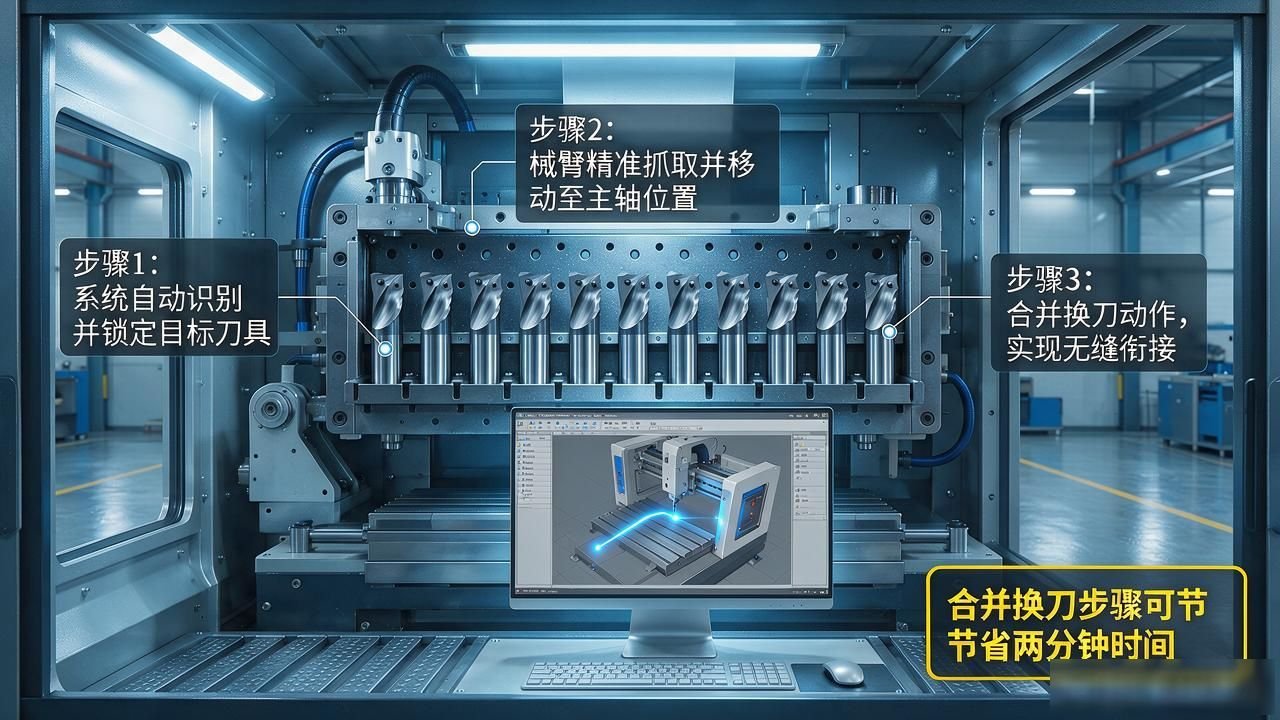
When the CAM software generates the G code, the movement of the Z axis becomes an invisible and very powerful killer. Every time a tool is changed, it has to lift the tool and then put it down again. This back and forth process wastes more than ten seconds.

If we can merge the tool changing steps in the continuous tool paths together. The machining process of a part containing more than a dozen knives can save almost two minutes.
Make no mistake about the cooling method
In 2025, a precision machining plant in Guangzhou discovered a phenomenon. When they were milling carbide, they used a large flow of coolant. Not only did it not solve the problem, but it also aggravated thermal deformation. So they decided to switch to minimum quantity lubrication. In this way, the amount of coolant was reduced from 3 liters to 0.5 liters. The dimensional stability was improved and the life of the tool was extended by 8%.
The coolant is suddenly turned off for the last few tools of fine milling, and the thermal expansion and contraction effects will eat up the tolerances. The correct approach is to wait for the spindle to continue idling for two turns after finishing the machining before exiting the tool, or to add a transition step using low-speed coolant at the end of the program.
Program structure determines debugging efficiency
There is a factory in Dongguan that produces auto parts. They will replace a batch of new workpieces for processing in 2024. Because the old program parameters are hard-coded in various paragraphs of the program, if you need to adjust the parameters, you need to change dozens of lines of code.
Later, they extracted important information such as working speed, feed speed, and tool number, and placed them at the head of the subroutine. In this way, the debugging time was reduced from the original two hours to just twenty minutes.
Adding comments to G-code is not a waste of time. According to statistics from a workshop in Shenzhen in 2025, it can be clearly seen that for those program files with comments, it only takes half a day for new employees to get started. In contrast, programs without comments require a master to watch and guide them throughout the process, which takes two days.
Therefore, when the team size is large, these time savings add up to a considerable amount.
Don’t skip post-processing
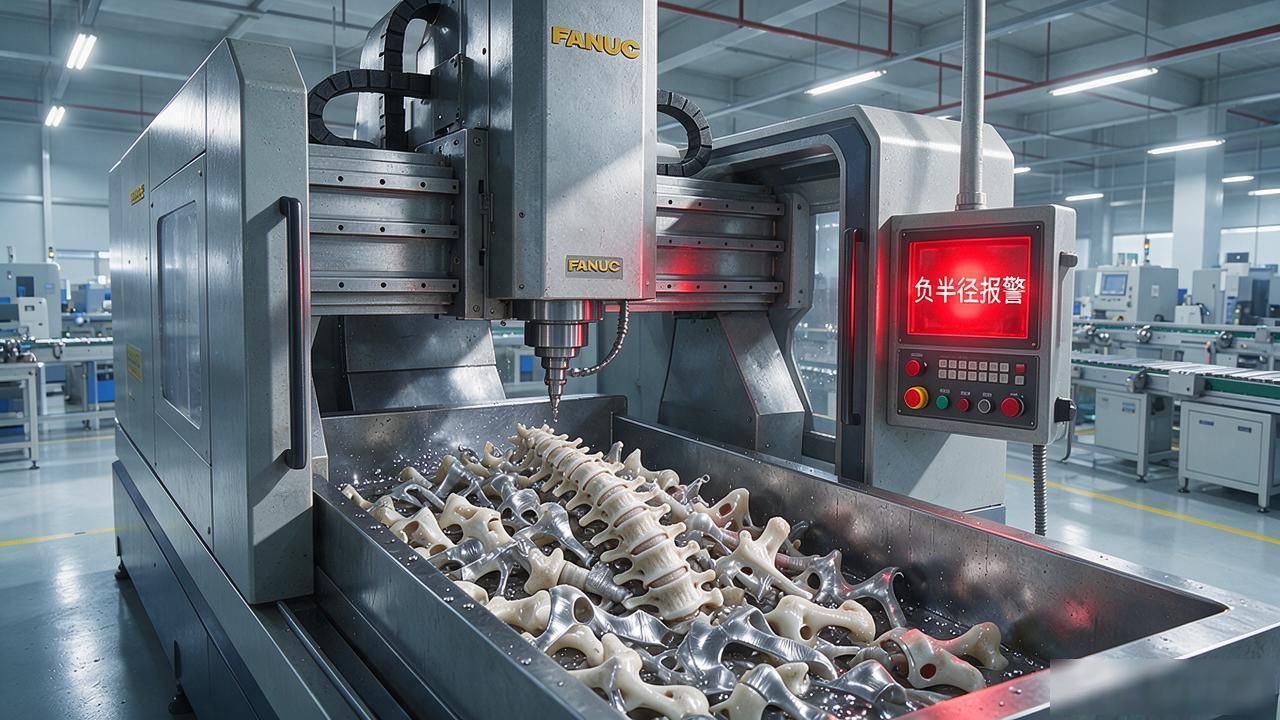
In 2025, there was a medical implant company in Hangzhou. Because the post-processing work was not done well, the FANUC machine tool had a negative radius alarm. As a result, the entire batch of workpieces jammed the machine and it stopped for three days. As long as the correct post-processing template is added, problems like this will generally not happen again.
The tool compensation instructions of the three suppliers SIEMENS, FANUC, and Mitsubishi are written in different ways. The post-processing program will also automatically optimize the interpolation accuracy and segment the arc. The surface quality processed using the default template and the customized template can differ by half a grade.
Data comparison before and after optimization
In January 2026, a consumer electronics OEM factory in Chengdu made a systematic optimization of the CNC milling program used across the entire line. As a result, the time it took to produce a single product was reduced from the previous 47 minutes to 38 minutes, and the monthly production capacity was also increased from 12,000 pieces to 14,500 pieces. In terms of tool costs, 600 yuan can be saved for every 10,000 pieces produced.
Many people may have a view that program optimization is a special matter that only large companies do. In fact, this is a misunderstanding.
Even if your production workshop is small in scale and only equipped with two CNC machine tools, as long as the operator is willing to pull out all the currently running programs and then conduct a detailed inspection line by line, this approach can identify at least three to five design links that can reduce processing time, and this part of the time saved is pure profit in financial accounting.
Is the G code in your workshop still completed by manual handwriting, or is it generated through a CAM system? When optimizing it, which specific step is the most troublesome for you? Please go to the comment area to express your opinion. If you think this point of view is indeed useful, don't forget to like it and forward it to your peers. Let's work together to improve work efficiency.





暂无评论内容