

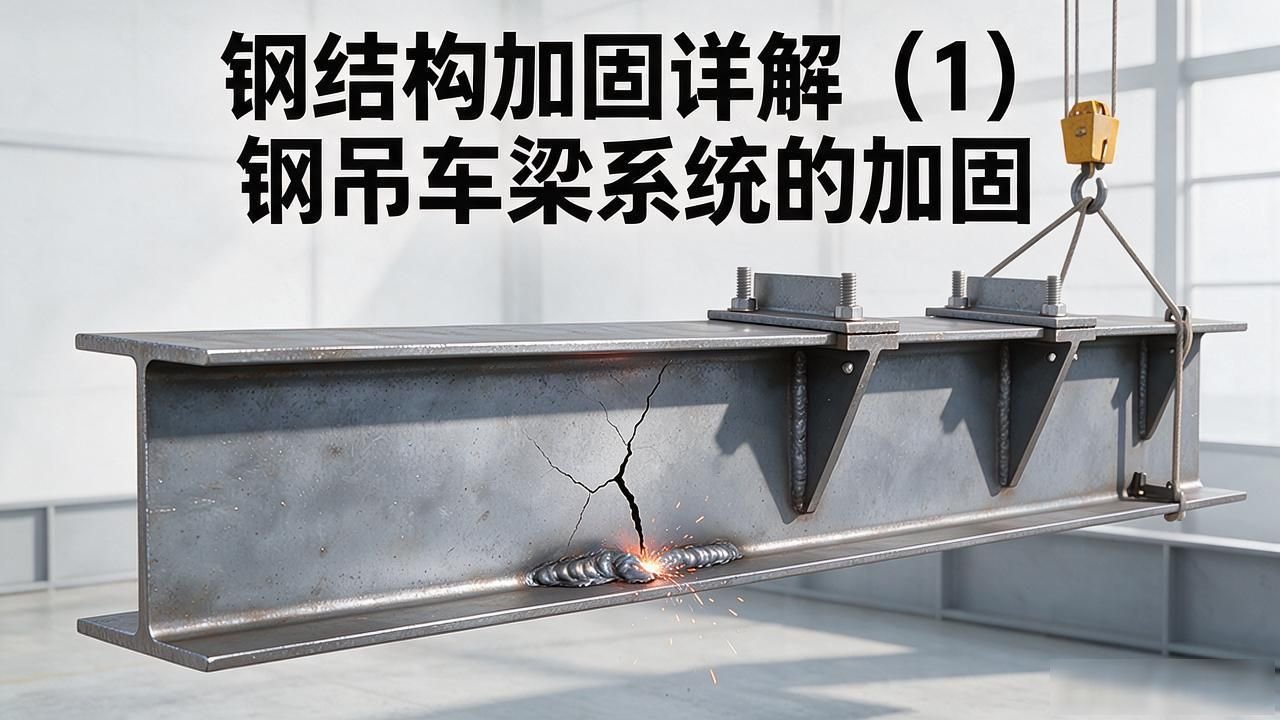
Detailed explanation of steel structure reinforcement (1) Reinforcement of steel crane beam system
When cracks appear on the surface of the factory crane beam, the riveting and welding operations between the upper flange and the track pressure plate will become the key to success or failure. Once these process steps are improperly performed, the entire reinforcement plan implemented previously will be completely ineffective and all efforts will be wasted. Next, we will give a thorough, detailed and in-depth explanation of the core points and key steps in the actual operation process.
Upper flange crack identification and groove repair
When a crack occurs at the weld connecting the upper flange to the web, the first task is to clearly distinguish whether the phenomenon is a crack caused by fatigue or caused by stress concentration.
For those beams that use heavy-duty working cranes, and trusses that use heavy-duty or medium-duty working cranes, after reinforcement, their fatigue strength must be re-calculated in accordance with the current general steel structure design specifications. It is important not to end the construction hastily by simply blocking welding.
During the repair process, the location of the crack needs to be grooved along the crack. Regarding the design of this groove, it is necessary to ensure that both ends of it exceed the end position of the crack, and the length of the excess cannot be less than the numerical standard of 50 mm. After completing the groove processing, it is necessary to fill in the new weld content.
If conditions permit, two boards should be used to implement T-shaped reinforcement. In addition to the above measures, it is also required to install bolsters or pads under the track. These pads or pads are laid directly on the upper flange. For the strict requirements on the quality of the generated welds, a step-by-step inspection workflow must be implemented.
Key points of riveting and welding construction of track pressure plate
The riveting and welding connection between the track pressure plate and the upper flange of the crane beam is actually the most prone to problems in the entire crane beam system. Therefore, before welding, the contact surface must be polished thoroughly, and the rust must be removed until the original color of the metal is revealed.
At the same time, the thickness of the cushion layer under the pressure plate must be strictly controlled within 2 mm. If the thickness of the cushion layer exceeds the limit of 2 mm, the welding penetration ratio will not be able to meet the qualified standard. As a result, delamination will easily occur when it is used later.

The order of riveting welding is from the middle of the beam span to both ends, and the welding should be started symmetrically. After each weld is completed, you need to stop and wait for more than 20 seconds to allow the generated heat to dissipate and avoid deformation due to local overheating.
Within a period of 48 hours after the welding is completed, there should not be any vibration load on the span. This is to prevent the new welding seam from generating secondary fatigue cracks during the cooling process.
Replacement strategies for brake structures and supports
When the damage to the brake truss reaches a relatively serious state, repair measures are no longer taken, but the brake plate is directly chosen to be used. Regarding the connection between the brake plate and the upper flange of the crane beam, the preferred option is to use high-strength bolts.
If you choose to weld, it is also allowed, but ultrasonic flaw detection must be strictly performed after the welding is completed. For those high-strength bolts that have become loose, all of them must be replaced as a whole. It is absolutely strictly forbidden to reuse these tightened old bolts after replacement.
When the vertical support is damaged, and this damage does not involve other structural components, if it is confirmed that the entire system still has a sufficient degree of spatial stability, then it does not need to be repaired.
Regarding the connection between the braking structure and the crane beam or crane truss, once damage occurs, the processing method must be changed uniformly, and high-strength bolts must be used for the connection operation, instead of the previous welding method.
Precautions for track deviation adjustment and movement
When the deviation of the track in the vertical direction exceeds the standard, it is necessary to raise the crane beam or add pads and pads under the track for adjustment. If it is a deviation in the horizontal direction, it can be dealt with by moving the crane beam. During the moving process, temporary supports must be used to fix the connection position between the upper flange and the web. The purpose of this is to prevent new fatigue damage problems caused by movement.
Before the adjustment work begins, the operator uses a total station to measure each frame of the track one by one to obtain the actual elevation value of the track. For those cases where the deviation exceeds 2 mm, these are the items that need to be prioritized.
After all the adjustment work has been completed, retesting work needs to be carried out using a spirit level and a steel ruler to ensure that the deviation is controlled within one ten thousandth of the track span. Finally, relevant data must be recorded in detail for archiving and future reference.
Web crack plugging and stiffener selection
If cracks appear on the upper part of the crane beam web, the first step is to check whether there is any eccentricity in the track. After the eccentricity problem is adjusted, the cracks can be repaired by plugging welding.
The specific conditions of the crack length need to be dealt with separately: when the length of the crack does not exceed one-third of the width of the web, it is enough to add a T-shaped stiffener after completing the plug-welding operation; but once the length of the crack exceeds one-third of the width of the web, local reinforcement must not be adopted, and the entire web must be replaced.
Once fatigue cracks appear in the tension flange and web areas, the entire structure or the entire part must be replaced, because there is no room for repair in this case.
For the local concave and convex deformation problem that occurs in the upper flange and the compression area of the web, you can choose to use mechanical methods for leveling, or you can choose to set up stiffeners to deal with it. However, if it involves reinforcement work in the tension area, the use of stiffeners is absolutely prohibited.
Fatigue calculation and review after reinforcement
Because of the strengthening process, the fatigue calculation categories of components and connections have changed. At this time, for those crane beams that are loaded by heavy-duty working cranes, and those crane trusses that are borne by heavy-duty or medium-duty working cranes, they must follow the current steel structure design specifications.
Specifically, the fatigue strength needs to be calculated again based on the new category after reinforcement. As for the load combination used when calculating, the most unfavorable working conditions must be used.
Within a week after the reinforcement work is completed, we will conduct the first ultrasound scan, and after waiting for three months, we will complete the second review task.
If any new cracks are discovered during the process, the construction work must be stopped immediately. As for the value of the horizontal load increase coefficient, the re-determination steps need to be carried out in accordance with the current national standards and specifications. This must be strictly observed. It is absolutely forbidden to continue to use the old data content before the reinforcement stage.
When we carry out crane beam reinforcement work in our factory, how is the division of labor generally carried out regarding the riveting and welding work of the track pressure plate and the bolt connection work of the brake plate? Please talk about it in the comment area. If you find this content useful, please like it and forward it to your fellow workers.






暂无评论内容