

Product parameters of steel beam pressure plate/track double hole pressure plate
This double-hole pressure plate called GDGL-2 is riveted and welded on the upper flange of the crane beam. A set contains four accessories, none of which are indispensable. You want to ask about the price, is it calculated according to national standards, or is it a cheap price like a low-priced product? If you reverse the construction order of the welds, the entire track will be installed in vain, and when the crane starts running, the position will shift.
Double hole pressure plate body size
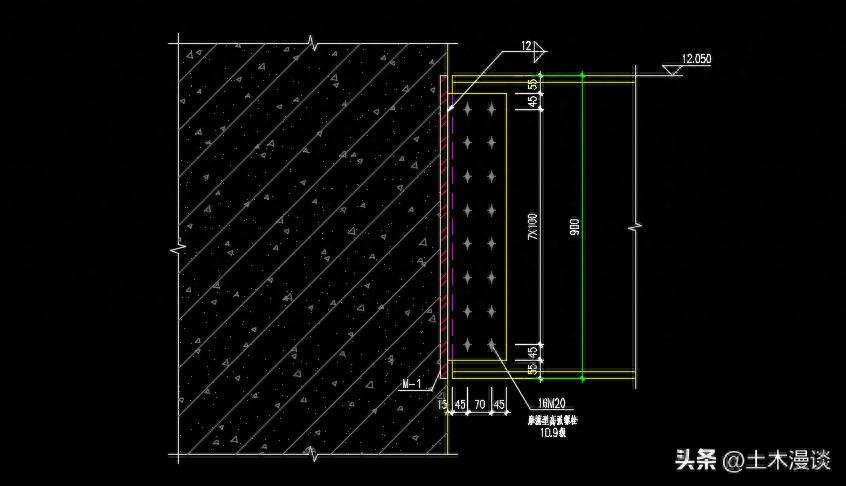
The specification of the double-hole pressure plate is 95×18×150mm, the specification of the M-shaped track pressure plate backing plate is 78×8×170mm, the upper flange of the crane beam is riveted to the track pressure plate , and the specification of the wedge-shaped backing plate is 70×70×10mm. The three-piece combination covers the flanges on both sides of the rail, forming a symmetrical clamping structure that firmly locks the rail to the top surface of the beam.
The matching bolts use the specification of M20×100mm, and its strength level belongs to level 4.8. When installing, the bolts pass through the double-hole plate and the M backing plate in sequence, and are screwed into the embedded holes in the upper flange of the beam. Lock the entire set of pressure plates on the steel beam. When disassembling, just loosen the bolts.
Material and quality threshold
The material of the entire set of pressure plates is unified to Q235-B steel. This product is produced in accordance with national standards. The manufacturer provides national standard price quotations by default, and does not include other options other than a full set of products. No inferior substitute materials are used in production, and there are no low-quality products for users to choose from. The safety bottom line of quality is clearly expressed here.
When customers place an order, they must clearly state in the remarks whether they want to get the total price of a set or just the price of a single accessory, because there is a huge difference in the quotations between the two. For those customers who do not care about product quality, we recommend that you consider it carefully, because there is no low-quality goods in this store that can be substituted.
Installation welding process

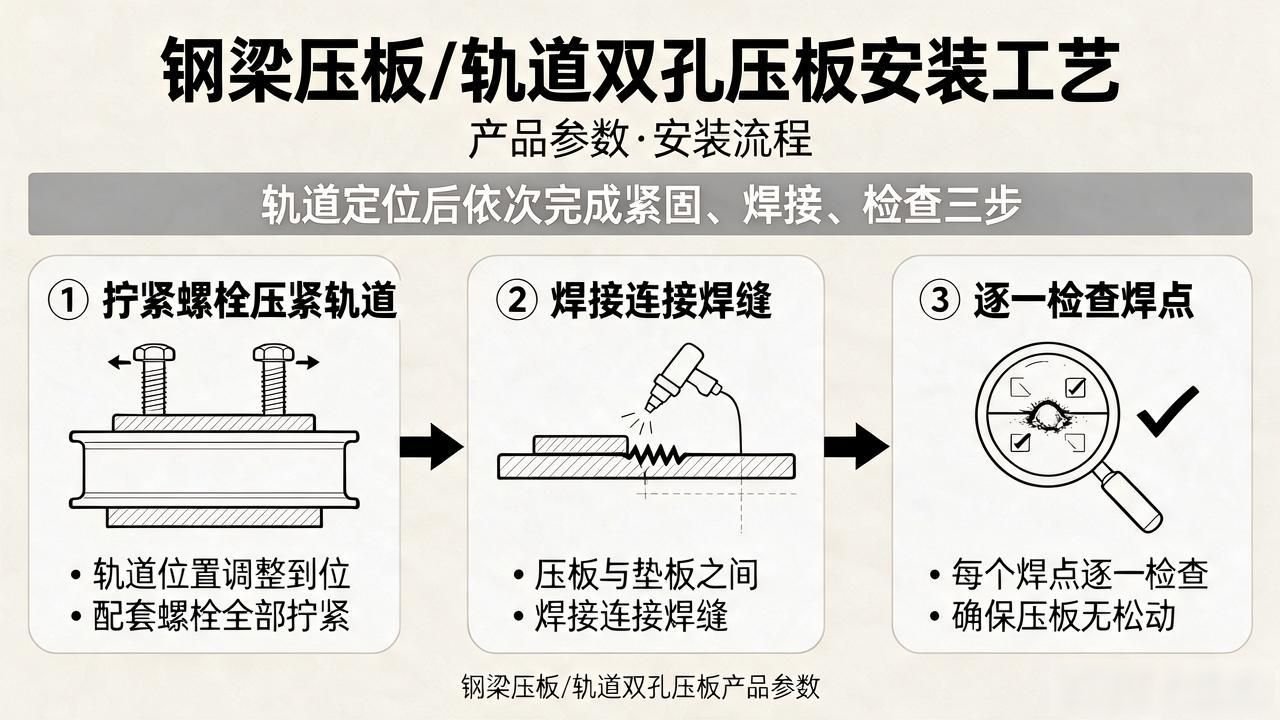
After the track position is adjusted, first tighten all the supporting bolts and compress the track, and then weld the connection weld between the pressure plate and the backing plate. After welding is completed, check each solder joint one by one to ensure that the pressure plate is not loose in any way.
Welding is an operation that must wait until all the rails are adjusted to the correct position before welding. The practice of welding is strictly prohibited, that is, fixing the weld first and then adjusting the track route. This is not allowed.
Before starting the welding, the bolts have already tightly pressed the track. The purpose of this is to allow each welding point to receive a uniform force, thereby avoiding subsequent movement and deflection due to the existence of internal stress.
Rubber pad shock absorption principle
The cross-section of the pad is slightly convex in the middle, and the rectangular rib structure contained inside it is easily deformed. This deformation characteristic can expand the contact area between it and the track, thereby achieving shock absorption and buffering effects.
After two million such fatigue performance tests, its performance is still in very good condition, and there is no damage even after continued use for a long time.
The rectangular grooves are arranged along the direction of the cross-section, which is intended to reduce the overall lateral deformation of the pad after being subjected to force and reduce the damage to the rubber panel caused by extrusion. At the same time, combined with the treatment measures for the steel plates, the friction increases and the rails are less likely to move.
Anti-movement and convenient maintenance
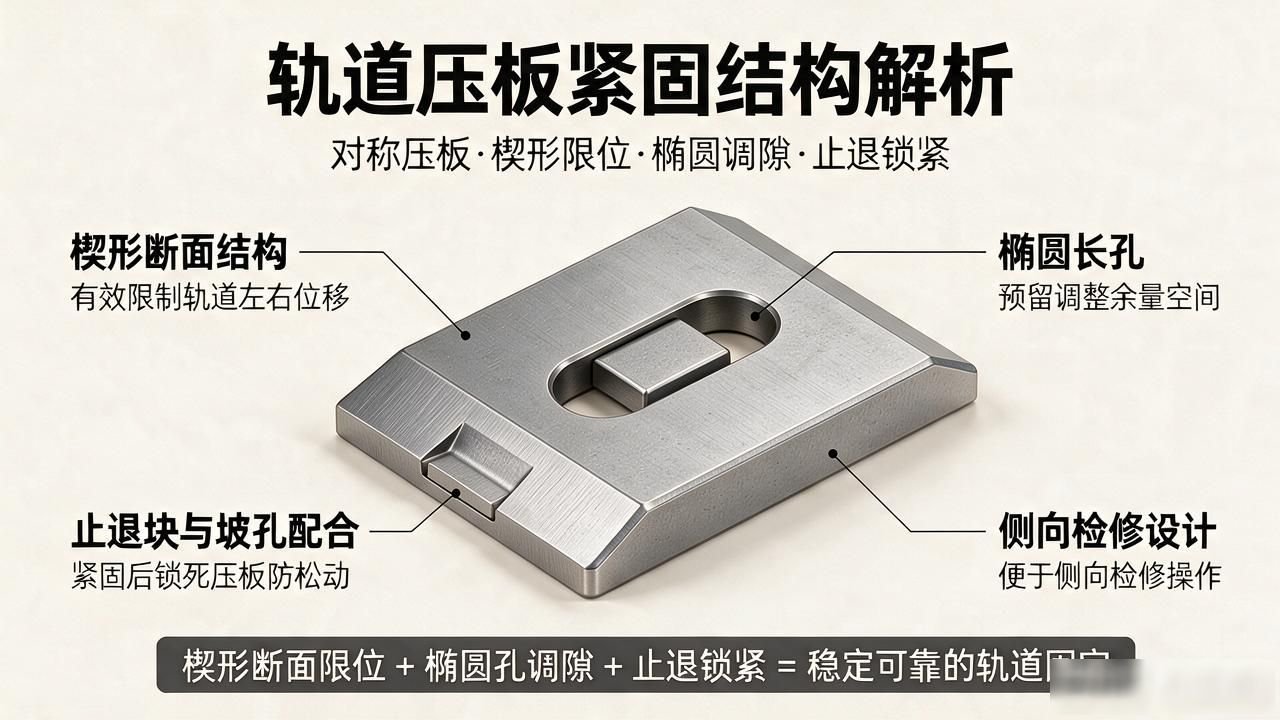
The symmetrical pressure plate forms a wedge-shaped structure in the direction of the cross section. This design effectively limits the displacement of the track in the left and right directions. There is an oval long hole on the main body of the pressure plate, which can leave room for adjustment. The backstop block and the hole with a slope are matched together for fastening, and then the pressure plate is locked so that the pressure plate will not loosen and can be easily inspected laterally.
On the basis of allowing the track to have a slight swing when the crane is running, the undesirable phenomenon of uneven gaps in the beam body is eliminated.
For rails with a specification of 38kg/m, it must be ensured that there is no looseness after the tightening operation is completed, and that it cannot cause wear and tear on the crane beam. This form of structural design can also be applied in usage scenarios that include the installation of welded long rails and subsequent maintenance work processes.
Series models and quotations
There are a total of seven GDGL models, ranging from GDGL-1 to GDGL-7. Among them, GDGL-2 is a double-hole pressure plate type. This model is suitable for specific occasions. In this case, the upper flange of the beam has been drilled with holes . The upper flange of the crane beam is riveted and welded to the track pressure plate , and bolts are used to connect the steel beam and the pressure plate, and then the track is fixed in this way. Other models correspond to different beam styles.
The manufacturer reported the GDGL-2 product, and the quotation was based on the national standard Q235-B. This is the price of a complete set of product parameters for the riveted steel beam pressure plate/track double-hole pressure plate on the upper flange of the crane beam and the track pressure plate. It does not disassemble the parts and quote them separately. Customers, you have to decide in advance whether you want to buy the whole set or just a single accessory, because the price difference between the two is quite large, so this is to avoid the trouble and disputes caused by everyone's wrangling when placing orders in the future.
Ask your company what type of pressing plate equipment it uses for the upper flange of the crane beam, and also discuss whether you have experienced common problems and pitfalls caused by improper welding sequence during the riveting welding process. Everyone is welcome to interact and share experiences in the comment area. If you think this information has certain practical value, please give it a thumbs up and forward it to colleagues in the company's production workshop so that more people can learn about it.






暂无评论内容