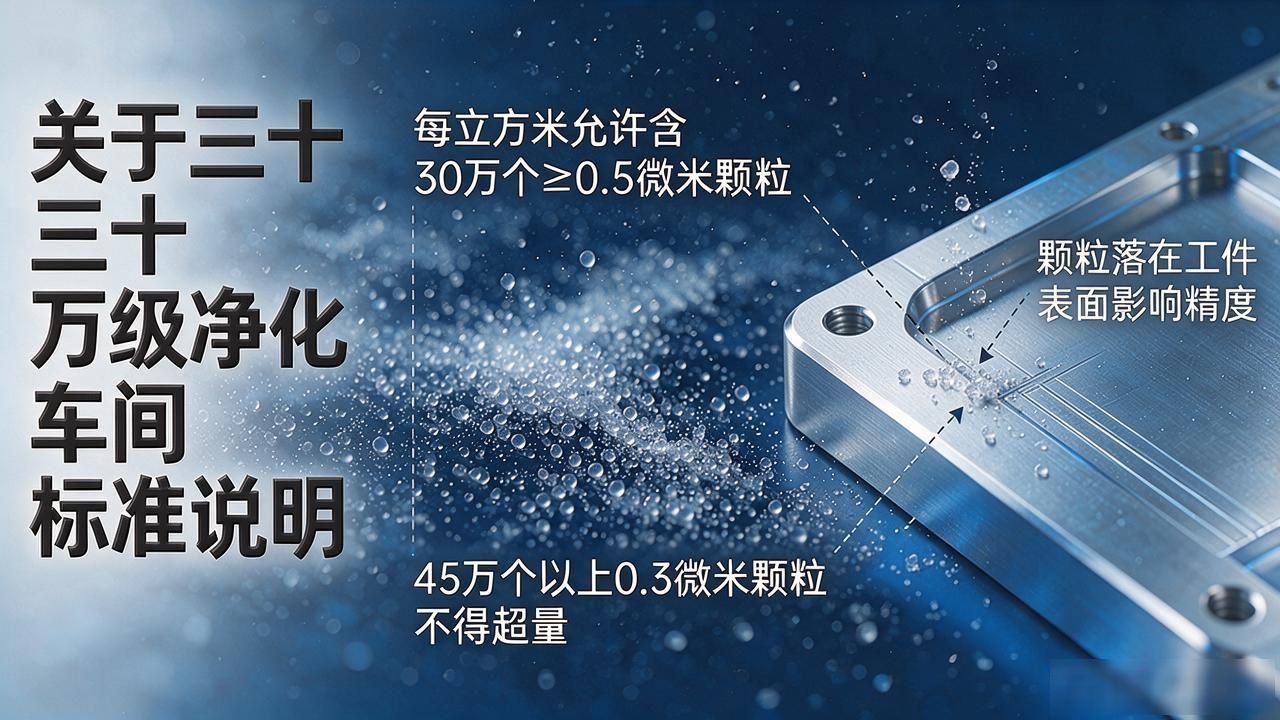


Description of standards for 300,000-level purification workshops
Many companies engaged in precision machining will directly ask which cleanliness level the workshop needs to be built at the beginning. However, when they get the parameters in the relevant standard documents, they cannot understand them at all.
So, what does the so-called 300,000 level mean in actual situations? Today I plan to break down all the specific indicators involved in this set and tell you about it so that you can fully understand it.
The core definition of dust-free workshop
A dust-free workshop is not as simple as a dust-free room. It has a set of very rigid index requirements. To explain it to you in layman's terms, it actually means to expel all particles, harmful gases and bacteria from a specific space, and at the same time, lock the temperature, humidity, pressure, air flow, noise, light and static electricity at the set values.
Whether there is a sandstorm outside or the seasons change, it doesn't matter. The cleanliness inside always remains the same.
The standard for measuring cleanliness only looks at one number, which is the number of particles with a diameter greater than or equal to 0.5 microns in each cubic meter of air. The lower the number, the higher the level. The so-called 300,000 level means that there are no more than 300,000 such particles in each cubic meter of air. For precision machining, this level is usually sufficient.
How to calculate level 300,000?
Many people now understand the term "300,000 level" as a relatively vague concept, but in fact it is not illusory. It corresponds to the rigid level standard of ISO 8. This level is basically the entry threshold that workshops that need to meet certain cleanliness requirements must meet. For processes such as precision gears or bearing assembly, they can just get stuck on the 300,000 level line. If you have to raise the standards and invest more, Then the cost is too high.

To do some conversion, each cubic meter is allowed to contain 300,000 particles with a particle size greater than or equal to 0.5 microns, and the number of particles with a particle size of 0.3 microns or more is required to not exceed 450,000. If these particles fall on the surface of the workpiece, the roughness and dimensional accuracy will be directly affected. So it’s not that the cleaner the better, it’s that it should be in a state that is sufficient for use.
How to check temperature and humidity
In a 300,000-level clean workshop, the temperature is usually set in the range of 18 degrees Celsius to 28 degrees Celsius, and the humidity is 40% to 70%. Because during the process of precision machining, thermal expansion and contraction of objects will have a very small impact on the tolerance, and the degree of this impact is above the micron level.
For example, in 2023, there was a local bearing factory in Suzhou. They lowered the constant room temperature from the original 26 degrees Celsius to 22 degrees Celsius. As a result, the coaxiality deviation of the parts was directly reduced by about one-third. Because of this, this batch of products later successfully passed the customer's re-inspection.
The effect of humidity is actually more subtle. When the humidity is too high, condensation will appear on the metal surface, which will cause the concentration of the machining fluid to be diluted. On the other hand, if the humidity is too low, there will be a problem of static electricity accumulation, causing all the chips to be adsorbed on the surface of the workpiece.
Therefore, in the production workshop, it is generally necessary to equip a constant humidity machine to stabilize the ambient humidity at around 55%, and to control the deviation within 5%, which is within the range of plus or minus 5%. These two data need to be written on the daily inspection form.
Don’t ignore positive pressure and wind speed
The workshop must maintain positive pressure for external operations. For the requirement of 300,000 level, it means that the pressure difference cannot be less than ten pascals.
The so-called pressure difference is reversed. Once it happens, the purification system is useless. Everything that gets in through the door crack is dust, because the air in the workshop has a little more pressure than that in the corridor. When the door is opened, the wind blows outside, so the dirty air cannot come in.
In terms of wind speed, there are no mandatory regulations on the number of forced air changes. In actual operation, the design is generally based on the ratio of ten to twenty air changes per hour. The type of air supply outlet used is turbulent type, and the air supply speed is controlled within the range of 0.3 meters to 0.5 meters per second. For example, in 2024, when a precision machining factory in Shanghai was undergoing renovation, The wind speed was reduced from 0.6 meters per second to 0.4 meters per second. As a result, the particle concentration stabilized and the electricity bill for air conditioning was saved.
Noisy lighting and static electricity

The noise in the workshop should be controlled below 65 decibels, and the illumination should not be lower than 300 lux. If workers stare at calipers and microscopes for a long time to take readings, and if the lighting is insufficient, the accuracy of the judgment will be very poor. In terms of static electricity, the ground should be covered with conductive epoxy, and the workbench should be covered with copper foil and grounded. This can reduce the electrostatic voltage to a level within a hundred volts.
In 2025, a company in Shenzhen that made electronic precision parts failed to do a good job in controlling static electricity. As a result, tiny cracks appeared on the surface of a batch of micro-diameter shafts after grinding. Later, when they traced the cause, they discovered that this was because the insulating material used in the turnover box had not been replaced.
The so-called "small parameters" we mentioned earlier cannot be omitted in a 300,000-level workshop. Even if there is just one missing regulation or one missing operation step, the entire batch of products may need to be reworked, that is, the entire batch must be processed again.
Why does precision machining need to pass this hurdle?
For companies engaged in precision machining business, their so-called 300,000-level cleanliness requirement is definitely not a face-saving project just for good looks. Because aircraft engine blades, medical titanium alloy brackets and mobile phone camera modules require extremely high precision. Their tolerance range is usually at the micron level, or even to extremely high levels such as sub-micron.
If a tiny particle, completely invisible to the naked eye, accidentally falls on these workpieces in the production workshop, an entire batch of products may be scrapped. In this way, once an accident occurs, the cost of tens of thousands of dollars will be completely wasted and cannot be recovered at all.
When customers conduct factory inspections, ISO certification, and AS9100 system audits, cleanliness parameters are all items that must be checked. Write all seven items of temperature, humidity, pressure difference, wind speed, noise, illumination, and static electricity into the SOP, and post it on the wall so that everyone in each shift can see it. This method is a hundred times more effective than verbally saying that we are very clean.
In your workshop, what is the specific concentration value of particulate matter currently measured? You are welcome to come to the comment area below and report the specific number. If you think this information is helpful to your work, you might as well click the favorite button and forward it to those who need it.




暂无评论内容