


Repair method for deformation of main beam of bridge crane

The main beam of the bridge crane will arch downward after running for a long time . Riveting and welding to correct the deflection and deformation of the main beam of the bridge crane. Riveting and welding to correct the deformation of the main beam of the bridge crane. If not dealt with, it will be a safety hazard. Choosing the wrong way to fix it is worse than not fixing it at all.
Common causes of deflection deformation of main beams
The bridge crane has been operating at full load for a long time, and the main beam is subject to continuous bending moments, which gradually causes downward deflection. In addition, the temperature difference inside the workshop is very large, the dust content is high, and the corrosion is very serious. These factors lead to the continuous reduction of the effective area of the main beam section. As the stiffness of the main beam continues to decrease, its deflection speed becomes faster and faster.
In addition to the factor of overloading, insufficient camber value reserved during the installation process is also a major source of this problem. In some cases, for the sake of cost savings, when some manufacturers perform the arching process, the actual value is only equivalent to 70% of the value stipulated in the design specification, or even lower than this ratio.
The direct consequence of this is that within a few months after the equipment or structure is put into use, its condition quickly reaches the critical limit of deflection.
Basic principles of prestressed repair method
At both ends of the lower cover plate of the main beam, support structures are set up and fixed, and prestressed tendons are used to pull out multiple steel bars and steel wires. Due to the influence of the bending moment, the stress direction of the main beam will gradually realize the recovery process of upward arching. During the operation, the prestressed state in the steel bars and the direction of the working pressure are the result of an opposite relationship, so that part of the load can be directly offset.
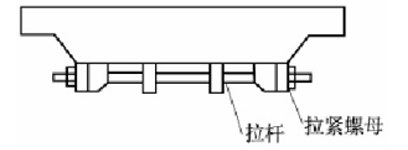
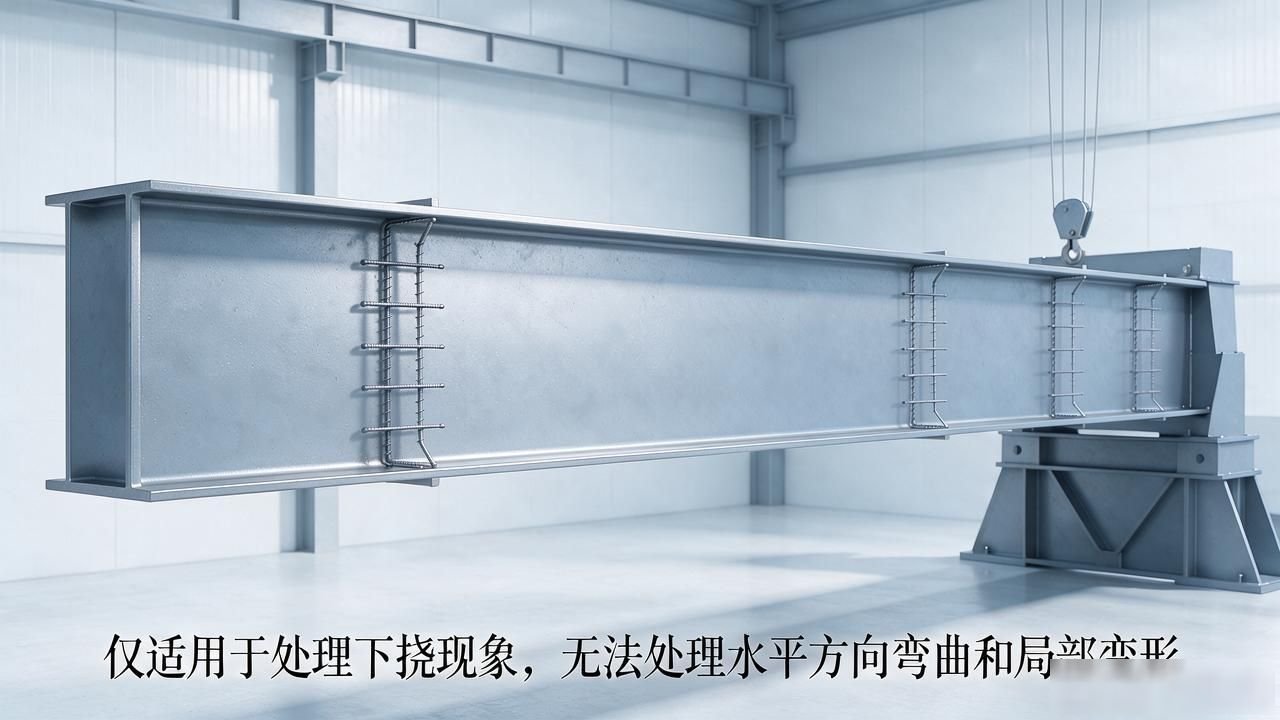
After the correction is completed, the strength and stiffness of the main beam have been significantly improved, the construction period is relatively short, the construction cost is relatively low, and the operation process is still controllable. But there is an unavoidable problem or flaw here, that is, this method can only deal with the phenomenon of downward deflection. It cannot be used for horizontal bending and local deformation, and it will leave traces of prestressed tendons on the appearance.
Key data when operating the prestressing method
During the process of tightening the steel bars, the upper camber value of the main beam must be measured in real time to ensure that the pressure on the outer layer of the lower cover plate does not exceed the maximum tensile stress limit that the material can withstand. At the same time, the tensile stress of the upper cover plate is also stably controlled within the allowable value range, because once this limit is exceeded, plastic damage will occur, and this damage will make the condition of the equipment worse and worse, causing the situation to become worse as it is repaired.
In daily operation and maintenance work, the prestressed parameters need to be adjusted in a timely manner according to the actual changes of the main beams. For those bridge crane equipment that have been at full load for a long time, have very poor working conditions, and have poor load capacity, prestressed repair treatment is the first choice. This method has the highest cost performance.
How the flame correction method works
The main beam needs to be locally heated, which allows the metal to plastically deform. After cooling, shrinkage stress is used to pull the deformation back to its original position. The heating temperature must be controlled within the range of 700 to 800 degrees Celsius. In this range, the metal yield limit approaches zero, and the correction effect is better.
When it is necessary to reduce the degree of web corrugation, the partition can be used as a heating pad, but at the same time, the dangerous sections of the main beam must be avoided. For exactly the same position, repeated heating operations are absolutely not allowed.
If this is done, the internal metallographic structure of the material will be damaged, which will permanently reduce the bearing capacity of the entire structure. The consequences will be very serious and will cause great hidden dangers and impacts in the future.
Reinforcement must be done after flame correction
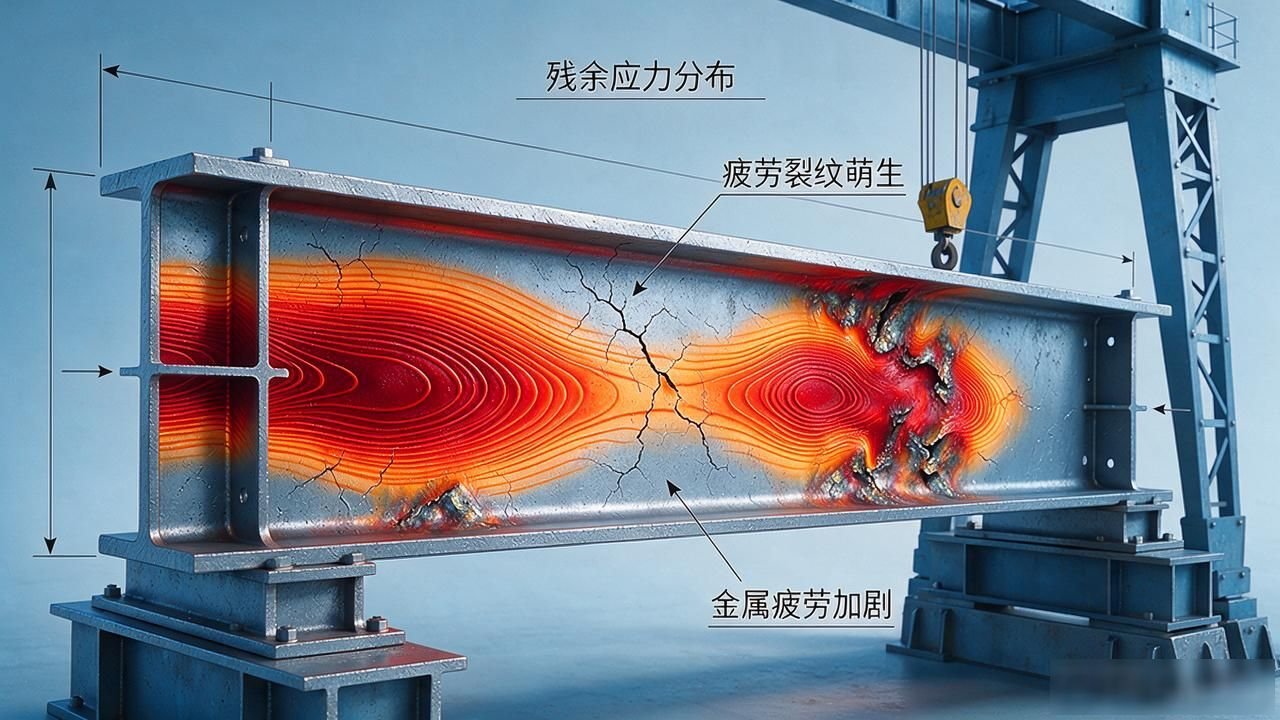
After all the correction work is completed, very large residual stress will be generated inside the main beam. At the same time, because the equipment needs to be in operation for a long time, the metal fatigue phenomenon will continue to intensify.
If reinforcement measures are not taken, the structural deformation will show signs of rebound and may even worsen. In response to this situation, the conventional engineering technique is to weld the channel steel to both sides of the lower steel plate within the span of the main beam to effectively lock and release the internally generated stress.
The flame correction process is very flexible and the construction is relatively simple. However, this method has a necessary prerequisite, that is, the operator must first make a clear and accurate judgment on the deformation type of the main beam.
If the deformation of the main beam manifests itself as horizontal bending or local bulging, forcibly using flame correction to deal with it will inevitably lead to further deterioration of the engineering condition. Therefore, blind operations are absolutely not allowed in this case.
How to choose between the two methods?
In response to the situation of downward deflection, everyone will choose to use the prestressed construction method, because this method has a shorter construction period and lower cost.
If there is local wavy deformation or the camber deviation is relatively small, in this case, you can choose the flame correction method. This method is more flexible to operate, but it must be reinforced with channel steel. When the overall deformation is particularly large and the on-site working conditions are severe, it is safer to use the prestressed construction method.
Before selection, the deformation data should be measured first, and then the metallographic state of the main beam should be checked. If you are not sure, you can use a combination of the two methods to correct the deflection and deformation of the bridge crane's main beam by riveting . Don't make decisions casually.
Dear colleagues, how many millimeters are left in the current upper camber value of the main beam of the lifting machinery used in your workshop? Please tell this number in the comment area so that I can help you determine what specific treatment method should be adopted. If you think this answer is of certain practicality, you might as well give it a thumbs up and forward it to your colleague in the workshop who is struggling with the condition of the main beam every day.






暂无评论内容