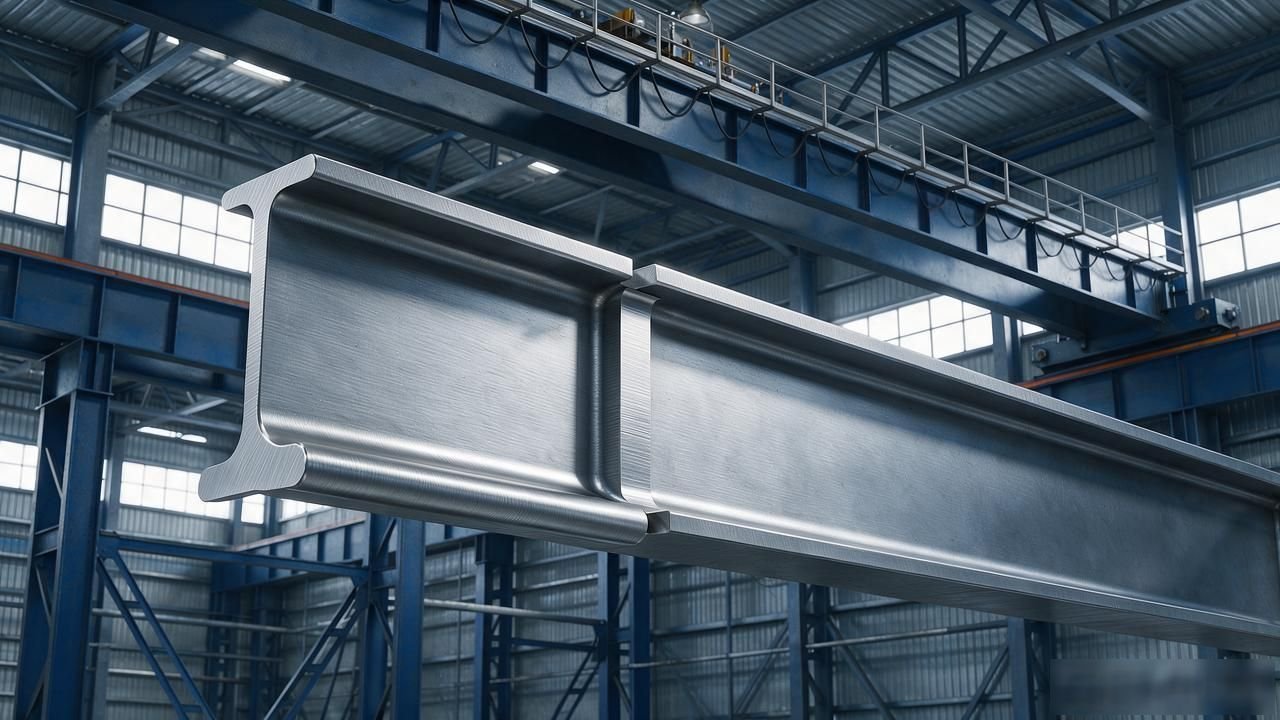


What are crane beams and crane tracks? Precautions for crane beams in steel structures
In many construction sites, there is a phenomenon that the riveting and welding process between the upper flange of the crane beam and the track pressure plate is treated as an ordinary weld, causing the track to jump whenever the crane is running. Next, this article will sort out in detail the various errors that are most likely to occur during the construction process, and explain them all at once.
Don’t miss out on support systems
When the span is reached, auxiliary trusses must be added
When the span of a heavy crane girder is greater than or equal to 12 meters, and when the span of a light or medium crane girder is greater than 18 meters, auxiliary trusses must be set up in the project, and lower flange horizontal supports must also be set up. This is very strict.
Just in 2025, such a specific engineering case occurred. A certain automobile assembly workshop omitted to install this auxiliary truss during the construction process. As a result, the crane truss had a particularly serious problem, that is, its vertical deflection exceeded the prescribed safety standards and could not be used normally.
Because of this reason, the entire workshop had to be shut down for rework. This shutdown and rework process took a full two weeks to complete.
The vertical support position cannot be misplaced
Vertical supports cannot be set at the section where the vertical deflection of the beam or truss is the largest. Generally, they are set at one-quarter or three-quarters of the span. If it is installed in the wrong position, local deformation will be aggravated, and the gap between the upper flange and the rivet weld of the track pressure plate will be stretched wider, causing the track to deviate laterally.
Don’t be lazy when processing flange edges
The tension flange must be rolled or gas cut

For heavy-duty crane beams, the edge of the flange plate on the side located in the tension zone needs to be made into a rolled shape or automatically gas-cut. If you only rely on manual cutting or a shearing machine to perform the cutting operation, you must carry out planing and smoothing along the entire length of the boundary line.
There is a well-known heavy machinery company. In order to save convenience and trouble, in 2024, it did not perform the planing process as required. This directly led to stress concentration at the root of the flange. Not long after, transverse cracks appeared on the beam after only half a year of operation.
Check edge fit section by section before riveting welding
Before riveting the rail pressure plate and the upper flange, the operator needs to pick up a ruler and check the fit of the edge section by section. If it is found that some sections are not firmly or tightly fitted, then these parts must be reworked and repaired.
If this situation is not dealt with and the process goes directly to the next process, then after the riveting is completed, the lateral displacement deviation of the track is likely to exceed 5 mm. Once the deviation exceeds the standard, all subsequent bolt hole positioning work will be completely canceled, and the construction engineering team will need to dismantle all the completed structures and start operations again.
Three hard rules for flange welding
Welding of pendants and fixtures is prohibited
The tension flange of the crane beam is not allowed to weld parts that require suspension equipment. At the same time, it is not allowed to operate by ignition or use clamps to perform welding. In 2025, a steel structure factory had such a situation. They clicked two on the above-mentioned flange position to use as lifting rings to facilitate hoisting operations. However, the judgment result of the quality inspection was that it did not meet the qualification standards. In the end, the entire beam was cut and scrapped and needed to be remade. The resulting economic loss reached more than 100,000 yuan.
The riveting and welding process must be submitted for review separately
The riveting welding between the upper flange and the rail pressure plate is a critical weld. Therefore, the welding materials, welding current and interpass temperature used need to be submitted to the supervision unit for confirmation in advance. If construction is carried out in winter, the preheating process must not be omitted. Because riveting is performed under low temperature conditions, the probability of cold cracks is very high, and the repair cost is three times the normal construction cost.
Bolt holes and elevation stuck numbers
If the reserved hole is 5 mm off, it is out of tolerance.
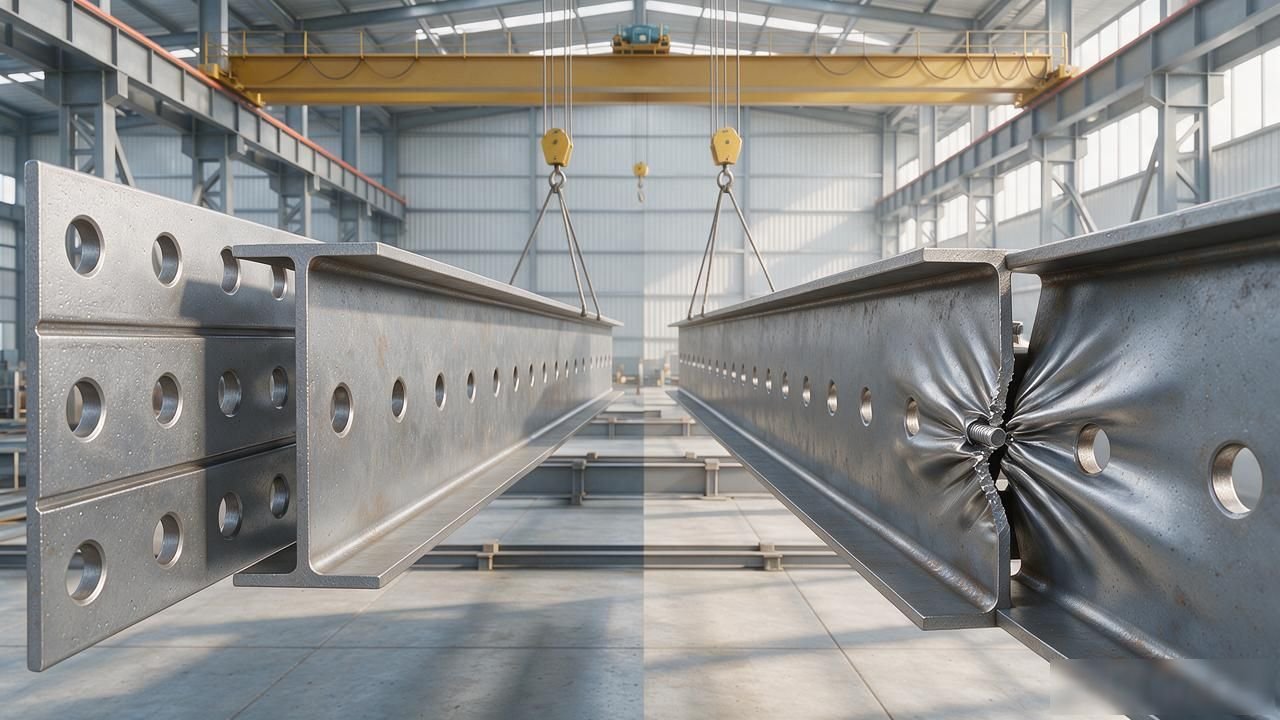
The positional deviation of the bolt holes reserved in the transverse and longitudinal directions of the beam must be controlled within the range of 5 mm. The size of the screw hole is 2 to 7 mm larger than the diameter of the bolt. In an industrial factory project in 2024, the hole position was offset by 7 mm. As a result, the crane beam could not be aligned during assembly, and the project progress was unwillingly delayed for up to ten days.
If the difference in elevation between the two beams exceeds 15 mm, it must be corrected
The relative elevation deviation between the upper planes of the two crane beams must not exceed 10 mm at the location of the column, and 15 mm at all other locations. The specific elevation data of the top surface must be recorded one by one and stored in the archive file. This is to prevent the level from being unable to be adjusted later when the track pressure plate is installed and riveted and welded, resulting in quality problems such as track gnawing and running route deviation.
Grouting layer and setting out verification
The top surface of the beam must be flushed before grouting
Before pouring the grouting layer between the concrete crane beam and the track, the top surface of the crane beam must be rinsed very clean before subsequent construction operations are carried out. However, in a certain engineering project in 2025, construction workers directly carried out grouting without performing this step of flushing.
This resulted in hollowing and detachment of the grout layer. Because the stress on the riveted welding part of the pressure plate became uneven, all the parts became loose after half a year of use, and eventually had to be reworked.
Check the thread length item by item after setting off
After the laying-out work has been completed, a list of processed parts should be listed based on the actual measured data, and the length of the thread should be reviewed item by item. In 2024, a certain workshop calculated an extra 30 millimeters, resulting in the pressure plate being unable to be screwed in after arriving at the site. In order to solve this problem, gas cutting was used to cut the parts on site. As a result, the base material was accidentally damaged, and the entire batch of pressure plates had to be reprocessed.
I would like to ask you about the project you are currently in charge of, regarding the riveting and welding construction plan of the crane beam, has the review procedure been completed?
Now we sincerely invite you to share and communicate in the comment area and talk about the extremely difficult and troublesome riveting technical problems you have encountered during the implementation process. If you think that these experience contents are indeed of practical value, then please be sure to click the like button and forward this content to relevant personnel engaged in front-line operations at the construction site.






暂无评论内容