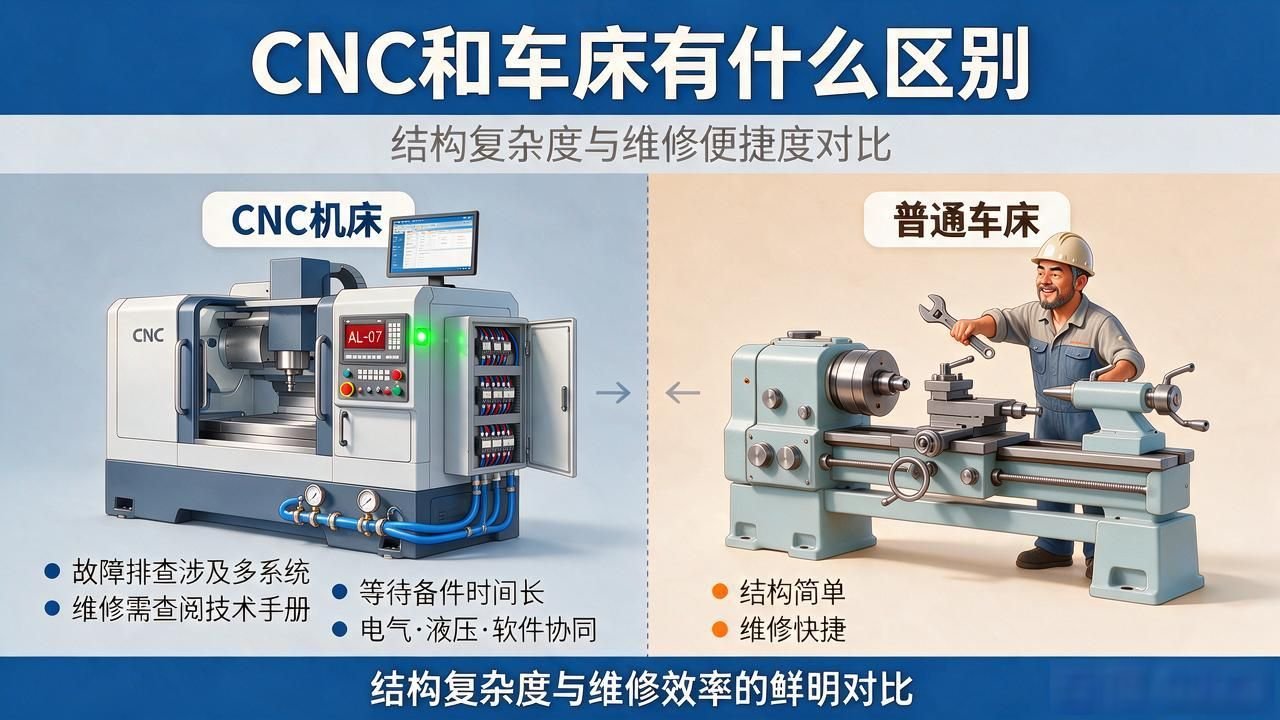


What is the difference between CNC and lathe?
Many factory owners spent hundreds of thousands of yuan to buy CNC, only to find that all the equipment could be done by ordinary lathes, and the equipment was just sitting there gathering dust. What are the differences between CNC turning and ordinary lathes? Today I will explain this issue to you thoroughly from six dimensions.
Completely different controls
CNC machine tools use G codes and M codes to drive the spindle and feed axis to achieve synchronous movement. In this way, a three-axis CNC lathe can complete various processes such as cylindrical machining, step machining, end face machining, thread machining, and groove machining at the same station at the same time.
On the other hand, the situation with ordinary lathes is completely different. Lathes have to shake the handwheel by hand, and have to change the tools themselves, and have to set the tools. All of this is controlled by the operator's feeling. Therefore, the size deviation of the same batch of parts produced will become very large, and the fluctuations will also be obvious.
In 2024, an auto parts factory in the Yangtze River Delta conducted a comparative test. They use an ordinary lathe to turn an M12×50 thread. Even a very experienced skilled worker must spend 18 minutes to complete it.
However, if CNC programs are used for automated processing, it only takes 6 minutes to complete the entire process. Moreover, the deviation range of the center diameter of each thread produced in this way can be strictly controlled within the standard of plus or minus 2 microns.
The difference in accuracy is orders of magnitude
Ordinary lathes mainly rely on screws for transmission and require manual observation. Its repeatable positioning accuracy is generally around 0.05 mm. When turning a slender shaft, once the thermal deformation phenomenon appears, the displacement of the tail can easily reach 0.1 mm.
The CNC lathe has a closed-loop servo system, which returns position information every time it rotates, allowing its repeat positioning accuracy to reach 0.005 mm.
When machining aero-engine blade blanks, there is a requirement called coaxiality. This value cannot exceed 0.02 mm. It is basically difficult for equipment such as ordinary lathes to handle such work. Therefore, it is necessary to rely on five-axis CNC linkage grinding technology. Because of this, there is a result, that is, the workshop of the aerospace engine plant is full of various CNC equipment.
Efficiency and production line connection
CNC equipment is allowed to be connected to a detection device for online measurement. When the tool wear reaches a set value, the compensation operation will be automatically completed. Even if there is no personnel on duty during the night shift, it can still continue to operate. Ordinary lathes require a lathe to look after two machines at the same time. Loading and unloading, measuring dimensions, and replacing tools all rely on manual operations, which results in a two to three times gap in per capita production capacity.
In Dongguan City, Guangdong Province, there is a hardware factory. This factory implemented an equipment update initiative in 2025. Specifically, the eight 6140 ordinary lathes originally used were replaced with four CNC turning and milling compound machines.
The contrast in the production data is very obvious when the production shift remains unchanged at 12 hours a day. The factory's monthly output has increased from the original 12,000 pieces to 35,000 pieces. At the same time, the number of employees decreased from 16 to 6.
The trade-off between cost and threshold
Now everyone can understand an entry-level two-axis CNC lathe. At this time in 2025, the price in the market will be between 150,000 and 250,000. For an ordinary lathe, if the processing range is at the same level, it will only cost 60,000 to 100,000 yuan. The main price difference lies in the key components of the servo driver, ball screw and DNC controller.
However, there is another requirement for CNC equipment, that is, it requires the operator to master programming technology, and at least be able to read G codes using the FANUC system or Siemens system. This training cycle usually takes one or two weeks to start. In comparison, it only takes three days to get started with the operation of an ordinary lathe. It has a much lower threshold for recruiting people and is more cost-effective for small workshops.
Maintenance and environmental requirements

When we troubleshoot CNC machine tools, we must include the electrical system, hydraulic system and software system into the scope of investigation at the same time. If a problem such as a servo alarm code occurs, we can basically directly locate the specific fault point by consulting the relevant manual. However, once it is found that the bearings of the spindle or the encoder are damaged, it will take two or three days to wait for the supply of spare parts. In comparison, If an ordinary lathe has a minor problem such as clutch damage or the need to adjust the guide rail clearance, it usually only takes half an hour for an experienced master to hold a wrench to completely solve the problem.
In terms of environment, CNC machine tools are very sensitive to temperature changes in the workshop. Once the temperature fluctuation exceeds the range of plus or minus 5 degrees Celsius, the stretching effect of the guide rail due to heat will directly affect the accuracy.
For example, during the rainy season in the south, if humidity control is not carried out in the workshop, the size of the workpiece will easily drift significantly. In comparison, ordinary lathes are more durable and sturdy. It can even be operated in a shed under the open air.
Substitution or coexistence in the future?
In 2025, the output of domestic CNC lathes will account for more than 70% of the total lathe output, while the market share of ordinary lathes is continuing to shrink. However, considering the specific application scenarios such as township agricultural machinery maintenance points, school training workshops and small batch mold repair, ordinary lathes will not be eliminated in the short term because they are relatively low-priced and easy to repair.
From the perspective of trends, CNC is developing in the direction of five-axis, turning and milling integration, and intelligent tool management, while ordinary lathes are being transformed in the direction of configuring automated loading and unloading devices. These two lines are developing in parallel. You need to choose according to your specific drying properties, whether it is batch precision processing or minor repairs.
Do you use more ordinary lathes or CNC lathes in your factory now? You can chat in the comment area, give a thumbs up if you find it useful, and forward it to the workshop director for a look.




暂无评论内容