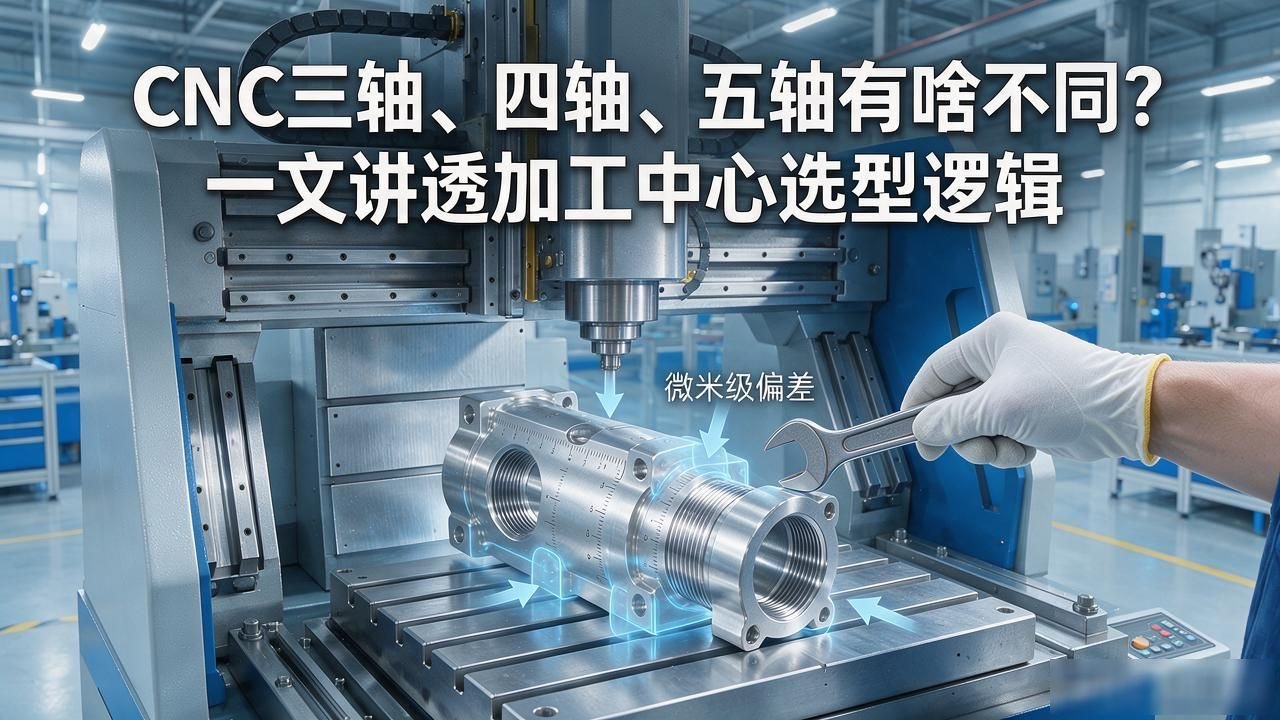


What is the difference between CNC three-axis, four-axis, and five-axis? One article explains the machining center selection logic
Many people think that five-axis equipment represents high-end and three-axis equipment represents low-end. This is a very common view. Especially some novices who have just entered the machining industry often carry such cognitive baggage. When they really need to choose processing equipment and arrange production processes, this kind of thinking can easily lead them to take detours and spend unnecessary money.
The three-axis is the main equipment in the workshop
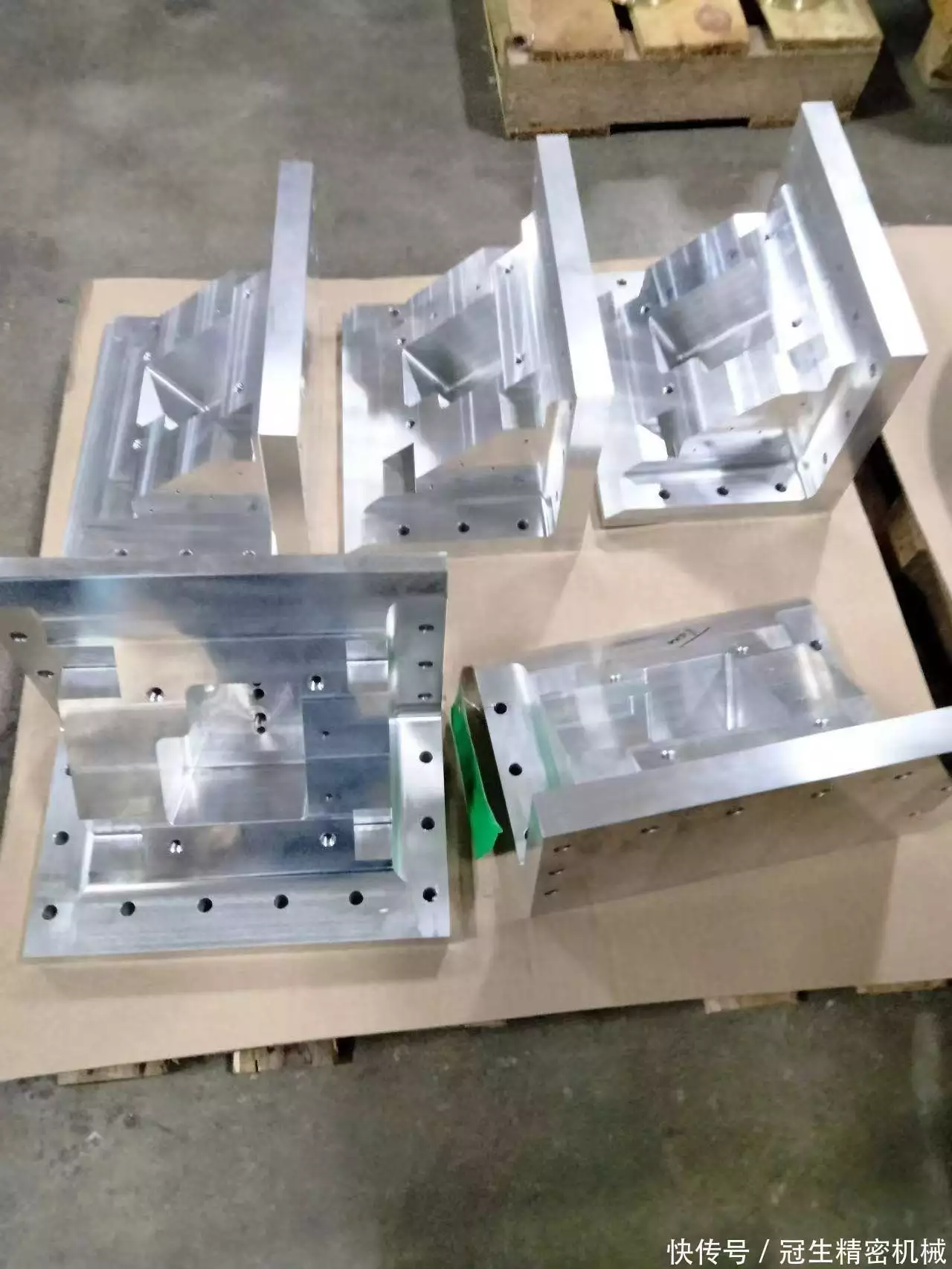
Among domestic mechanical processing plants, the most widely used equipment is the three-axis machining center. The three linear axes of this device, XYZ, correspond to the three directions of left and right, front and back, and up and down. It can handle face milling, drilling, grooving, step making and simple cavities. Whether it is steel or aluminum parts, it can directly handle most common industrial parts in various types of formwork and bases.
The maturity of the equipment is relatively high, the machine adjustment operation is relatively easy, and the stability during mass production is very good. From Dongguan, Guangdong to Taizhou, Zhejiang, in the workshops of small and medium-sized processing plants, the busiest thing is the three-axis machine equipment. The only thing that can really work and maintain production every day depends on it. Many processing plants use a three-axis machine that can run hundreds of thousands of products a year.
Those surfaces that are beyond the reach of the three-axis
The range that three-axis machining can reach is only limited to the upward surface of the part. For those structures located on the side, it is completely powerless. As for the undercut structure and the inclined hole part, the tool cannot contact and cut at all.
Therefore, it is necessary to rely on manual labor to perform the turning action, and a second clamping process is required. Only in this way can all the remaining processes be completed. As the number of flipping processes continues to increase, clamping deviations gradually begin to occur, and eventually manifest themselves as cumulative errors in dimensional accuracy.

For those parts that require high dimensional accuracy, the deviation introduced by repeated disassembly and assembly operations is difficult to control within the micron range. This is a shortcoming that cannot be circumvented by three-axis machine tools. It can only rely on experienced masters to make manual compensation, so the efficiency will naturally decrease.
Four-axis specializes in rotating parts
By adding the rotation function of an A-axis to the three axes, for the processing of rotary parts such as cylindrical parts, rollers, cylindrical cams, circumferential holes and annular slots, it is possible to complete the entire process continuously after one clamping, without the need to repeatedly disassemble and install the workpiece, thus directly and significantly reducing the deviation caused by clamping.
For moderately difficult rotary parts and cam parts, four-axis machining is the most cost-effective option. This approach can save a relatively considerable capital investment in equipment and avoid the extra man-hour cost of the turning operation that must be performed when using three-axis equipment.
Therefore, many auto parts manufacturers rely on the introduction of this piece of equipment to effectively support the entire production line's production needs for rotary parts.
Where the four-axis ends
Because the four-axis equipment only has the function of rotation, but there is no way to perform the swing operation, so when the workpiece has an inclination angle, the structure contains complex curved surfaces, or the part shape is multi-faceted, it still cannot play its role and is completely powerless. In this case, the five-axis machine tool must be used to handle the work. Do not force these tasks to the four-axis, otherwise the more you force it to work, the more errors will eventually occur.
To put it bluntly, four-axis machine tools are more suitable for processing workpieces that have certain rotational characteristics and are at a medium level of complexity. This does not mean that all parts that require rotation must absolutely rely on four-axis equipment for production processing. For processing tasks that really require the use of five-axis technology, it is ultimately necessary to use five-axis equipment to operate and complete the corresponding manufacturing process.
Five axes can be clamped on five sides at one time
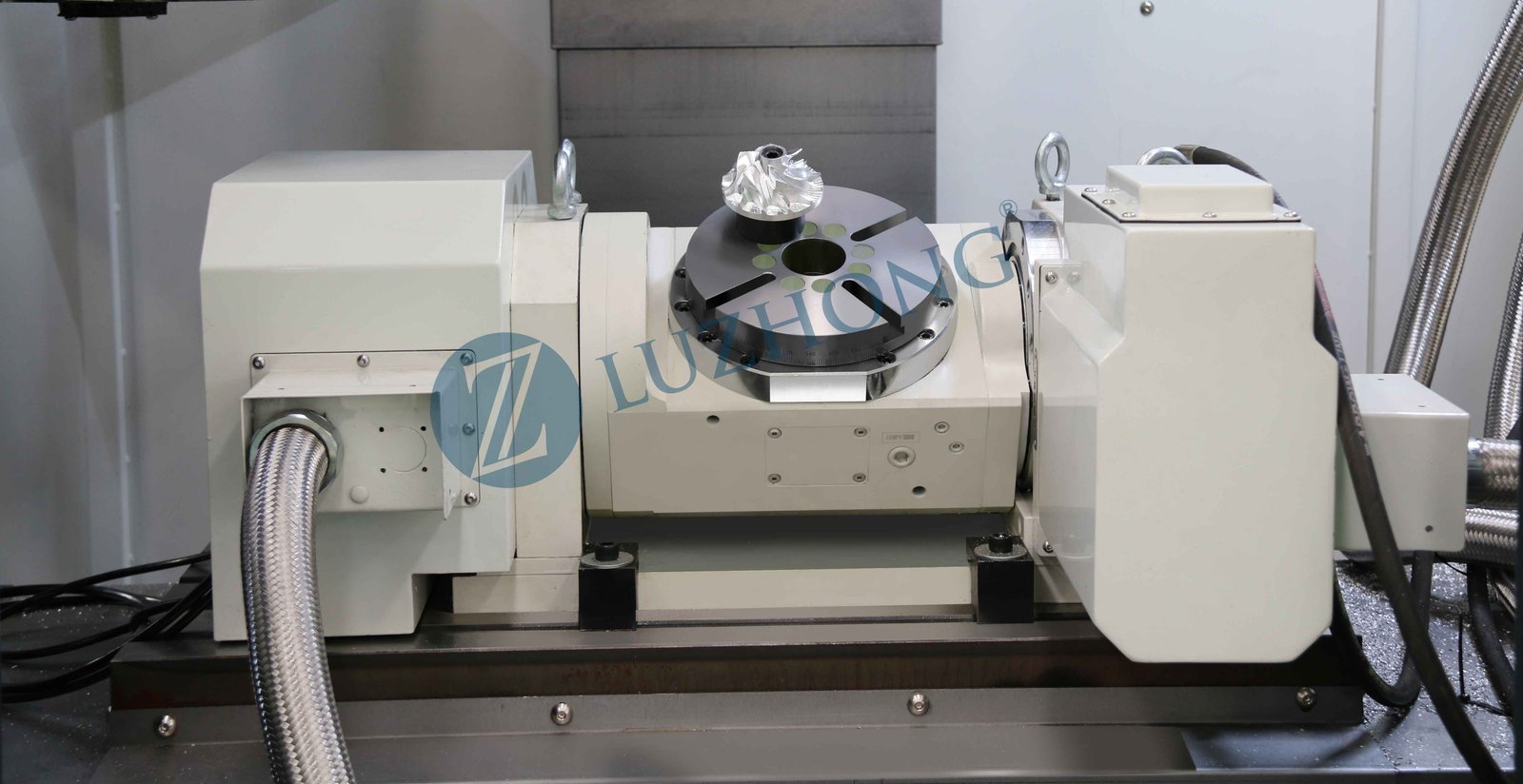
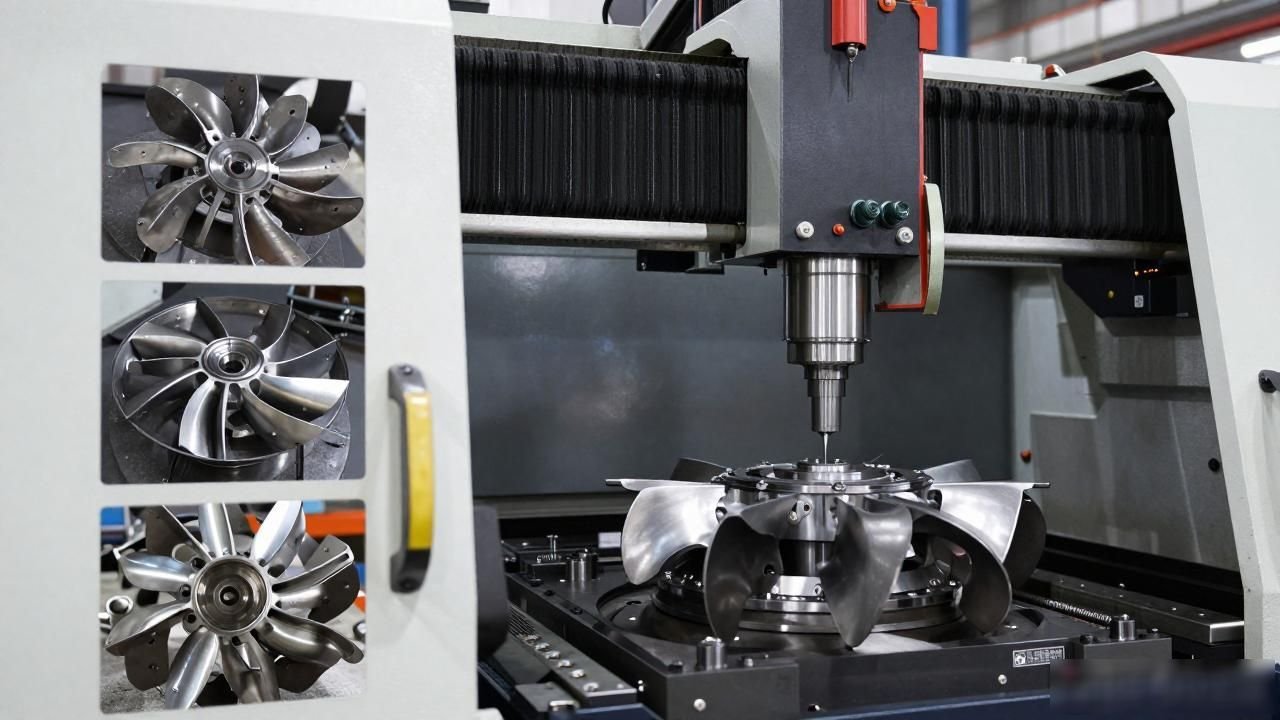
Such as impellers, blades, aerospace special-shaped parts, multi-angle inclined holes and complex mold cavities. In the past, the processing of these parts required three-axis equipment to be turned over and processed four or five times. Now, if it is switched to five-axis equipment, all processing can be completed with only one clamping. In this way, the marks of tool joining are greatly reduced, the clamping deformation is also much smaller, and the processing accuracy and efficiency are obviously improved to a higher level.
However, the underlying logic of the five-axis programming business is extremely complex, and the threshold for machine adjustment is also very high. This places extremely high demands on the operator's process understanding and tool path planning experience. Therefore, the salary level corresponding to the responsibilities of this position is also much higher than the ordinary level. It does not mean that every new employee can fully master and control this skill. Practitioners must have real skills.
Beginners, don’t rush into the five-axis as soon as you get started.
In the industry, those five-axis machining masters who truly have excellent skills are all based on solid three-axis practical experience. If the key contents of size control, allowance allocation and tool path logic are not thoroughly understood, they will have to bravely challenge five-axis machining. Then the entire learning process will become very difficult and the probability of errors will increase significantly. This will in turn cause the actual progress to be seriously hindered.
The first step is to thoroughly learn the basic skills of three-axis and lay a very solid foundation for the craft. Once this step is stable, you can then go up and enter the learning stage of four-axis and five-axis. It is a matter of course and natural, and there is no need to worry at all. You can't do things rashly, you have to do it step by step and slowly. This steady and steady approach is definitely much more powerful than rushing around without direction.
What are the specific types of several-axis equipment used in your factory now? What kind of pitfalls have you encountered in the actual application process? You are welcome to communicate and discuss in the comment area. If you think this content is useful, give it a like and forward it to your peers.




暂无评论内容