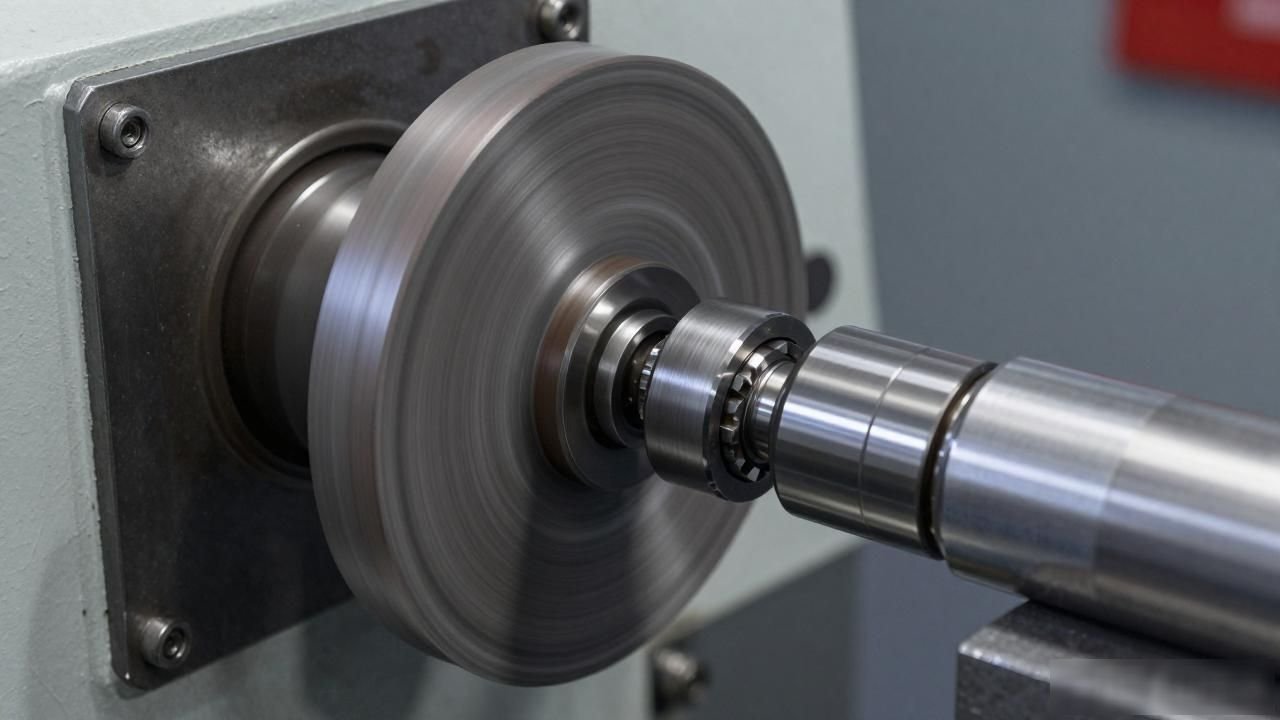


The decisive role of grinding wheel dynamic balancing and dressing technology in precision grinding
During the grinding process, once vibration begins to occur, roundness, roughness, and size will all change erratically. The first thing most people think of is to blame the machine tool, but in reality, 80% of the problems are caused by the condition of the grinding wheel itself.
How grinding wheel wear destroys grinding accuracy
The abrasive grains continue to become dull during wear, and will fall off and remove chips, blocking all the gaps. This makes the contour of the grinding wheel's working surface slowly become less and less regular, and as a result, the cutting force does not remain quietly and constant, but begins to oscillate back and forth in circles. This oscillation directly leads to the generation of chatter, and finally leaves a series of messy ripple marks on the surface of the workpiece. The surface roughness seriously exceeded the prescribed standard limit, and there were even burn marks in some places.
In the actual workshop production site, if a brand-new grinding wheel is continuously used for ten to fifteen days without trimming, and is used to process the same batch of shaft parts, its roundness error will increase from the initial 5 microns to 15 microns, and the dimensional deviation will become very obvious, resulting in a direct doubling of the scrap rate.
Eccentricity is the hardest source of vibration
Because the density of the grinding wheel is uneven, the flange installation is skewed, and the degree of wear shows symmetrical deviations, it will cause its center of mass to deviate from the position of the rotation axis. When rotating at high speed, the mass caused by eccentricity will be thrown out, thereby generating a centrifugal excitation force, thus forming a continuous and forced vibration state for the entire system composed of the spindle and the grinding wheel.

When the spindle speed reaches tens of thousands of revolutions, even the excitation force generated by an eccentricity of a few tenths of a gram is completely enough to create visible ripples on the surface of the workpiece. Since the main shaft bearing needs to withstand the impact of this alternating load for a long time, its service life will be directly cut by as much as half.
What exactly was repaired?
Dressing work mainly does two things. The first thing is to cut off the dull abrasive grains to expose the sharp cutting edge again. The second thing is to correct the outline of the grinding wheel and restore it to the design size. After these two steps are completed, the grinding force can be reduced by 30%, and the cutting performance can truly be restored.
It is necessary to use a diamond pen roller for trimming. After trimming once, the microscopic topography of the working surface will become more uniform, so that the load distribution will be balanced, so the periodic vibration excitation source will be eliminated from the root. If you choose not to trim, then no matter how balanced the work is, there will be no way to suppress the vibration force in the end.
Key data for dynamic balance correction
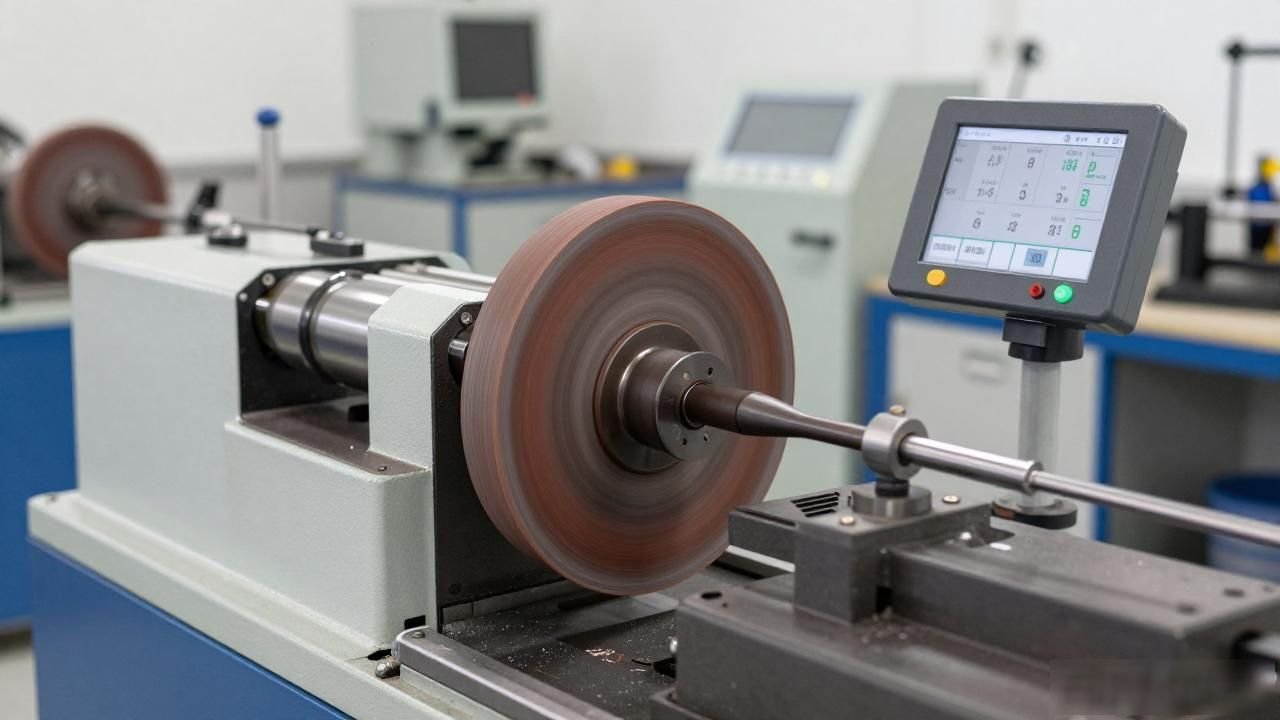
Through the method of dynamic balancing, the residual imbalance is reduced to the level of G1 or G2.5, usually controlled to a level below 0.5 grams per millimeter. After the correction operation, the vibration amplitude of the spindle system was compressed from the initial tens of microns to a range of less than 3 microns, thus making the entire rotation foundation more stable.
The condition of qualified balance is that when the grinding wheel rotates at high speed, it no longer throws out the force, and there are no evenly spaced vibration marks on the surface of the workpiece. Then the dimensional accuracy and shape accuracy return to the range of the design tolerance.
Why trimming and dynamic balancing must cooperate
After trimming changes the contour, the mass distribution will change accordingly, and the original balance data will be invalidated, so the dynamic balancing operation must be performed again. If only balancing is done without trimming, passivation and distortion will still exist, the vibration source will not be truly eliminated, and errors will still exist.
Trimming the geometric shape of the pipe and the cutting ability to manage the mass distribution of the rotating part of the pipe under dynamic balance are all problems in a certain dimension for each pipe. As long as any one piece of work is missing, the vibration will not be completely suppressed, and the processing accuracy will sooner or later lose control.
How to implement closed-loop control
The rules of the workshop say that this is done, that is, every time the grinding wheel is repaired, a dynamic balancing operation must be completed simultaneously, and then the residual imbalance amount must be recorded, as well as the contour. These must be written on the process card. If this rhythm can be maintained during batch processing, then the dimensional consistency and surface quality will be stable.
We need to implement closed-loop control. Burns caused by grinding are basically eliminated, chatter marks are basically eliminated, and dimensional drift is basically eliminated. The scrap rate is successfully reduced to less than 1%. The repeatability of the process is greatly improved, and customer complaints are significantly reduced.
When you carry out equipment trimming and operating dynamic balancing in the workshop, do you choose to separate them and perform them separately, or do you choose to link them to complete the operation together? You are welcome to share your own opinions and experiences in the comment area below, like it and share it with more peers.







暂无评论内容