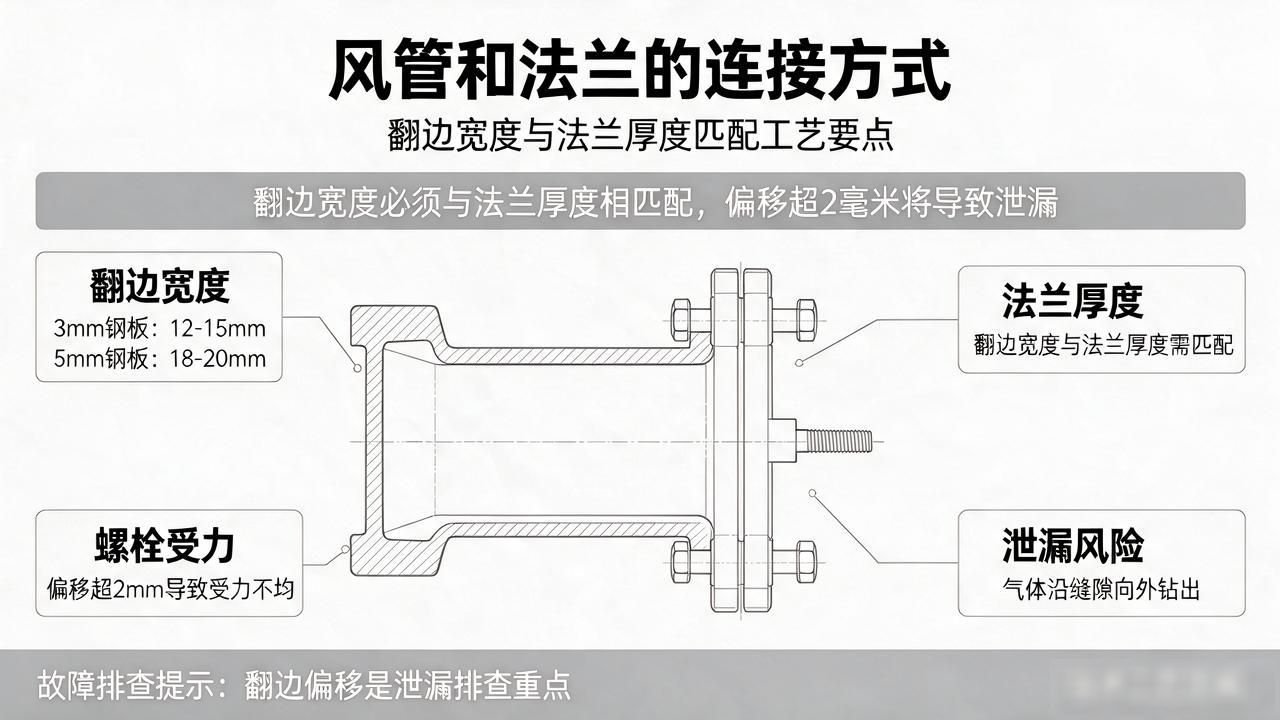


The connection methods of air duct and flange are:
During the operation of the dust removal and exhaust system in the factory, if the position of a certain flange is incorrect, air leakage will occur in the entire pipeline. Regarding the three common connection methods of welding, flanging and riveting, it is often difficult for workers on site to distinguish accurately. Once rework is required due to a mix-up, the economic losses caused will be as much as tens of thousands of dollars.
Where are welded connections used?
For dust removal pipes with working pressures exceeding 500 Pa, as well as carbon steel square air ducts with a wall thickness of more than 6 mm, they are generally welded directly. As for high-temperature flue gas pipelines, as well as those pipeline equipment containing corrosive dust, welding must also be used.
Why is this? Because if you only use flanging and riveting, you will never be able to withstand the severe thermal expansion and contraction effects caused by extreme high temperatures. After a long time, these connection parts will eventually become damaged and cracked.
After welding is completed, it does not mean that all the work is over. According to the latest acceptance specification requirements in 2025, 100% visual inspection of welds in critical parts must be carried out. If defects such as pores or cracks are found, they must be re-welded until they reach qualified standards.
As for making air ducts out of galvanized sheets, never use welding to connect them. Because once heat is applied, the zinc layer will be destroyed and disappear. In this way, it will easily be rusted through after more than half a year. In addition, if the dust adheres to it, it cannot be cleaned off at all.
Key points for flanging connection operations
This is the most frequently used connection method in the field. First, fold the end of the square air duct outward into a 90-degree right-angled edge, then place the flange plate and clamp it with bolts from both sides. If disassembly is needed for maintenance in the future, just unscrew the bolts without using an open flame, which will have minimal impact on the production activities of the workshop.

The width of the flange must match the thickness of the flange. If a three-millimeter steel plate is used for flanging, the width should vary within the range of twelve to fifteen millimeters. If a five-mm steel plate is used for flanging and riveting factory dust removal exhaust system square pipe flange , the width should be controlled between eighteen and twenty millimeters. Once the flange is offset by more than two millimeters, the force on the bolt will be uneven, and the leaked gas will drill out along this gap. This will cause great trouble and headache when troubleshooting.
How to use riveting connection in practice
When the thickness of the thin steel plate is less than 2 mm and a low-pressure exhaust system is used, riveting is the most trouble-free method. Workers only need to prepare a hand drill and a rivet gun to complete the connection of a whole row of square pipe sections in about half a day. The cost of materials used in this process can be reduced by 30% compared to the welding method, and workers can easily master this skill. This is undoubtedly the most economical option for small projects.
One of its disadvantages is that the sealing performance is relatively poor, so a rubber sealing strip with a thickness of 3 mm must be placed at the face-to-face connection of the flange. At the same time, the distance between the rivets cannot be greater than 150 mm. If the dust-containing pipe exceeds 200 degrees, riveting is not recommended because the rivets are prone to annealing when heated. Once the gap is opened, the entire structure will be completely scrapped.
How to choose among the three methods
There is a rough limit line to remember, that is, welding is used above 500 Pa, flanging is suitable for the range of 100 to 500 Pa, and riveting is sufficient for riveting below 100 Pa. If the design drawing clearly states "welding flange", then you must not replace it with a flange on your own initiative during construction. It is necessary to find a design engineer for signature confirmation, otherwise it will never pass the acceptance process.
In real engineering projects, the most cost-effective approach is to mix and match. Specifically, the main pipe part adopts welding process to ensure the structural strength. The connection method of air duct and flange is as follows, while the branch pipe interface is flanged to facilitate subsequent maintenance, and the end short pipe link uses riveting technology to control the overall cost.
If all welding processes are used, the overall cost will be too expensive; on the contrary, if all riveting processes are used, the sealing performance cannot withstand the corresponding pressure requirements.
Common rollover points at construction sites
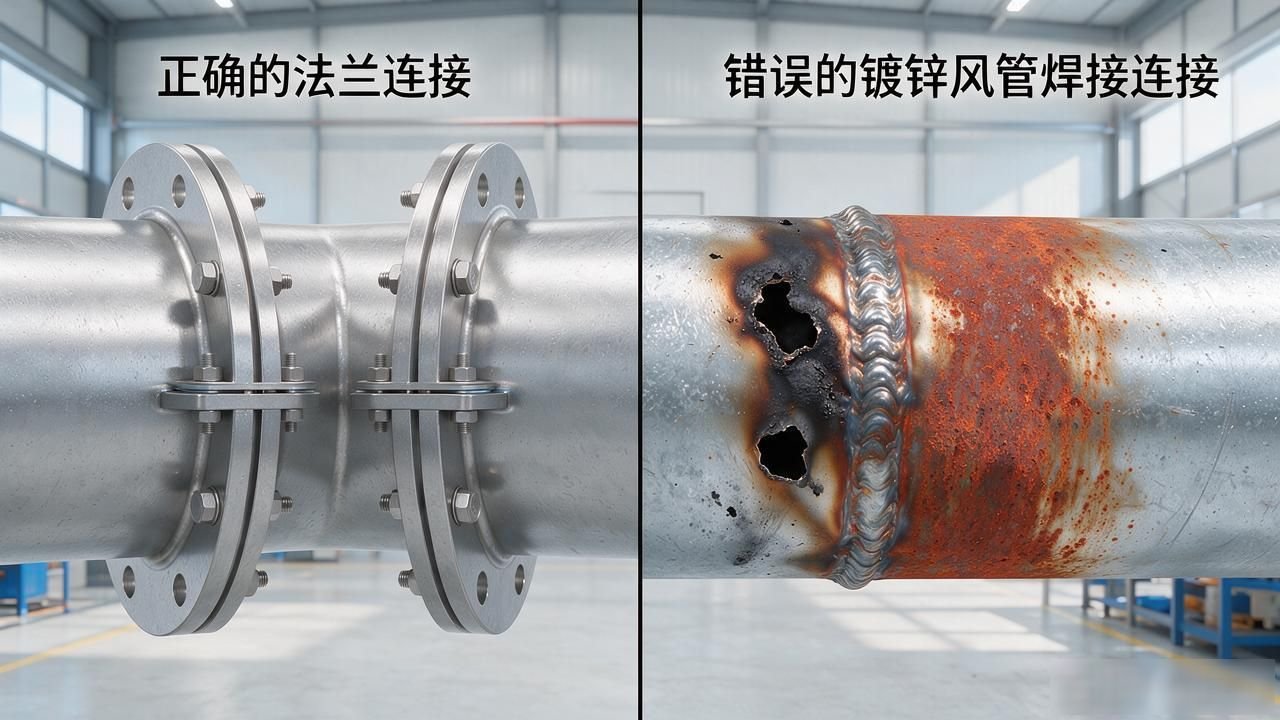
The most common erroneous practice is that some people directly weld galvanized air ducts to save trouble . This practice will cause the zinc layer to be burned and perforated. After only three months, the air ducts will begin to rust.
Another common mistake is that the flange is not flattened, causing the bolt holes to fail to align with the factory dust removal and exhaust system square pipe flange riveting . At this time, workers forcefully pull the installation, causing the flange surface to deform, and the sealing strip cannot be compacted. Air leakage problems will occur after half a year of use.
In 2024, when the dust removal project of a factory in Guangzhou was undergoing acceptance, a random inspection activity was carried out. After inspection, it was found that the gap at the flange joint flange exceeded 1 mm, accounting for about 30% of the total. Because of this, all of this part had to be reworked and remade. If two more millimeters had been measured at that time, tens of thousands of dollars in material costs and man-hours could have been saved.
What to check during acceptance
Welding joints need to be inspected, and the key point is to see whether there are cracks, pores or undercuts; for riveted joints, you must count the number of rivets and measure the spacing between them; as for flanged joints, you must use a torque wrench to review the pretightening force of all bolts one by one.
Before the sealing work of each joint is carried out, photos should be taken and kept as archival data. Never wait until the entire installation work is completed before taking additional photos, because at those points in time, the internal situation will no longer be clear.
After the factory's dust removal system is completed, relevant data must be retained for five years in accordance with national regulations. When there is an air leakage problem in the pipeline and a dispute arises in the future, you only need to dig out the previous photos and torque records. Then it will be clear at a glance which paragraph has the problem and whose responsibility it is, so there is no need to have a long debate.
You are currently working on a dust removal and exhaust project in the factory. For the flange part used in the main pipe, do you plan to use welding or flanging? Please explain the specific reasons for your choice. We can communicate in the comment area here.






暂无评论内容