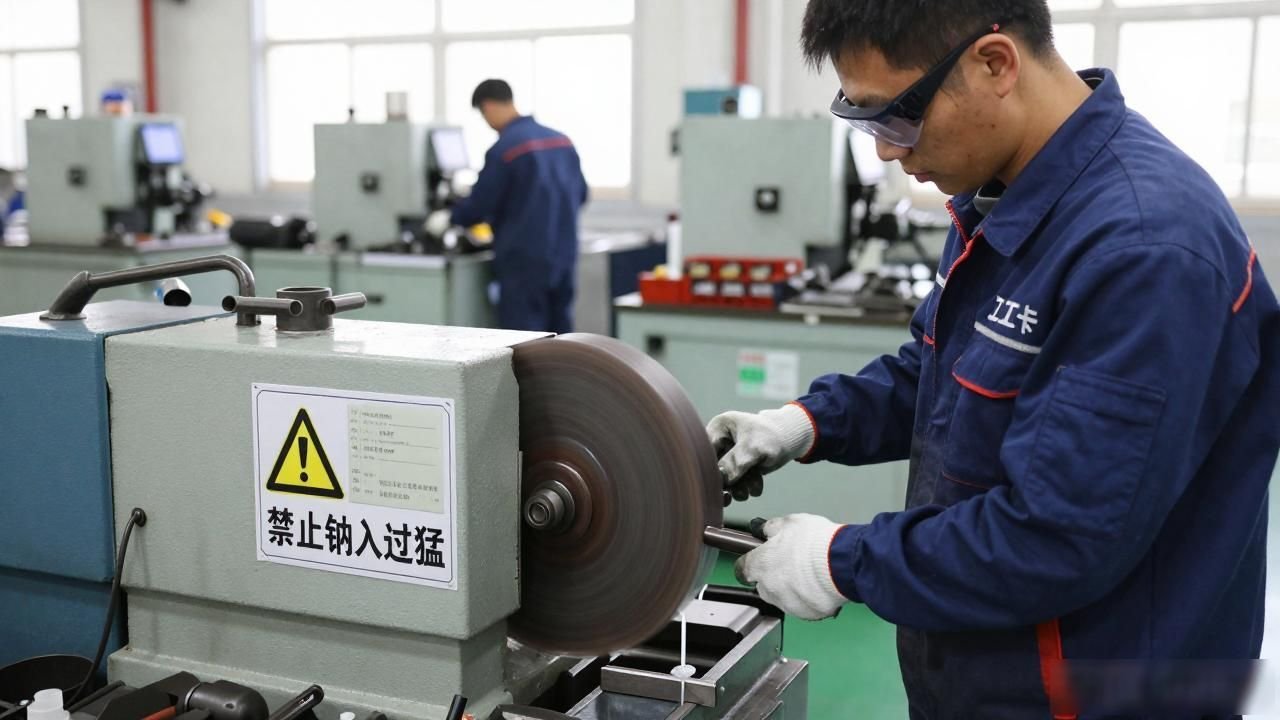


Grinding safety operating procedures
If there is any negligence in the operation of the grinder, the debris generated by the grinding wheel can fly into the human body at a speed of 80 meters per second. During the practical training, the most common problem that students encountered was not that they did not know how to perform grinding operations, but that they omitted several steps of inspection that should be performed before starting the machine.
Dressing is not formalism
When entering the production workshop, the first thing to do is to tie up the cuffs, collar and hem. As for long hair, it must be tucked under the work cap.
A real safety accident occurred in a technical college in 2023. One person was a girl. Her hair was caught in the high-speed rotating grinding wheel. As a result, her scalp was torn. The reason for such serious consequences was simply because she was operating the grinder without wearing a hat.
The teacher has been emphasizing over and over again that tying clothes tightly is not a formality at all. It is actually to prevent clothes from being caught by the rotating working parts, and then strangulation.
The looser and bulkier your clothes are and the more disheveled your hair is, the greater the risk of injury. Whether it is grinding operation, turning process, or milling process, this universal iron law about safety protection must be followed by everyone, and no one can make exceptions for special circumstances.
Check the equipment item by item before starting the machine
It takes two minutes to do a five-step inspection before starting the machine. The first step is to see if there are any cracks in the grinding wheel. The second step is to see if the grinding wheel cover and grinding wheel are tightened. The third step is to see if the motor belt cover is secure. The fourth step is to see if the hydraulic oil is sufficient and there is no oil leakage or blockage. The fifth step is to see if each handle has returned to the non-working position. After confirmation, you can turn on the switch. At the same time, check the indicator light and suction cup appliances.
If any of the test results are unqualified, be sure to repair the problem first, and then perform power-on operations. Do not start working directly with the idea that there will be no problem, because if the oil pipe of the hydraulic system is blocked, the oil pump will be burned out if it is forcibly started, and if there is oil leakage or slippage, it will injure your hands. These two aspects are faults that often occur in practical training workshops.
You can’t skip this step of preheating the suction cup.
When using an electrical suction cup to clamp a workpiece, you must first turn on the filament switch on the rectifier, and then preheat it. After the preheating process has lasted for five minutes, you can then trigger the suction handle on the machine tool. When placing the workpiece, it must be placed in the middle of the suction line. If there is an offset, the suction force will not be sufficient, and the result will be that when the machine is first started, The workpiece will slide and deviate.
In order to save trouble and speed, many newcomers often choose to skip the preheating step and then directly operate the handlebars. As a result, because sufficient negative pressure was not established in the suction cup, the workpiece flew out as soon as the grinding wheel rotated. In fact, waiting for those five minutes is a very low-cost insurance. If you want to save this time later, it may lead to an accident. If this account is not calculated clearly, it is wrong.
Positioning guards are the last line of defense
You must first ensure that the lubricating oil has completely filled the grinding head spindle before you can start the grinder for work. If you perform dry grinding for only a few seconds, the grinding wheel may produce tiny cracks. The stop on the workbench needs to be adjusted to the appropriate position and tightened. The protective plate also needs to be blocked in place. Grinding safety operating procedures require that only after these three steps have been completed, can the power be turned on to start the equipment. It is not acceptable if one of the steps is missing.
Blocks and guards are not decorations used to look good or show off to others at all. If the grinding wheel suddenly breaks while it is running, the speed of the flying fragments can exceed 80 meters per second.
The function of the guard board is to serve as the last line of defense barrier to prevent these dangerous debris from flying forward. During the actual operation training, if someone starts the machine without turning off the guard, the instructor will immediately take measures to stop the behavior. There is no room for bargaining on this point.
Don’t be too aggressive when it comes to taking a knife

The depth of the feed, the rotational speed of the grinding wheel, and the flow of coolant must all be carried out according to the process card. Do not add anything extra by yourself. The material of the grinding wheel is brittle. If it is cut too hard, it will be crushed directly. If the fragments fly out, it will be a safety accident. When loading and unloading workpieces, your hands must be farther away from the rotating surface, and your movements must be steady and free of bumps and vibrations.
Memorize the parking sequence, first retract the tool to let the tool leave the workpiece, then stop the rotation of the grinding wheel, and finally turn off the power. If this order is reversed , the grinding wheel will continue to rotate with the workpiece. If you do it this way, the surface of the workpiece will be scratched in the slightest case, and the grinding wheel will crack in the worst case.
Don’t be sloppy with measuring tools and finishing touches
For precision measuring tools such as micrometers and dial indicators, the operator must only apply very light force when contacting the workpiece to be processed. After use, the tools need to be wiped clean and then returned to the designated box. These tools must not be placed on the working surface of the machine tool casually, because even a slight bump may cause the zero point of the measurement to shift. In this way, the entire batch of parts will become scraps, resulting in the cost of reprocessing. Much more than those few seconds saved.
After a day's work, the main power supply should be turned off. At the same time, the dirt on the surface of the machine tool needs to be wiped clean. Lubricating oil should be added to the guide rail and spindle to prevent rust.
If equipment such as grinders are not maintained for a long time, the bearings and guide rails will be worn and burred in half a year. In this case, the accuracy of the equipment will drop by one level. Once this level of damage is reached, even if it is repaired later, it will be impossible to restore it to the original condition when it left the factory.
Have you ever tried to omit a certain link during practical training and been stopped by the teacher on the spot? If you have such experience, please share it in the comment area. If you find the content helpful, you can press the like button and forward the link to your classmates.







No comments yet