

Austenitic stainless steel
When processing duplex stainless steel, tool breakage will always occur. As for precipitation hardened steel, the knife will start to slip after just a few cuts. Many factories are still using ordinary carbide tools to handle these machining tasks, which is a complete waste of money.
Martensitic-ferritic dual-phase steel has low hardness but good toughness
The representative steel type of martensitic ferritic duplex stainless steel is 0Cr13Ni9Mo. Its corrosion resistance is close to that of martensitic steel, but its hardness is lower than that of pure martensite. Its plasticity and toughness are much higher, and its welding performance is also much better, so it is suitable for working conditions that require both corrosion resistance and weldability.
When machining this type of material, the tool wears slower than when cutting pure martensitic steel, but the cutting force is too high. In fact, when placing an order, I would like to give you a suggestion, which is to use cobalt-containing high-speed steel for processing or use carbide blades with a hardness below HRC 45. Do not choose a tool that is too hard, because if it is too hard, it will easily chip off the blade.
Austenitic-ferritic dual-phase steel has high strength and corrosion resistance
Austenitic ferritic duplex stainless steel is divided into three types of austenitic stainless steel, which are Cr18, Cr21 and Cr25. This kind of steel has high strength, small expansion coefficient, large thermal conductivity, and outstanding resistance to intergranular corrosion and stress corrosion cracking. It has low Ni content and is much cheaper than pure austenitic steel.
After 2019, the usage of this kind of steel in domestic petrochemical pipelines, offshore platforms, and power desulfurization equipment has obviously shown an upward trend. When machining it, special attention must be paid and precautions must be taken to avoid the adverse phenomenon of work hardening. Especially when selecting the cutting speed, it must not be set too high. If you do this, the surface of the material will harden, and then it will be very easy to get stuck when the next cutter is cutting.

Don’t Choose the Wrong Material of Duplex Steel Cutting Tools
Duplex stainless steel has very good plasticity and toughness, but it will suffer from serious work hardening. If you use ordinary carbon steel tools for processing, the tools will easily stick to the material, causing the tool to jam. In actual production, it is recommended to use tool holders made of solid carbide, and also need to be equipped with blades with titanium aluminum nitrogen coating on the surface, and control the turning speed within the range of 80 meters to 120 meters per minute. Keep the feed between 0.1 mm and 0.2 mm per revolution.
Using titanium-coated blades can effectively reduce sticking, and the tool life will be three to five times longer than that of uncoated bare chips. In 2023, a factory that produces valves recommended stainless steel processing tool materials . They changed the blades they used to turn dual-phase steel from TiN to TiAlN. As a result, the cost of single-piece processing was reduced by 40%, saving nearly 800,000 yuan in a year.
How to cut precipitation hardened stainless steel with ultra-high strength
Precipitation hardening stainless steel is based on a matrix of martensite or austenite, with elements such as copper, niobium, and molybdenum added, and then undergoes a heat treatment process such as solid solution treatment and aging treatment. Finally, the nano-level hardening phase is precipitated. Its tensile strength can reach the range of 1,200 MPa to 1,500 MPa, which is much higher than the strength of ordinary stainless steel materials.
When cutting this kind of steel, high-grade cemented carbide materials must be used. Specific examples include the YG8X model, or ultra-fine grain blades containing TaC. At the same time, the cutting speed should be controlled below 50 meters per minute.
In 2024, an aerospace parts processing manufacturer processed aging state test pieces of 17-4PH material. The manufacturer used cubic boron nitride inserts to complete one-time clamping cutting, and the final surface roughness Ra value was 0.8.
Comparison of tool selection of different steel types
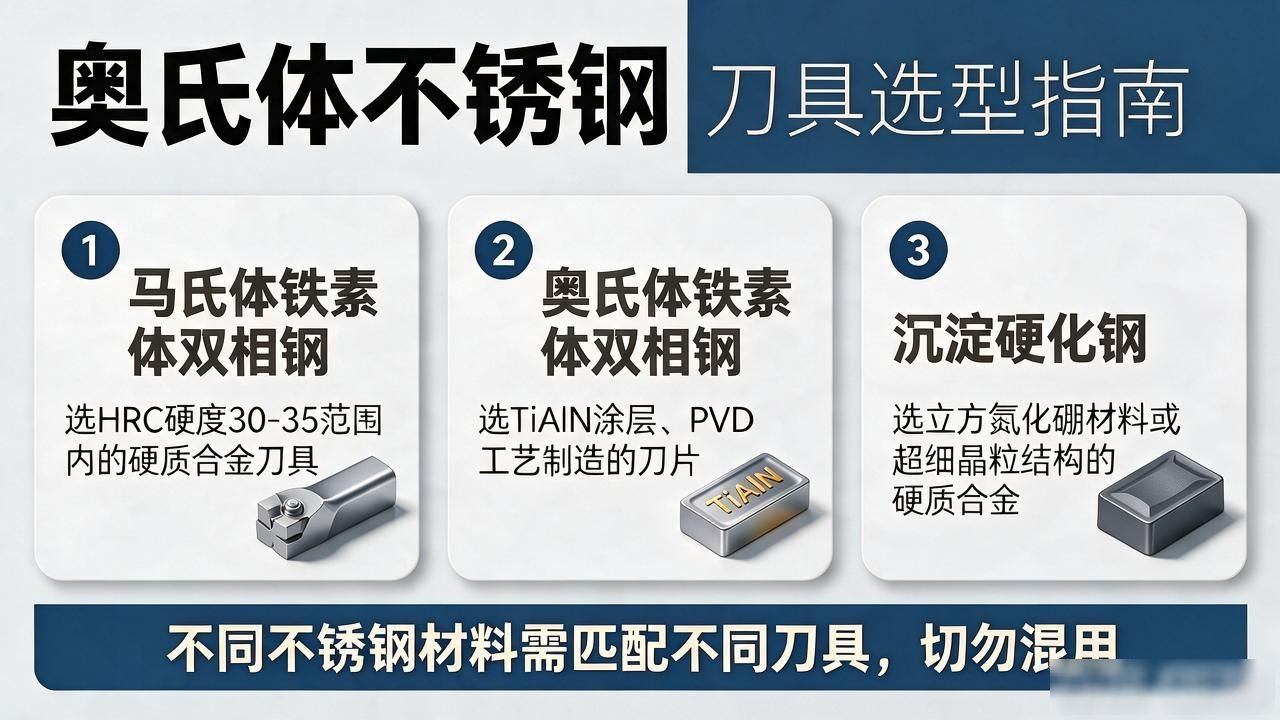
To put it simply: Martensite-ferrite dual-phase steel must choose carbide tools with an HRC hardness in the range of 30 to 35. Austenitic-ferritic dual-phase steel is best used with TiAlN coating and blades made by PVD process. Precipitation hardening steel should choose cubic boron nitride material or cemented carbide with ultra-fine grain structure. Never mix these things together.
When placing an order, the type number of the workpiece, the status of the heat treatment, and the batch size must be sent directly to the tool supplier, and let them recommend the corresponding type number based on the characteristics of the material. If you just guess the correspondence, there is a high probability that you will need to rework and replace the tool. This time cost is actually much higher than the cost of those blades.
Machining parameters are more important than tool material
Even if you use the best tool, if the parameters are not set correctly, it will be in vain. When processing duplex stainless steel, sufficient cooling must be achieved, and dry cutting cannot be used at all.
The concentration of the cutting fluid should be adjusted to between eight and ten percent, and the temperature should be controlled below forty degrees. If this is not done, work hardening will occur, which will make the next cutting operation more difficult.
In 2024, an aviation parts factory made relevant adjustments. The factory reduced the milling speed of duplex steel from 3,000 to 2,020. At the same time, the feed rate is also halved. The result is longer tool life, from four to 11 pieces. Therefore, the cost of a single piece is directly cut in half, that is, it becomes half of the original value. Adjusting parameters is much cheaper than changing tools. The master in the workshop can try this method first.
If your factory is processing duplex stainless steel or precipitation hardened steel, what kind of tool materials are you using now, and how long can the service life of these tools last? Everyone is welcome to communicate and discuss in the comment area, and give a like to share this information with those old friends in your workshop who are still blindly choosing tools.



暂无评论内容