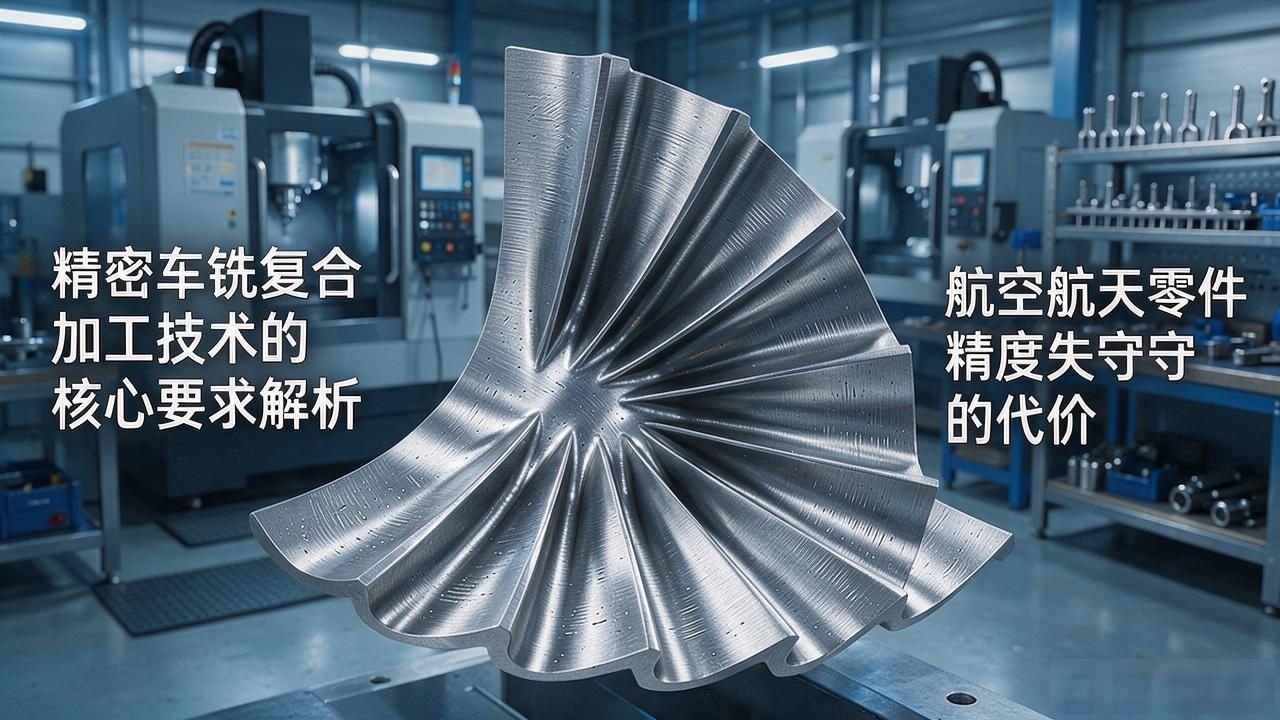


Analysis of the core requirements of precision turning and milling composite processing technology
The cutting parameters of the combined turning and milling machining were not set properly, and the dimensional deviation exceeded the micron level, and the entire batch of parts was directly scrapped. Once the shape accuracy drops, the assembly will not match up, and the entire downstream line will come to a halt. Regarding accuracy, it’s really not enough.
Why dimensional accuracy must be stuck at the micron level
If the diameter or length of the engine blades differs by just a few microns, the aerodynamic efficiency will be reduced. In the aerospace field, tolerances on key dimensions such as part hole diameter and shaft diameter are usually required to be within the range of plus or minus 2 to 5 microns. Once this value is exceeded, the product is deemed to be defective.
When the machine tool called turning and milling in the workshop is performing processing work, if the cutting parameters really deviate a little bit, then the two conditions of thermal deformation and tool wear will be superimposed, so dimensional drift becomes a very common daily situation, so it is definitely not a matter of simply measuring it with a ruler after everything is processed. Instead, you must carefully watch and stare at every step of the tool path during the entire processing process.
Transmission and tool positioning are the key to accuracy
In high-precision transmission scenarios, we use components such as ball screws or racks and pinions, and their positioning accuracy must be strictly limited to a range of plus or minus 2 microns. Once any form of gap occurs in the tool positioning device, the alignment deviation generated during each tool change operation will actually accumulate and be transmitted to the workpiece.
When the spindle is in a hot state, its elongation will directly affect the dimensional accuracy in the Z-axis direction. Therefore, in many factories, they usually rely on the use of compensation parameters to achieve the purpose of correction. However, at the same time, the cutting parameters themselves must also be adjusted accordingly, because once the speed increases, the heat generated will increase, and then the compensation values will have to be recalculated.
Don’t just rely on the human eye for measurement feedback mechanism
Online measurement will use a three-dimensional coordinate probe or laser probe. Every time a feature is processed, data will be collected. Then compare with the drawings. If the size is found to be out of tolerance, an alarm signal will be issued immediately. If we rely on manual inspection, these problems will often not be exposed until the next process.
The feed rate and rotational speed will directly affect the chip thickness and surface roughness. Large parameter fluctuations mean poor dimensional stability. At this time , the cutting parameters of turning and milling composite machining cannot be saved, no matter how accurate the measurement feedback is. Therefore, cutting conditions need to be firmly maintained at the source.
The shape accuracy of curved surface threads is most likely to overturn
During the five-axis simultaneous machining of curved surfaces, once the contour deviation exceeds 5 microns, the assembly gap will be wrong. If there is a problem with the thread profile angle, the cumulative pitch error becomes very large, and the tightening torque cannot meet the design requirements. As a result, the life of the connecting piece will be directly shortened.
When performing combined turning and milling processing to make threads, the two parameters of cutting speed and feed must be strictly matched with the thread pitch. If there is a deviation in the parameters, the thread profile will be deformed. Regarding the performance of technical indicators such as roundness and cylindricity, it is not enough to just rely on adjusting the cutting parameters. You must also pay attention to the rigidity of the machine tool itself and the accuracy of the fixture.

The cost of losing precision in aerospace parts
In 2019, an aviation company encountered a batch of turbine disks. Due to the size deviation of the hole diameter reaching 0.003 mm, the entire batch of goods was eventually returned by the supplier. This situation caused economic losses of more than 10 million. The position of the air film hole on the blade is offset, which reduces the efficiency of the cooling channel, and the cost of recall is much higher than the cost of direct scrapping.
Once such parts flow out of the cutting parameters of turning and milling composite machining, and enter the installation stage, the consequences cannot be completely solved by the act of repair operation alone. As for the cutting parameter file, version management must be performed. Every change must have a corresponding record. At the same time, the responsibility must be assigned to a specific person. It must not be completed by relying on verbal explanations.
How to match cutting parameters with accuracy requirements
The three sets of parameters, speed, feed and depth of cut, must be linked to the accuracy level. When encountering micron-level tolerance requirements, it is necessary to use low depth of cut, high speed, and small feed to work in order to reduce the fluctuation of cutting force. For the two stages of rough machining and finishing machining, the parameters must be set step by step, and the same set of parameters must not be used all the way to the end.
The life of the tool is also a variable. A brand new tool will gradually become dull during use, and its processing dimensions will also slowly drift. By setting the number of forced tool replacements, combined with the results of online measurement data, the cutting parameters can be fine-tuned in advance before the tool is about to be blunted, thereby avoiding passive processing until the quality exceeds the standard range.
When our workshop is doing the turning and milling compound processing, do you set the cutting parameters by looking at the tolerance value on the picture and deriving it backwards, or do you rely on experienced employees to determine it based on their feelings? You are very welcome to discuss it together in the comment area. If you find this content useful, please give it a like and forward it to your colleagues so that they can also take a look.






暂无评论内容