

Pressure vessel riveter production requirements
In the field of manufacturing pressure vessel components and ship hull structures, riveting seems to be a relatively traditional old craft. However, once the accuracy deviates, even if it is only a few tenths of a millimeter, it will directly lead to sealing performance failure and fatigue life cannot be guaranteed.
Therefore, before the actual operation of the riveter, what needs to be closely observed and controlled most are the data indicators listed below. The lack of any value will not work.
You can’t just choose the rivet material
The bottom line drawn in the "Pressure Vessel Safety Technical Supervision Regulations" is that the tensile strength of rivets must not be less than 650MPa, and their yield strength must not be less than 350MPa. If we downgrade a little in the choice of material, once the pressure is added to the inside of the container.
The rivets with this kind of low material will be the first to deform and give way automatically. In this way, the entire rivet seam connected by rivets will be completely scrapped in terms of load-bearing capacity. Even if you want to perform welding repair after this, there is no way to repair it.
During the actual procurement process, the material certificate and tensile test report of each batch must be verified. Both sets of data are indispensable.
If it is discovered that mixing of materials occurs between batches, or the heat treatment temperature does not meet the specified standards, the entire batch of products must be returned directly. Do not have the idea of using it as a makeshift product. After all, once a problem occurs, the price to be paid far exceeds the price of a batch of rivets themselves.
Pay attention to surface cleaning before riveting
The surface of the workpiece that is to be riveted must be cleaned very clean to remove all the scale and oil on it. The scope of this cleaning must not be less than 50 mm on each side. However, in many construction sites, everyone just uses sandpaper to lightly wipe the area around the rivet hole. In this case, a layer of rust and oil film is still attached to the final joint surface. After the riveting action is completed, the rivet head cannot exert enough force. Later, when the pull-out test is performed, the result will definitely not pass the standard.
After the cleaning is completed, you need to take a look with your eyes and touch it with your hands for double inspection. When you touch it with your fingertips, it does not feel astringent and no black marks are seen. This is considered passed.
If there is still some oil stain left, it must be wiped with acetone again. Don't just wipe it with a rag and continue working just because you want to save time. If you save this little thing, if you need to rework in the future, the rework alone will be enough to take three days.
Rivet seam spacing and hole diameter tolerances
The distance between the centers of two adjacent rows of rivet holes must not be less than 3 times the rivet diameter. This is a rigid rule to prevent stress concentration. Once the distance shrinks very small, the rivet seams will crack first under the action of cyclic loads.
The hole diameter tolerance must be strictly controlled within the range of plus or minus 0.1mm. If the hole diameter is too large, the rivet will be shaking inside. If it is too small and the rivet is forcibly driven in, the hole wall will be cracked.
At this stage of blanking and drilling, be sure to use a special drilling die for positioning operations. You must not use an ordinary electric hand drill to blindly and freely align the points.
Whenever a row of holes is drilled, a feeler gauge must be taken out immediately to randomly check the size of the gap. Once a problem is found to exceed the limit of 0.1 mm, it must be expanded and repaired immediately. Do not accumulate this problem and leave it to the process of installing rivets to find out that it cannot penetrate, otherwise all the previous processes will be in vain and meaningless.
The hot riveting temperature is stuck in this range
When performing hot riveting operations, the heating temperature of the rivets needs to be controlled within the range of 1000 to 1100 degrees Celsius. The reason why it is limited to this range is because the plasticity of the material performs best at this time. When hammered into shape in this state, there will be no cracking or breakage.
If the temperature is below 950 degrees, the rivets will become brittle and will crack if struck. And if the temperature is higher than 1150 degrees, the grains will become coarse, so that after the riveting is completed, the strength will drop directly.
Equipped with an infrared thermometer on site, measure each rivet one by one before entering the hammer. Do not guess whether it has reached a red-hot level based on its color. Even if the rivets come from the same furnace, the temperature difference between them may reach fifty or sixty degrees. If you do not use instruments to measure, you are gambling. Once the gamble fails, the entire row of rivets needs to be dismantled and started again.
Cold riveting pressure is based on specifications

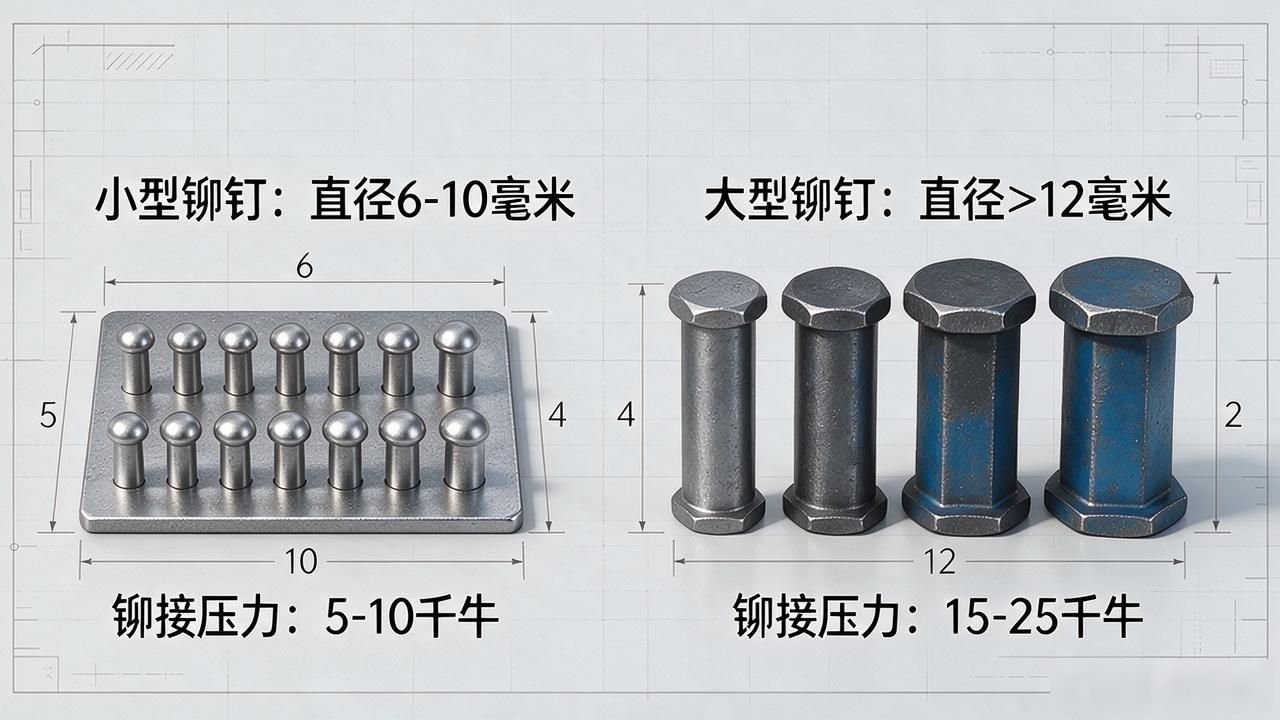
For small rivets, the diameter range is between 6 mm and 10 mm. The riveting pressure selected at this time should be within the range of 5 kN to 10 kN. If it is a large rivet, that is, the diameter exceeds 12 mm, then the pressure value should be considered in the range of 15 kN to 25 kN.
If the applied pressure value is too small, the rivet head may not be fully formed, and the degree of mutual engagement may be too shallow. If the pressure is too great, the workpiece will be dented at specific local locations, and the main part of the original material may even be directly cracked. Therefore, in these two aspects, there can be no mistakes or deviations in either direction.
First adjust the pressure of the riveting machine, then make a test piece, use a micrometer to measure the diameter and height of the rivet head, and compare it with the dimensions on the drawing.
When riveting is officially carried out, the same machine must be used throughout the process and set at the same gear. Do not change gears or machines midway. Because if the pressure fluctuates, the size of the rivet head will not be uniform, and holes will appear during the appearance inspection, which will be seen as a problem.
After riveting, you must knock and count.
The surface of the riveted seam should be smooth and smooth, and there should be no obvious hammer marks or cracks. Use a 0.5kg hammer to tap lightly along the seam. The sound must be crisp. If there is a mute sound, it means there are gaps or micro-cracks inside. It must be disassembled and re-riveted immediately. You cannot try to muddle through and pass the acceptance after repairing it with putty.
For those vessels that withstand high pressure, designers must also calculate the stress amplitude and average stress in detail according to fatigue design specifications. At the same time, it is necessary to carefully check whether the rivet joints have sufficient fatigue margin within the specified service life.
Once it is found through calculation that these parameters do not meet the requirements, improvement measures must be taken immediately, such as increasing the number of rivets or re-changing the structural form of the rivet seam. Do not delay exposing these problems until the day when mandatory inspection is required to save trouble, because the additional cost and trouble caused by rework by then will become very huge, and the cost may increase several times.
When the riveter masters in your workshop are working, they are most likely to cut corners on hole diameter tolerance and riveting seam spacing. So what methods do you use to stick to these two levels on site? If you think this method is useful, you can like it and forward it to the masters in the workshop, and then go to the comment area to discuss with everyone how you operate it.






暂无评论内容