

Operation guide for surface matte treatment of pure titanium and titanium alloys
In the process of matte treatment of titanium alloy surfaces, failure to meet environmental requirements and irregular behavior during actual operations are two common traps that are most likely to lead to failure. If these details are accidentally ignored, the entire batch of workpieces will most likely need to be reworked.
Real goals for matte finish
This process will cover pure titanium materials, and it will also cover various titanium alloy materials. Its core goal is to eliminate the original glossiness of the surface of the substrate. Then, a state appears where the roughness becomes uniform and uniform.
The ultimate goal is to create a textured effect. Partial reflection is absolutely not allowed, and uneven color blocks are not allowed to occur. The surface texture after treatment will be very stable. This stable surface texture is very suitable for direct use in subsequent spraying processes. At the same time, it is also very suitable for direct use in subsequent coloring processes.
What the operator is using is a reagent called an environmentally friendly matte agent. The appearance of this reagent is a transparent and odorless liquid state, or a light yellow liquid state. Its pH value is never lower than 3.5.
This product falls into the slightly acidic category. Its proportion exceeds 1.0. It provides little irritation to the operator. The pressure involved in handling waste liquids is also relatively low. It does not bring any additional trouble to environmental compliance work.
Working fluid preparation and heating
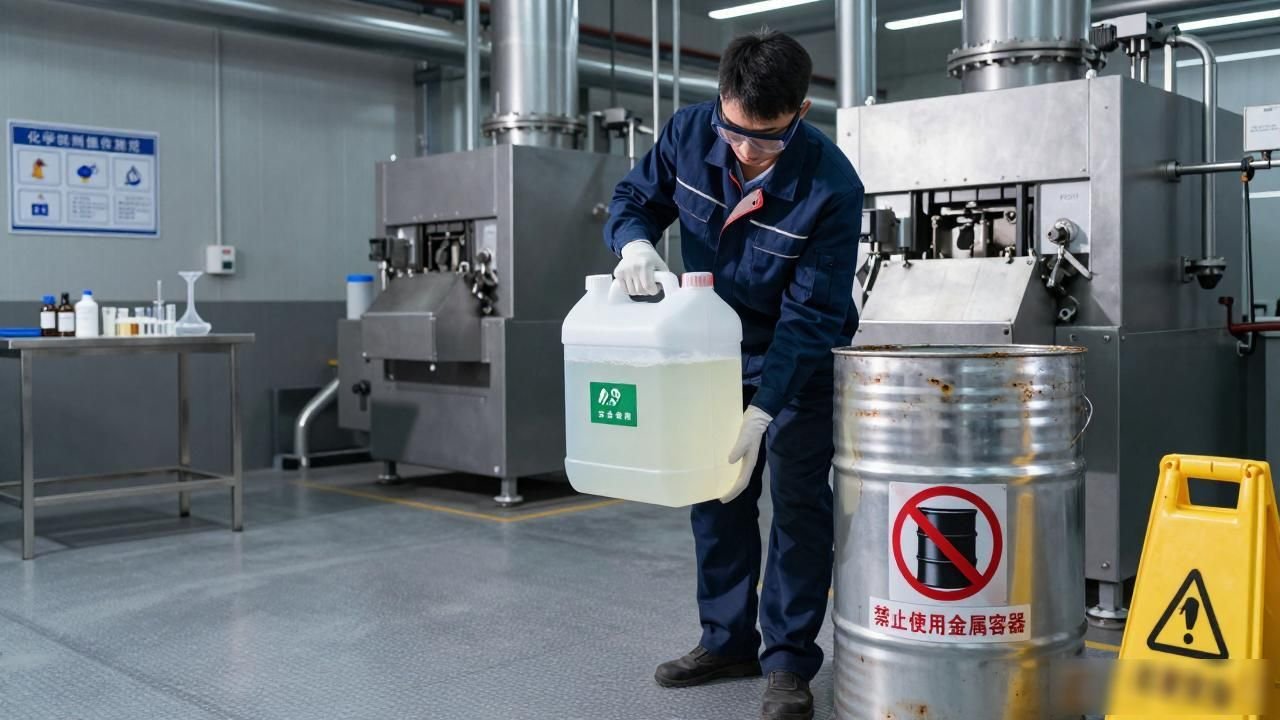
Take Yishun brand Q/YS.418 titanium alloy matte agent, mix it with tap water at a ratio of 1:1, stir evenly to form a working fluid. The container must be a plastic bucket or plastic tank, heat the liquid to 80 to 85 degrees Celsius, and use a thermometer to monitor it in real time. The temperature cannot be too high or too low.

There is a hard rule that must be strictly adhered to here, that is, only plastic containers can be used for the entire process, because once the metal container comes into contact with the reagent, a chemical reaction will occur immediately, which will cause the working fluid to directly fail. There is absolutely no way to continue to use pure titanium and titanium alloy surface matte treatment operation guide, so do not use stainless steel buckets or iron basins instead just for convenience. Even if you want to save money on one or two steps, in the end the entire batch of workpieces will have to be scrapped.
Soaking operation and time control
After the titanium workpiece has been deoiled and rusted, it must be put into the heated working fluid. While soaking, use a plastic tool to continuously stir and turn it to ensure that all surfaces are evenly exposed to the reagent. It is usually soaked for about 5 to 10 minutes. When the specified time is up, take it out, rinse it repeatedly with clean water, and then enter the next step of work.
This step of flipping cannot be omitted. If you don't do this, the reaction degree of the top and bottom of the workpiece will be different. When you take it out, it will be a dark color block and a light color block, and the direct consistency of the finished product may be lost. Time also cannot be held back. If it exceeds 10 minutes, the surface roughening will be excessive and it will be difficult to remedy it in subsequent processes.
Cleaning and subsequent processing
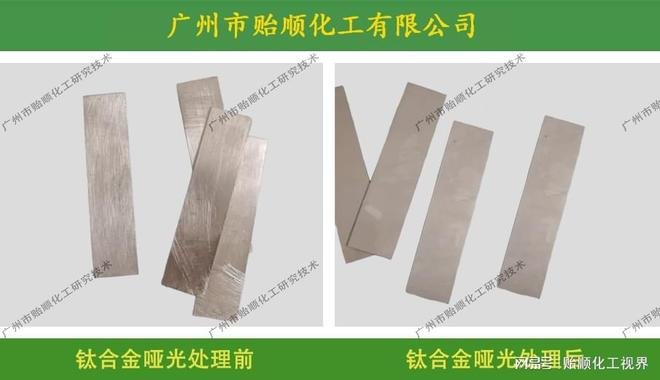
After matte treatment, the surface of titanium alloy will turn gray or black. This is a normal phenomenon caused by the residue left by the reaction.
At this time, use the titanium oil and rust remover numbered Q/YS.928 to perform a whitewashing process. The purpose is to completely remove the gray reaction layer on the surface, and then rinse it with clean water. Then you can choose to bake and dry directly, or passivation treatment first, and then implement the baking and drying step.
The whitewashing step must not be skipped, otherwise the gray-black residue inside will go directly to the subsequent spraying process or oxidation coloring process. In this way, the adhesion will definitely be compromised, and the color of the finished product will be dark and dull. Once rework is needed, the material cost and labor cost will be several times higher than if the whitewashing is done honestly. Everyone knows this account in their hearts.
Safety protection and operating specifications
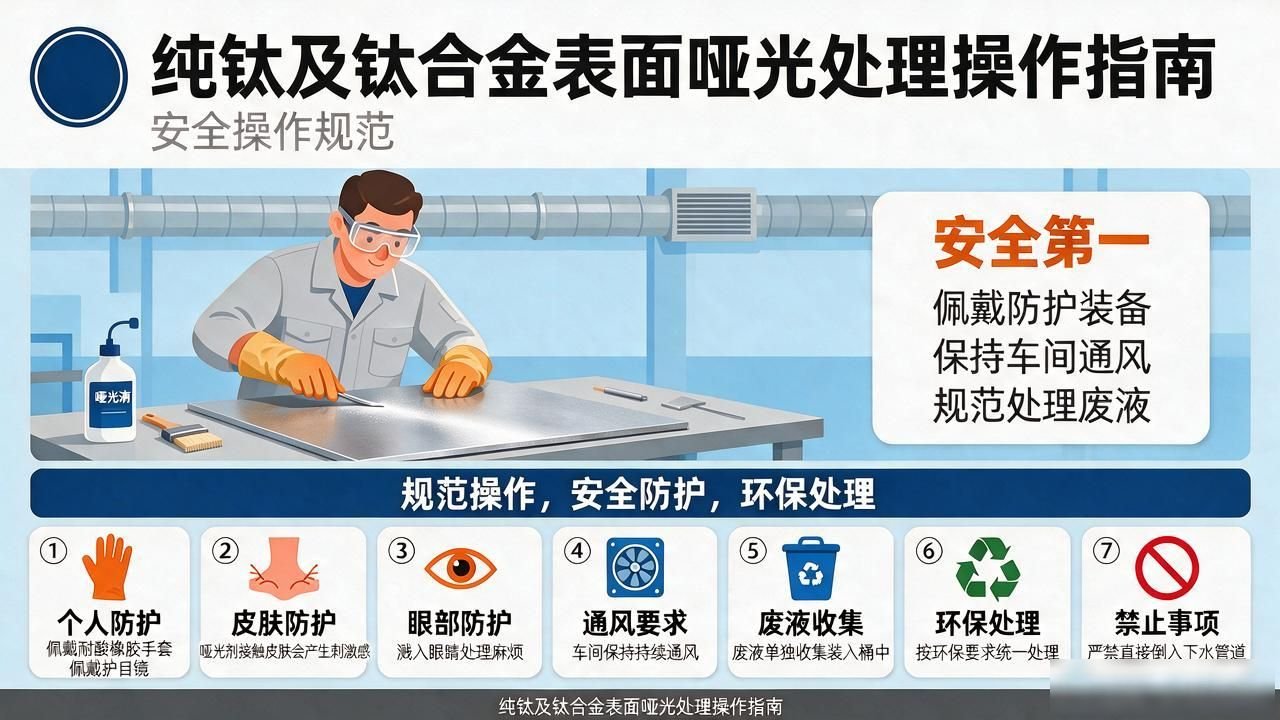
Operators must wear acid-resistant rubber gloves and goggles. If the matte agent touches the skin, it will cause obvious irritation. If the matte agent splashes into the eyes, it will be more troublesome to handle. The workshop must maintain continuous ventilation, and the used waste liquid must be collected separately and put into buckets. It must be uniformly processed according to environmental protection requirements. It must not be poured directly into the sewer pipe.
The working fluid, apart from being said not to be contained in metal containers, cannot come into any meaningful contact with stainless steel utensils or copper tools. You must know that even a slight touch like this may completely destroy the reagent in this tank.
Therefore, from the beginning of heating, to dressing, to soaking and stirring, the whole process of titanium alloy processing is environmentally friendly and safe . From beginning to end, this whole process can only be strictly limited to plastic materials, and there are no exceptions here.
Effect judgment and common deviations
The qualifying standards are very obvious. The surface needs to show a uniform and consistent matte gray-white state . Titanium alloy processing is environmentally friendly and safe . There should be neither bright spots nor local chromatic aberration, and the roughness must be controlled within the target range.
If it is found that the final effect is not uniform, then the focus should be turned back to verify whether the heating temperature is indeed stable within the range of 80 to 85 degrees, and then continue to check whether the soaking time has reached the specified standard.
Because the temperature is low, the reaction is insufficient, so the surface is still shiny; once the temperature exceeds 85 degrees, the roughening will be excessive, making the surface too grainy, making it difficult to connect subsequent processes; the lower limit of the soaking time is 5 minutes, and the upper limit of the soaking time is 10 minutes. In the actual production process, a value of about 8 minutes is the most stable and has the smallest deviation.
When you implement the titanium alloy matte treatment process in the factory, which specific link is the most distressing and troublesome? Everyone is welcome to communicate in the comment area. If you think this content does have certain reference value, you can like it and save it, or forward it to those who also need to know relevant information.




暂无评论内容