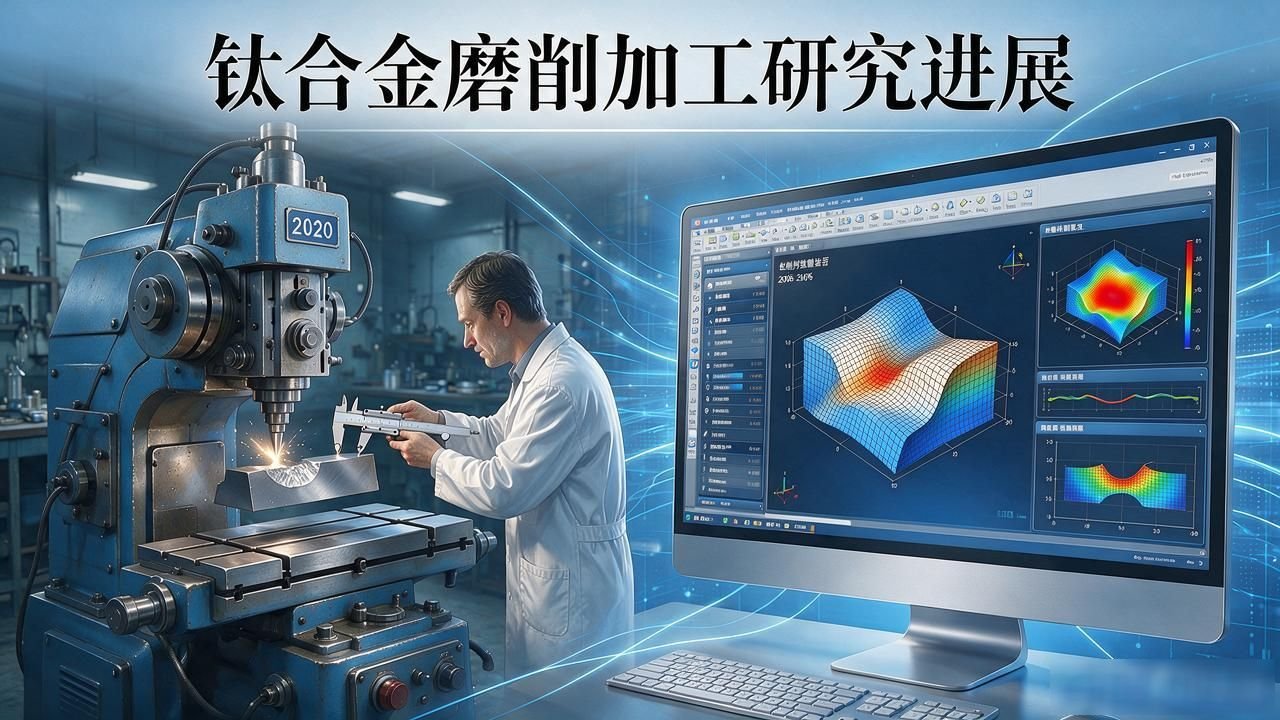


Progress in Research on Titanium Alloy Grinding Processing
Because the thermal conductivity of titanium alloy is only 1/5 of aluminum, it is difficult to dissipate heat during grinding operations, which can easily cause burns on the surface of the product. This situation has become the most common and most troublesome problem that domestic processing companies in the aviation and medical fields encounter during the production process.
How to choose grinding parameters
He Limin and others from Hunan University sorted out the rules of parameter selection in the journal "Precision Manufacturing and Automation" in 2008. What did they find?
It was found that the linear speed, feed rate and cutting depth of the grinding wheel must be adjusted in conjunction. If the rotational speed exceeds fifteen meters per second, a situation will occur. The temperature of the contact area will exceed the 800 degrees Celsius mark, and the metallographic structure of the material will directly change.
When Guo Li and the others were conducting experiments, they found a hotspot in grinding processing , that is, they used water or oilstone to replace the conventional grinding fluid. Because the thermal conductivity of the titanium alloy is not good, the cooling effect is compromised. The abrasive grains on the grinding wheel become dull before they can penetrate into the material. As a result, the surface roughness becomes higher, and the processing efficiency drops significantly.
Grinding burns are difficult to control
The problem of grinding burn has always been a very difficult problem in titanium alloy processing. When the temperature exceeds 650 degrees, a blue oxide layer will form on the surface of the workpiece, and the toughness of the material will drop sharply. The 2008 research article pointed out that most domestic production workshops lack online temperature measurement methods, and whether they are burned or not can only be judged by the worker's hand feel, so the rework rate remains high.
Later, researchers proposed using micro-grinding to replace ordinary grinding and reduce the cutting depth to less than 5 microns. Because the contact area between the grinding wheel and the workpiece became smaller, the heat concentration was alleviated and the risk of burns was significantly reduced, but the efficiency also dropped. Therefore, the mass production workshop is not very satisfied with this, and they do not buy this plan.
Grinding wheel adhesion problem is prominent
Due to the relatively strong chemical activity of titanium alloys, when the temperature increases during grinding, the titanium in the chips will run to the surface of the grinding wheel abrasive grains, thus forming an adhesion layer.
He Limin confirmed this through observation and analysis using a scanning electron microscope. What he saw showed that the thickness of this adhesion layer can exceed 20 microns, causing the clogging of the grinding wheel to become more and more serious, and the grinding force also continues to increase, so dressing operations must be performed very frequently.
Regarding how to deal with the adhesion problem, foreign countries have previously tried to add diamond or cubic boron nitride abrasive grains inside the grinding wheel. Because their hardness is very high, they are not easily attached or consumed by things like titanium. However, this type of grinding wheel is very expensive to purchase and difficult to dress.
In China, around 2008, grinding wheels made of corundum were still used as a rigid solution. In this case, there is a certain gap both from a cost perspective and from a technical strength perspective.
Breakthrough in efficient grinding technology
Ordinary grinding methods are relatively inefficient when processing titanium alloys. Take aviation blades as an example. Perform one grinding process on an aviation blade. It often takes dozens of minutes. Around 2008.
A concept called ultra-efficient grinding has emerged. This method increases the linear speed of the grinding wheel to more than 60 meters per second. At the same time, micro-cutting is used to operate. The material removal rate more than doubled.
However, the process of efficient grinding places extremely high requirements on the rigidity of the machine tool, and also imposes very strict standards on the quality of the grinding wheel. Looking at the time point in 2008, there were less than ten grinding machines in China that could stably operate at a speed of 60 meters per second.
These equipment are mainly deployed at the National University of Defense Technology and several research institutions in the aviation field. For ordinary small and medium-sized processing enterprises, it is basically difficult to use this equipment.
Finite element simulation becomes a trend

In the early stages of grinding, if you still have to rely on trial cutting for confirmation, the speed is too slow. Therefore, in the progress of research on titanium alloy grinding processing around 2008, finite element simulation technology suddenly became the focus of everyone's research.
A person named He Limin wrote an article and mentioned that if you use the software ANSYS to build a two-dimensional thermal analysis model, you can predict the approximate maximum temperature of the workpiece surface under different feed rates.
Moreover, he said that by comparing the predicted results with the actual measured data, the error between the two can be controlled within 15%. The advantage of this is that it can save a lot of time required for trial cutting.
However, the simulation in 2008 basically stopped at the two-dimensional steady state stage where there was little movement. If you want to achieve three-dimensional transient state, the integrated model that wants to put the wear of the grinding wheel and the plastic deformation of the chip together will have to wait for several more years to mature. At that time, the model mainly relied on data from the laboratory, so its versatility was relatively limited.
What aspects are still lacking in China?
He Limin put it quite clearly at the end. The domestic shortcomings mainly lie in three places. One is that the number of high-end grinding machines is very small and the research hotspot of grinding processing . The other is that the research and development of special grinding wheels is relatively backward. The other is that online monitoring is not popularized. According to statistics in 2008, there are a total of 22 production lines in the country that can perform five-axis simultaneous grinding of titanium alloys.
As time has entered the 2020s, domestic five-axis grinders have begun to improve, and at the same time, the construction of intelligent cooling systems has also begun to make progress. However, the special grinding wheels required for grinding titanium alloys are still largely imported from abroad. The window of opportunity for domestic substitution is gradually opening. The most critical part of whether this situation can be successfully achieved in the end is that the relevant material companies are unwilling to invest in long-term verification work.
When grinding titanium alloys, do you currently use imported grinding wheels or domestic grinding wheels in your workshop? Welcome to discuss in the comment area. If you think the content is of practical value to you, please like and share the content with friends in the same industry.





暂无评论内容