

How are temporary teeth fixed?
If the temporary fixing step is not done well, all the previous efforts will be in vain when rework and repair are performed later. If you look at the riveting and welding work and the dental restoration surgery process to understand it, they actually have similar thoughts and ideas about making a temporary fixation. The core of this meaning is only one word, which is stable.
What problems should be solved during the transition period?
Before the formal restoration is made, the area where the missing tooth is located remains empty. According to follow-up data conducted by Beijing Dental Hospital in 2024, the transition period will take an average of six to ten weeks. If the temporary teeth are not worn during this period, the gums will recede, and the adjacent teeth will slowly tilt. Eventually, the gap left will no longer fit when formal restoration is required.
In addition to maintaining the gap, temporary teeth are also responsible for solving aesthetic problems. When two teeth are missing in the front tooth area, if the gap is exposed when smiling in social situations, the psychological burden will be great. Temporary teeth cover this problem during the transition period, allowing patients to socialize normally without feeling anxious.
Temporary adhesives in action
When making a temporary crown or a temporary fixed bridge, the doctor will use temporary cement to place the restoration on the surface of the abutment tooth. Shanghai Ninth Hospital Restorative Department usually uses polycarboxylate adhesive. This material is quick to operate and reversible. It will not cause any damage to the enamel of the abutment teeth when performing disassembly, so it is very suitable for use in a short transition period.
Before the bonding operation is carried out, the abutment teeth must be precisely ground to ensure that their seating channels are properly set, and then the bonding agent is evenly applied to the inner surface of the temporary teeth. After the temporary teeth are completely in place, bite paper needs to be used immediately to comprehensively check whether there is early contact. This entire operation process usually only takes ten minutes to complete smoothly, and the patient can resume normal eating functions on the same day, thus ensuring that the rhythm of daily life will not be affected in the slightest.

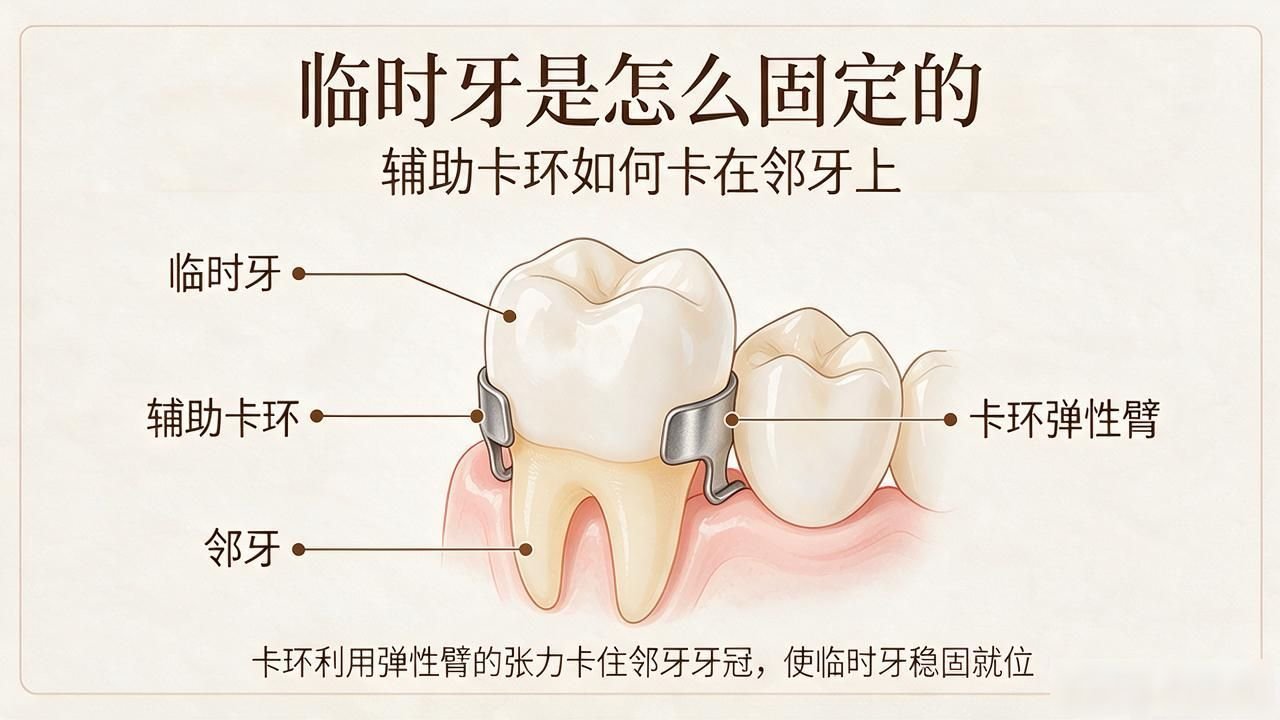
How does the auxiliary clasp get stuck on adjacent teeth?
Regarding how to temporarily fix the removable temporary denture during the riveting and welding assembly process , we need to add metal clasps on both sides to allow the clasp arms to hook the proximal or buccal surfaces of adjacent teeth. According to the 2025 return visit statistics of Hangzhou Stomatological Hospital, the shedding rate of this type of design is about 40% lower than that of pure bonding. This design is suitable for patients who need to take it off and wear it occasionally.
The elasticity of the clasp must be at just the right level. If it is too tight, it will damage the teeth. If it is too loose, it will not be able to provide fixed strength. The doctor will adjust the curvature and wrapping angle of the clasp according to the shape of the crown of the adjacent teeth and the specific size of the gap to ensure that the patient will not tilt or dislocate when biting.
Principles and applicable scenarios of wing plate fixation
The wing plate is a thin plate extending from both sides of the temporary tooth base and bonded to the lingual side of the adjacent teeth. A study conducted by the Tianjin Medical University Stomatological Hospital on a single missing tooth in the posterior tooth area shows that the fixation effect of the wing plate combined with the clasp is significantly more stable than that of bonding alone, which is especially suitable for situations where the posterior teeth are under heavy stress.
The wing plate is a device that is more suitable for patients with a relatively large lingual gap, because it can help share some of the force coming from the side when everyone is performing bite activities.
However, for those who have a tongue tie that is too short, they need to consider very carefully whether to use it. If used carelessly, it can easily trigger the nausea reflex feeling, and once worn, it may cause retching. In this way, the patient's cooperation during the wearing process will be greatly reduced. How to temporarily fix it during the riveting and welding assembly process is an issue worth noting.
How to choose the fixing method?
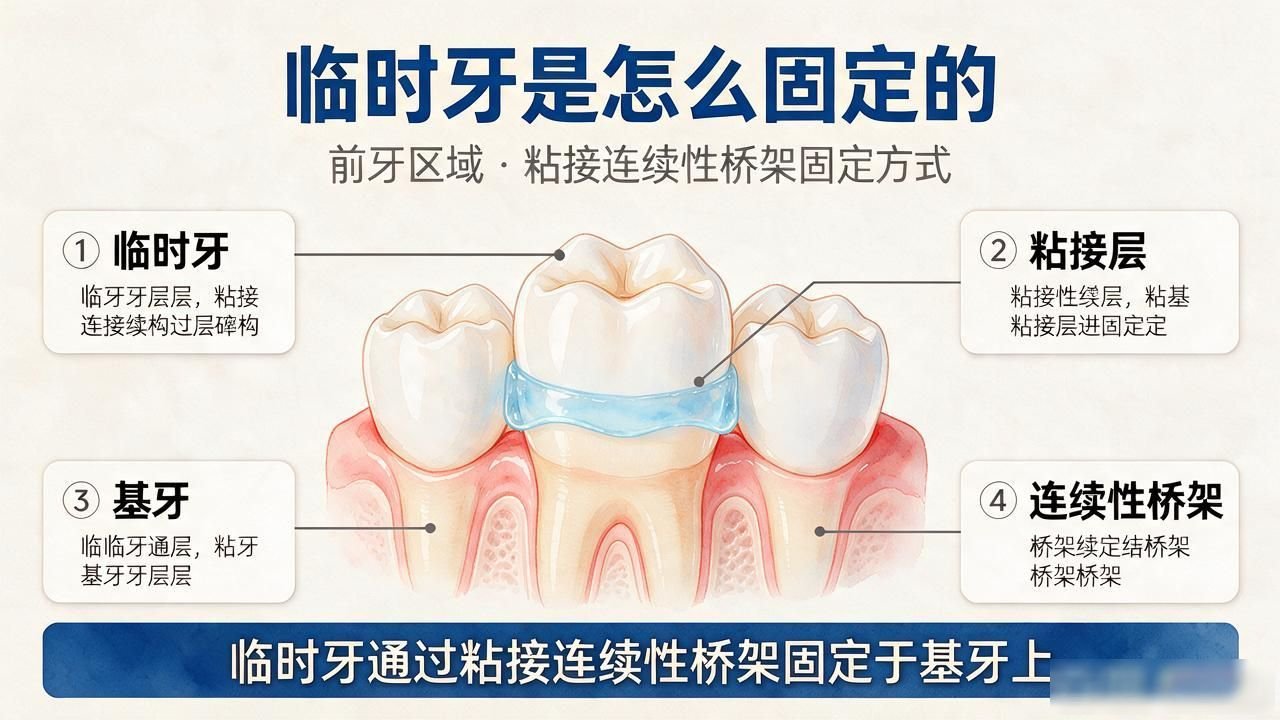
The core considerations of which specific fixation method to choose and how to fix the temporary teeth mainly depend on the specific location of the missing tooth, the current condition of the supporting abutment teeth, and the expected length of use. If you are facing a situation in the front teeth area, the treatment method of bonding a continuous bridge is generally preferred.
For cases with long missing teeth in the posterior region, designing restorations with clasps and wing plates is usually a priority. The professional advice given by Chengdu West China Stomatological Hospital mentioned that for those specific cases that require a transitional period of more than eight weeks, how to temporarily fix the riveting and welding assembly process requires a review in the mid-term stage, and corresponding adjustments must be made in a timely manner to achieve the best results.
The abutment tooth itself is loose or suffers from periodontal disease. In this case, the bonding operation must not be performed reluctantly. Periodontal inflammation must be controlled first, and then the subsequent treatment plan can be decided. Otherwise, there will be problems with the temporary teeth and the abutment teeth. In this case, the cost of rework will directly double the original value.
Don't get carried away by these details.
According to statistics from the journal "Prosthodontics" in 2025, the top three complications related to temporary teeth are bonding loss, abutment caries, and occlusal trauma. The root cause is mostly that the fixation method was not chosen correctly, or the patient did not return to the clinic on time or ate randomly and knocked out the temporary tooth.
All the work of making temporary teeth, as well as fixing the temporary teeth, must be completed under the guidance of a professional doctor.
If you stick it casually or get stuck for a while, in a light case it will fall off repeatedly and require rework. In a serious case, it will also affect the accuracy of the formal restoration and the length of its use. Then all the money spent in the early stage will be wasted.
Have you or your family ever had a temporary tooth repair like this? Did it fall off several times after it was fixed? Please talk about your personal experience in the comment area. If you think this content is useful, please like and share it so that more people can avoid stepping on this pitfall.







暂无评论内容