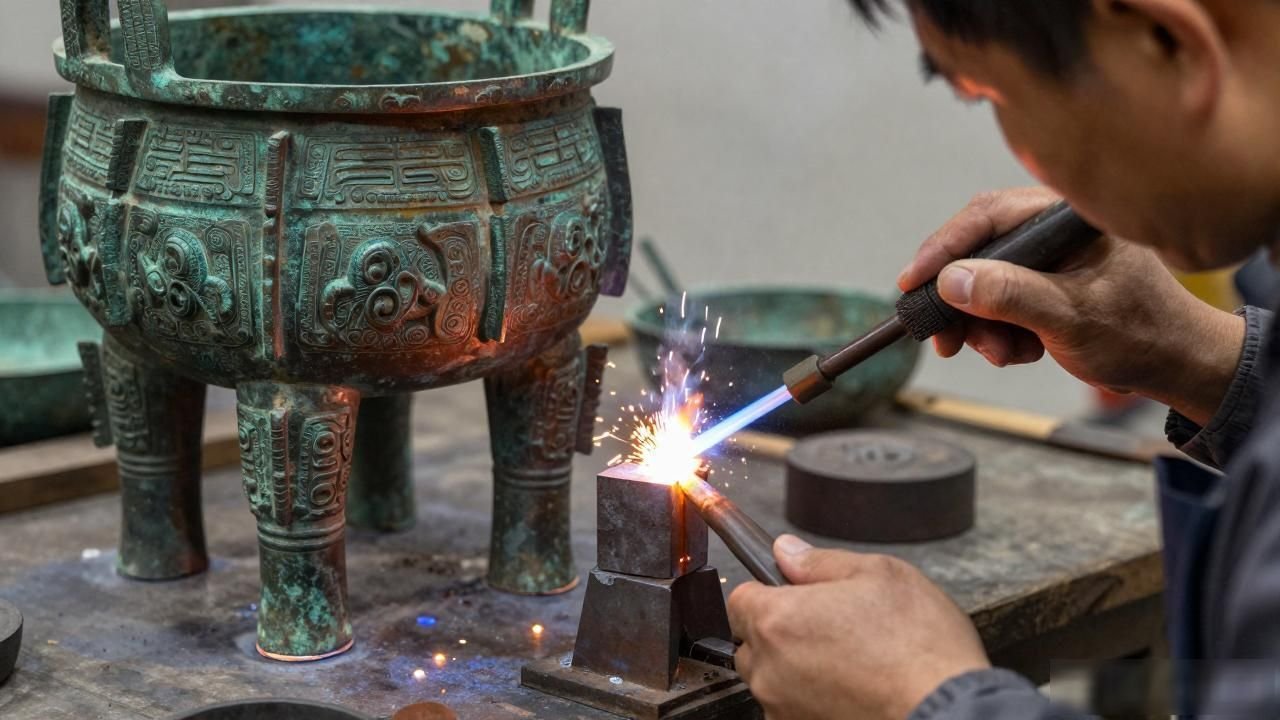


Ancient bronze welding methods
The bronze was broken into two pieces. In the ancient times, they did not have the technical means of electric welding at all, but they were able to join the artifact . Modern riveting and welding technology was used in the restoration of ancient metal cultural relics , and the final strength was even stronger than when the new casting was completed. This situation still makes many people engaged in the restoration of cultural relics feel very entangled and confused in the current period.
What did the ancients use to weld bronze?
At the end of the Shang Dynasty, very early on, traces of welding repairs were seen on the bronzes unearthed from the Erlitou site in Yanshi, Luoyang. At that time, there was no such modern welding equipment at all. The craftsmen at that time mainly relied on using copper powder, tin foil and charcoal fire to join the cracked and damaged bodies back together piece by piece.
In 1953, small bronze pieces with traces of welding repairs were also unearthed from the Shuanghuaishu site in Zhengzhou. Through these things, we can clearly see the application of modern riveting and welding technology in the repair of ancient metal cultural relics . At least 4,500 years ago, metal craftsmen living in the Central Plains region had already mastered the craft of filling cracks with fused metal.
Basic operation process of brazing
To be honest, there is nothing complicated about the core process of brazing. The craftsmen must first polish both sides of the cracked hole to a smooth surface, then sprinkle a fine layer of copper powder into the gap, and then use charcoal fire to heat it repeatedly until the temperature reaches seven or eight hundred degrees. After the copper powder has turned into liquid and penetrated into the texture of the metal, After it cools down, the two separated sides will bite together tightly.

The whole process is actually a very strict test of people's patience. If the temperature deviation of the fire is even only a few dozen degrees, the state of the copper powder will become very unsatisfactory. It will either be completely unable to melt, or there will be serious consequences of burning through the wall of the container. Take a copper tripod from the Shang Dynasty collected by the Henan Museum for example. There are three traces of copper welding repairs on its bottom, and the width of these welds is not more than two millimeters. This shows that the performance of the operators at that time in terms of operating accuracy was already at a very high level.
The difference between soldering and brazing
The melting point of soldering is only over 200 degrees, which is much lower than that of brazing. The craftsman pastes the thin tin foil directly on the cracked area, and then uses charcoal fire to dry it slowly. After the tin melts, the two sides are glued. This method is very suitable for repairing small cracks, but if it is in a place that is subject to very large stress, then brazing must still be used.
On the Western Zhou bronze pot discovered in Baoji, Shaanxi, we can detect traces of soldering and brazing coexisting. For those small cracks, craftsmen will use tin to weld; for larger cracks, they will use copper to weld. The craftsman will select the appropriate solder according to the specific location of the object that bears the force. This processing idea seems to be very similar to the logic of material selection in modern riveting technology.
Examples of welding on Shang and Zhou bronzes
In 1976, a bronze cup from the Shang Dynasty was unearthed in Lintong, Shaanxi Province. There was an eight-centimeter-long crack on the cup body. The craftsmen used brazing to repair five sections from the inside of the vessel. The spacing between each section was about one centimeter. The welds showed a fish scale-like overlapping state. So far, no cracks have occurred.
The bronze mirror from the Warring States Period unearthed in Xiangtan, Hunan, has traces of riveting and welding on the back. Because the mirror had cracked into three petals. So the craftsmen used copper rivets through the back of the mirror to fix it. And then use tin to weld and seal the nail holes. This method of combining riveting and welding . The application of modern riveting and welding technology in the restoration of ancient metal cultural relics is almost the same as the riveting and welding process in modern metal structures.
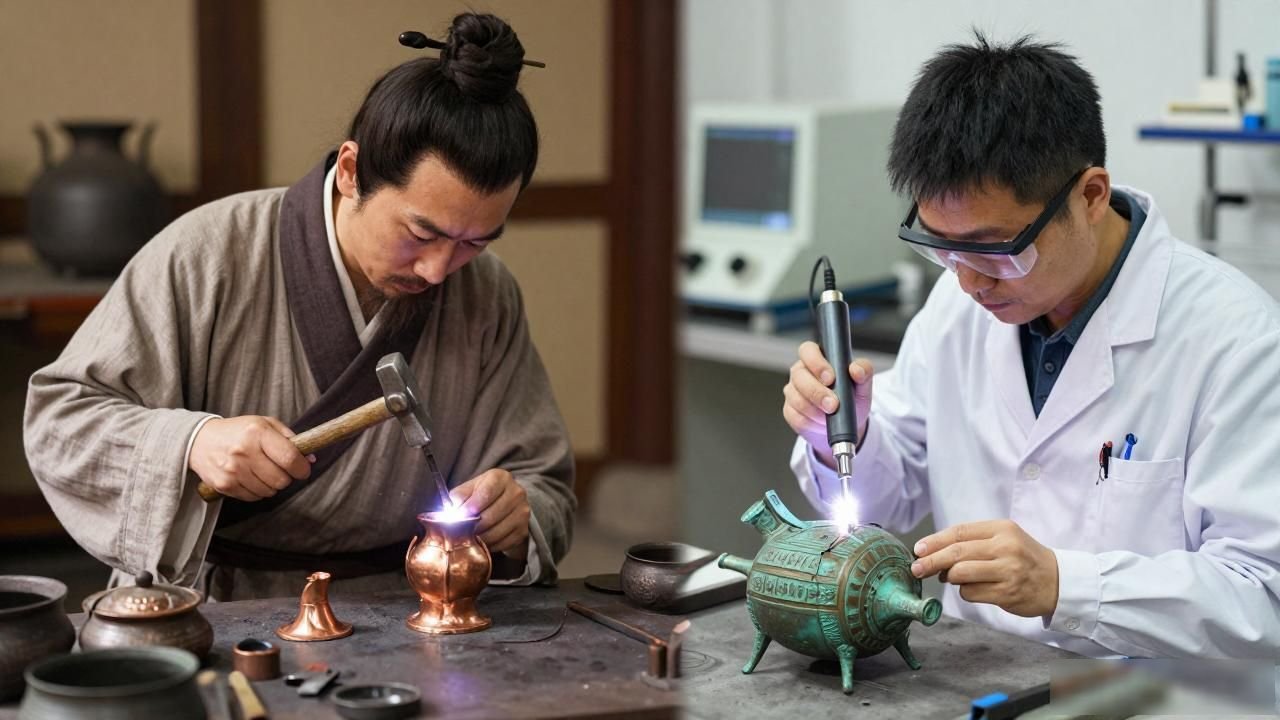
Ancient welding inspires modern restoration
In 2019, during the process of repairing a Shang Dynasty bronze gui at the National Museum, the crack at the bottom could not be directly treated using modern brazing technology. Finally, the staff referred to the ideas of brazing in the Shang and Zhou dynasties and used high-purity copper powder for low-temperature infiltration to fill the cracks. The entire operation process does not damage the original watch at all, and the final effect is much more natural than electric welding.
Ancient craftsmen used copper rivets and soldered them for sealing, which was more flexible in terms of fatigue resistance than the single pure welding method. When today's large bronzes are being transported and installed in display cabinets, they will also learn from the ancient bronze welding method, which is a solution of riveting and a little spot welding, in order to reduce the adverse damage and destruction caused by thermal stress to the displayed body.
Current status of riveting and welding technology in cultural relic restoration
At present, the total number of legally qualified metal cultural relic restorers nationwide is less than 2,000. Among them, the number of people who are truly proficient in the riveting and welding composite process is estimated to be no more than 300. Many young restorers are no longer able to inherit and continue the brazing feel accumulated through the traditional master-apprentice inheritance method, so the fault phenomenon in the talent team is very prominent.
Museums across the country send dozens of bronzes for repair every year, and many of them still use the old-fashioned soldering method of the 1970s. Because the ratio of solder used does not match the composition of the ancient artifacts, blistering and delamination will occur within a few years of being left. If we want to combine ancient riveting and welding experience with modern detection methods, there is still a long way to go.
Have you ever seen those antique bronzes around you that were damaged by soldering? Everyone is welcome to chat in the comment area. If you think this thing is useful, give yourself a thumbs up and forward this news to your peers.







暂无评论内容