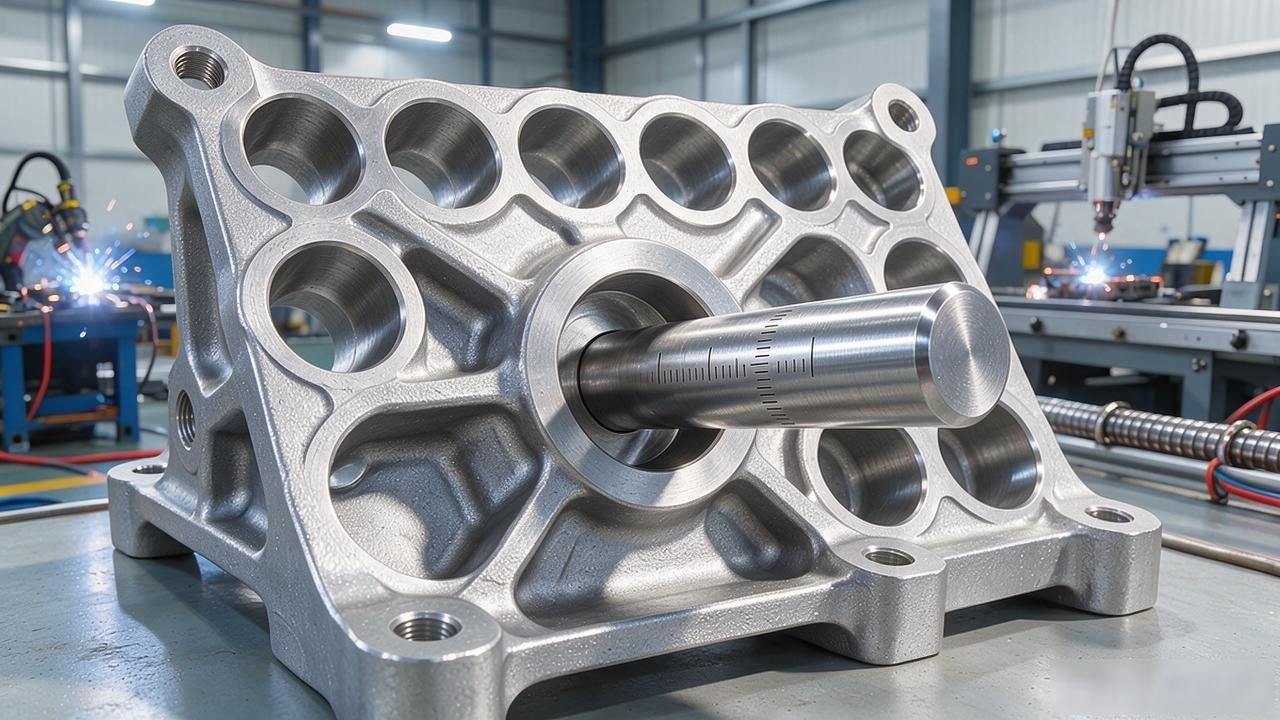


Yibin Changying Precision obtained the patent for the riveting fixture. Yibin Changying Precision obtained the patent for the riveting fixture, which improves the position accuracy of the workpiece and improves the position accuracy of the workpiece.
In the riveting job, the most worrying thing is that the workpiece secretly moves behind the back. If you wait until deformation has occurred before you discover it, it will be too late. An electrical company in Yibin, Sichuan has just authorized a patent. This patented method is to install the position sensor directly into the fixture, so that those tiny deformations can no longer be hidden and become invisible.
Pneumatic clamping replaces manual pressing
On the base of this set of clamps, multiple sets of clamping units are arranged. At the position of each unit, pneumatic pressing parts are used to press the workpiece tightly. And below that, there are support limiters to support the bottom surface. After turning on the air source, the clamping force is even. This does not depend on the worker's touch. So during mass production, the beat is stable.
The company completed the registration procedures in Yibin in 2021. Its main business scope covers the manufacturing of electrical machinery and equipment production activities, and its registered capital is RMB 100 million.
The riveting fixture product is actually one of the 67 patent reserve resources owned by the company. From this situation, it can be seen that the company has been making continuous financial and technological investment in the structural direction of process equipment.
Dowel pin locks horizontal freedom
The reserved positioning hole on the workpiece has been set. After the pin of the positioning unit is inserted into the hole, it will be mechanically locked in both horizontal directions. When performing riveting operations, the rivets are driven from above to below, and the workpiece will not move left and right. Its positional accuracy is a level higher than that of simply relying on clamps for clamping.

This design is really very friendly to porous plates. If you look at the aerospace structural parts and the car body-in-white that is riveted after welding, as long as the position of a hole is off by a few tenths of a millimeter, the subsequent assembly process will definitely be stuck. However, through the combination of pins and shafts, the radial tolerance is suppressed within the micron range.
Multi-point sensors monitor deformation in real time
The deformation monitoring unit is the biggest highlight of the entire solution. Multiple position sensors are attached to key points on the surface of the workpiece. These sensors are electrically connected to the processor and continue to collect distance data throughout the riveting process. As long as there is a slight deformation of the workpiece, the distance between these points will change immediately.
A specific numerical limit is set inside the processor. Once a change in distance is detected that exceeds the limit, the warning device will trigger an alarm signal. The operator no longer needs to repeatedly use calipers for measurement. As long as he pays attention to the display content on the screen, he can clearly understand the position and status of the workpiece, making the response speed reach a higher order of magnitude.
The industrial chassis behind the Yibin workshop
According to the data and information provided by Tianyancha, this company has participated in a total of 23 bidding activities. In terms of administrative licensing, it holds 50 relevant license certificates. In addition, it also made an external investment in a company.
From the perspective of regional promotion, the company's business is not limited to Yibin, but radiates to external regions. This phenomenon shows that its products have been implemented in many different industrial scenarios. This means that the company's technical solutions are not purely theoretical solutions in the laboratory, but have the basis for practical engineering applications.
This company has a registered capital of 100 million and also holds 67 patents. It is a relatively large entity in the electrical machinery manufacturing circle in southern Sichuan. In the surrounding areas of Yibin, there are industrial clusters such as Chengdu Aircraft Manufacturing Co., Ltd. and power battery, which make the demand density for riveting and precision assembly very high. Because of this, the company objectively possesses innate geographical advantages.
Solutions to the pain points of traditional riveting
In the past, riveting operations relied on manual visual inspection. Deformation of the workpiece was often not exposed until it entered the next process, which resulted in a high scrap rate and high rework costs. This set of fixtures embeds monitoring functions into the process. As long as deformation occurs, an alarm will be issued immediately. The operator can immediately adjust parameters or stop the production line, thereby intercepting quality problems at the moment of riveting.
The patent application date is December 2025, the authorization announcement has been released recently, and the review cycle will not be particularly long overall. This situation means an important time point for the production line, that is, procurement and deployment can be carried out as soon as possible without having to face the long and anxious waiting process for approval.
What’s the next step for micro-deformation tooling?
The current solution mainly uses position sensors for quasi-static monitoring. If temperature compensation and high-speed sampling are superimposed, it should be able to cover more complex working conditions such as hot riveting and high-speed riveting. After the data is reconnected to the MES system, the deformation curve of each rivet can be fully traceable.
This company is based in Yibin, which is in the south of Sichuan, where the manufacturing cluster is very dense. If this company can continue to iterate, move forward in the direction of smart tooling, and expand a single fixture product to a complete set of online inspection solutions, then its market space will once again be promoted to a higher level.
Are you still using measuring tools to manually measure product deformation at the riveting workstation in your factory? If you think this operation idea can continue to be implemented and deserves recognition, please click the like button to support it, and forward this information to your colleagues, friends, or other people in the industry to take a look.



No comments yet