

What is the difference between I-beam and H-beam? Come and find out!
From the appearance, you may think that I-beams and H-beams are made of the same material, but the production methods are actually different. Their cross-sectional structures are also completely different, and the riveting and welding butt jointing process is completely different. If you confuse the two, the lighter one will waste materials, and the heavier one will cause the construction schedule to be completely disrupted.
The cross-sectional shape can be separated at a glance
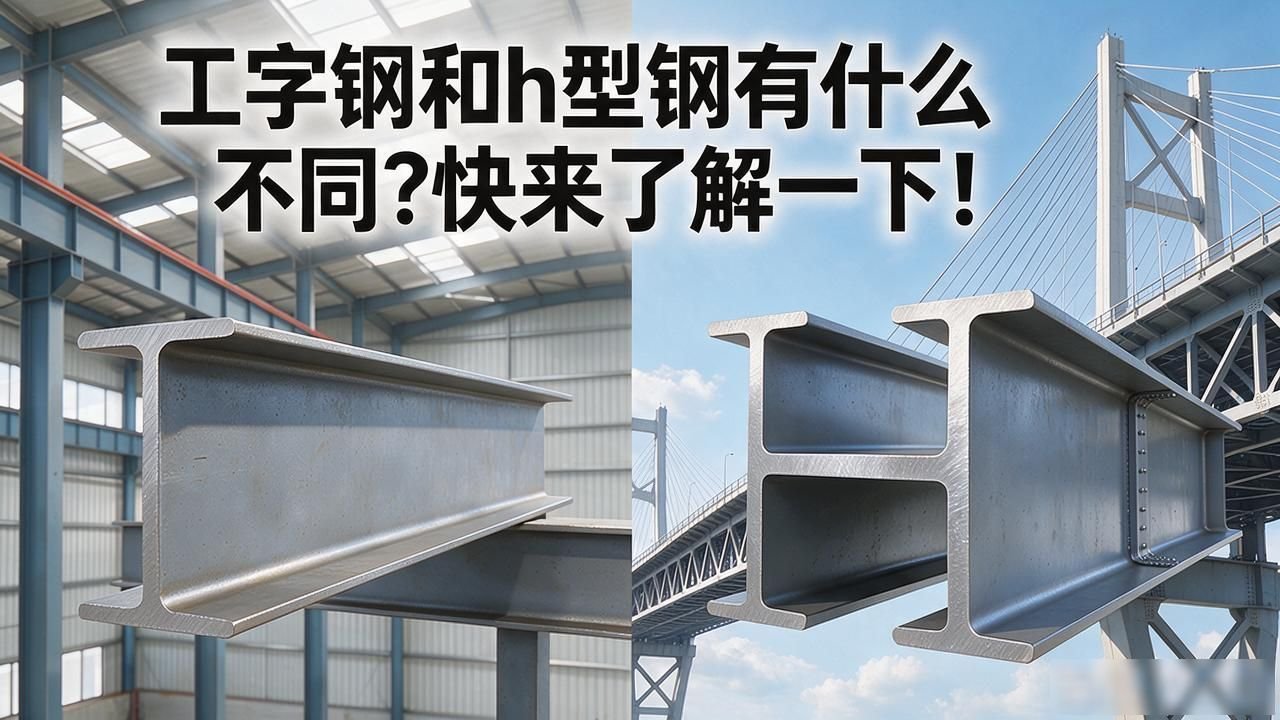
The cross-sectional shape of the I-beam is a standard Chinese character "work". It consists of an upper flange piece, a lower flange piece, and a web in the middle to connect the two parts. Its overall outer contour is like a capital English letter I. The common specifications that can be seen on the market range from I10 to I56, which corresponds to the height dimension changing from 100 mm to 560 mm. At the same time, as the height continues to increase, The width of the flange portion will also increase incrementally.
The cross-sectional shape of H-shaped steel looks like an English letter H. Its two flanges have the same width and thickness, and remain parallel. The web is vertically connected between the two flanges. In addition, the two ends of the flange have no slope, and both sides are right angles. This forms a very obvious contrast with the sloping shoulders of the I-beam, which can be clearly distinguished with the naked eye.
completely different production methods
The only process for I-beam is hot rolling. The steel billet is heated and then rolled into shape bit by bit on a universal rolling mill. This whole process does not require welding operations at all. Large domestic steel plants in places like Tangshan and Baotou already have very mature hot-rolling production lines.

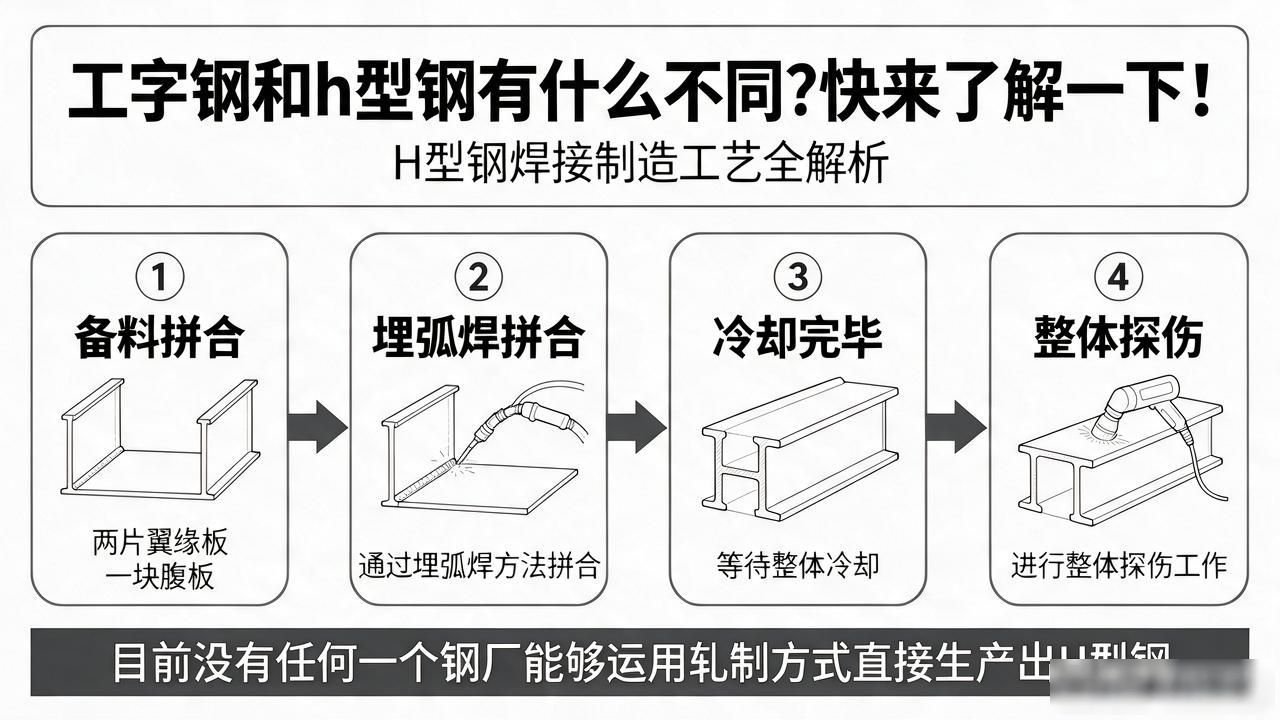
H-shaped steel uses a welding process. Specifically, two flange plates and a web plate are put together through submerged arc welding. After cooling, the overall flaw detection is performed. As for the current point in time, no steel plant can directly produce H-shaped steel using rolling.
Flange inclination angle is key
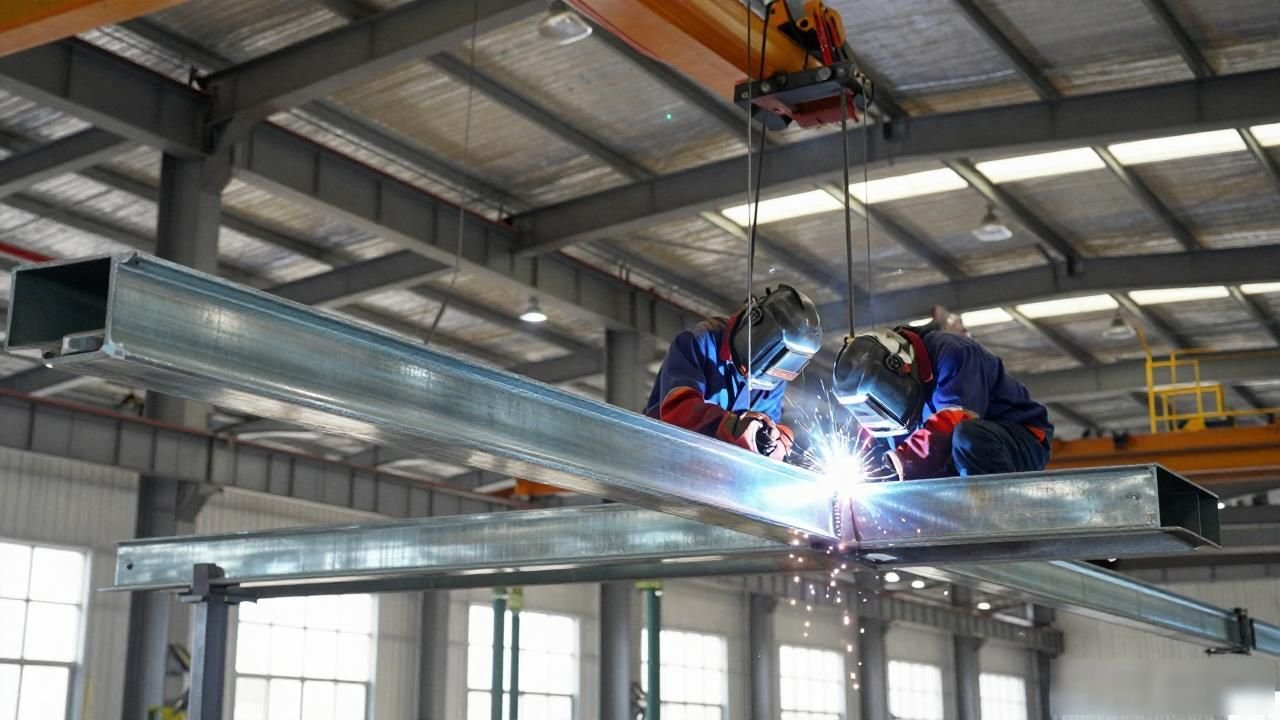
The inner side of the flange of the I-beam is processed according to a slope of one to ten, and each side will have a chamfer of about 1.25mm. This phenomenon is a feature left during the hot rolling process. When performing riveting butt welding operations, this existing slope will increase the difficulty of the assembly welding work. In addition, the shape of the weld is not as easy to operate as the right-angle case.
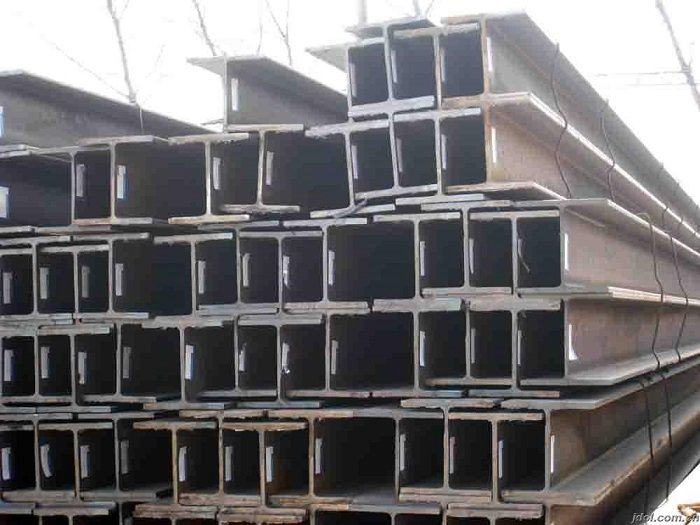
Because the flange of the H-shaped steel is completely vertical on the inner side and the outer side, it has no slope. Therefore, when we perform splicing operations, the two pieces of material called H-shaped steel can be tightly and perfectly attached to each other. In this way, whether it is connected by welding or using bolts, it will become simpler, so the speed of work at the construction site will be much faster. It is definitely much faster than those ordinary I-beams.
Rolling equipment varies greatly
I-beams can be produced by using ordinary universal rolling mills. This working method means that the rollers exert pressure on the billet from both sides at the same time to shape it. The country has already had the ability to manufacture such equipment as early as the 1950s. At present, many small and medium-sized steel manufacturing companies in Hebei and Jiangsu are also fully capable of starting production lines for I-beams.
H-shaped steel requires the use of a special H-shaped steel rolling mill. Its roller spacing and reduction are completely different from rolling I-beams. In China, only a few companies such as Baosteel, Anshan Iron and Steel, Shagang, etc. have such a production line. The investment in equipment is very large, so the number of production lines they have is also very small.
Where are I-beams mainly used?
I-beams are often found in factory beams, bridge load-bearing members, and heavy equipment bases. In 2024, domestic hot-rolled I-beam production was approximately 38 million tons. Jiangsu and Hebei are the main production areas, where prices are relatively cheaper.
The gap between its strong axis moment of inertia and weak axis moment of inertia is very large. In scenarios such as plane bending, its bending resistance is obviously insufficient, so it is not suitable for use on arc beams or long-span structures. Its application range is much narrower than that of H-shaped steel.
Where are H-shaped steels mainly used?
H-shaped steel is mainly used on steel columns and steel beams in industrial plants and civil buildings. In 2025, the use of domestic steel structures will continue to grow. The specifications range from H100 to H900. This coverage is very wide, from long-span factory buildings to high-rise residential buildings.
Its strong axis performance is relatively close to its weak axis performance. When used as cylindrical load-bearing components and industrial supports, it can save about 30% of the material usage compared to I-beams. As for those splicing operations that require riveting and welding, it can also save a lot of man-hours, so for large projects, its overall cost is lower.
When you are doing riveting and welding work on the construction site, have you ever confused I-beams with H-beams? Please describe in detail the various problems and lessons you have encountered in the comment area. If you think these contents are helpful, please help to like them and forward them to your colleagues for a look.


暂无评论内容