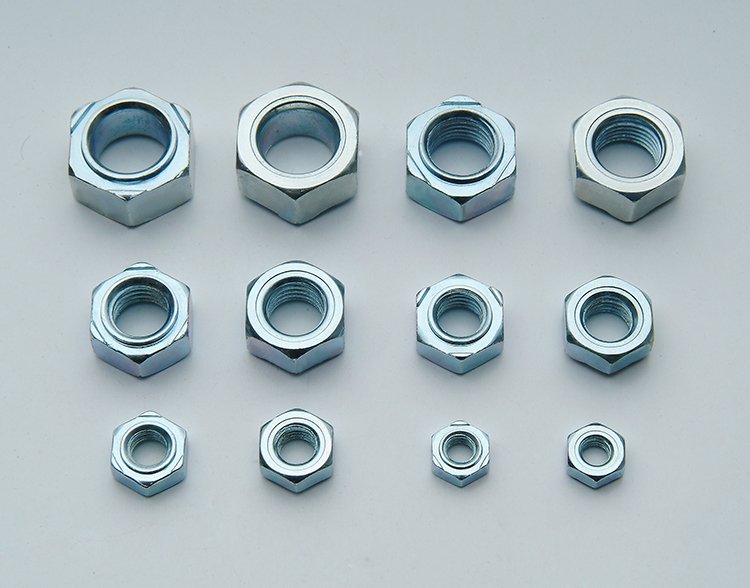


What is the difference between welding nuts and pressure riveting?
Welding relies on high temperature to melt and fuse metals together, while rivet nuts rely on cold pressure to embed them into the plate. The two are completely opposite in terms of strength maintenance logic. Once the personnel engaged in sheet metal work choose the wrong connection method, the consequences will be that they have to rework and re-make them, or that the entire batch of goods will be scrapped.
The underlying logic of welding
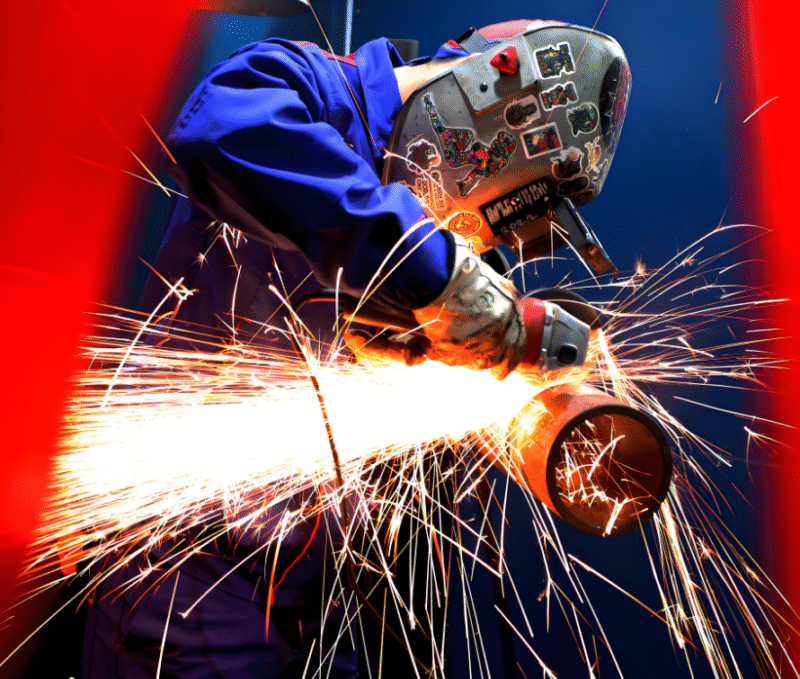
The essence of welding is to use high temperature to forcibly fuse two pieces of metal that were originally separated. And in this process, alloy is also added into the middle as a filling material.
After these materials cool and solidify, the two parts will be forcibly bitten into an indivisible whole by virtue of the forces between the molecules and the strength comparison between metal riveting and metal bonding . What is formed in this fusion area is a new crystallized organizational form. The strength of this structure is often much higher than that of the original base material.
The price paid is that the grains in the heat-affected zone will grow again, and the properties of the material will undergo adjustments that cannot be reversed. This is the most essential difference between it and the riveting process, and it is also the most fundamental reason for the deformation of the weldment.

How rivet nuts work
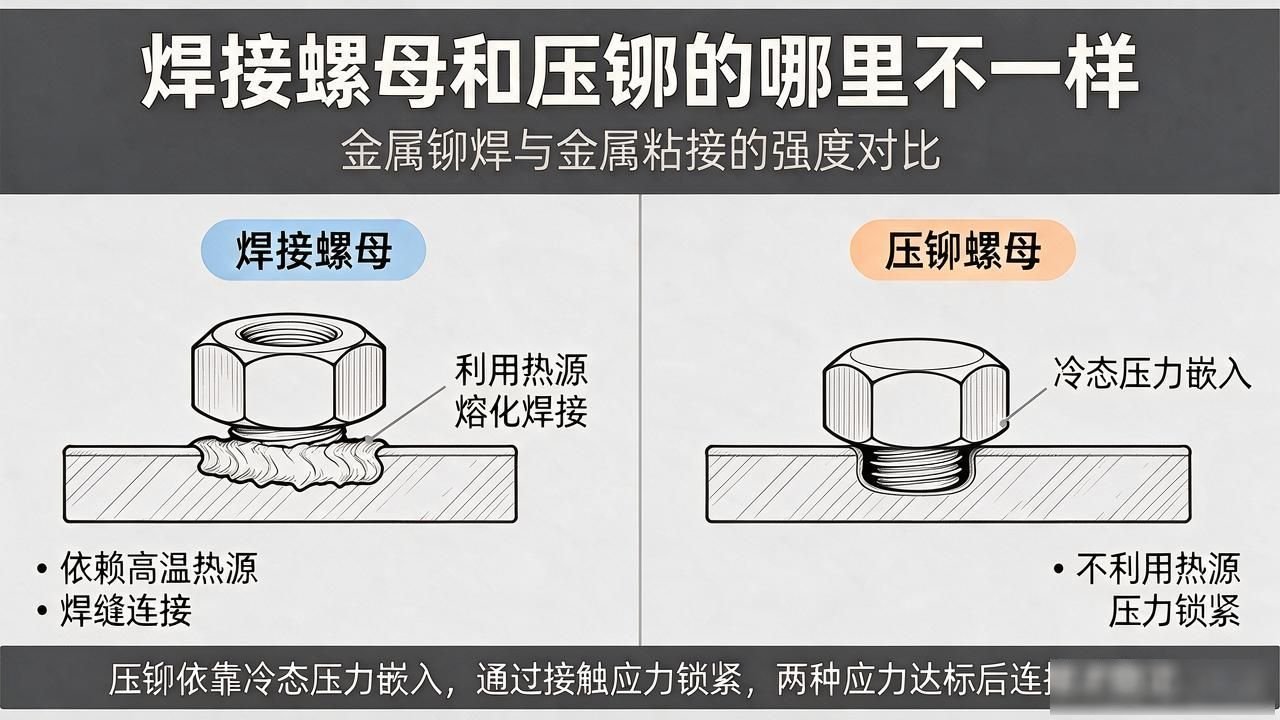
The pressure riveting process does not use heat sources, but relies on pressure to embed parts such as nuts into the holes of sheet metal parts in a cold state. During this process, contact stress will be formed on the contact surface, causing the two objects to be locked together. What the nut itself bears is shear stress . The strength comparison between metal riveting and metal bonding , while the parent material bears plastic crushing stress. Only when these two stress states reach the qualified standard, Only the connection between the two can achieve true stability.
The mode of failure is very clear because if the strength of the nut is not sufficient, it will undergo shear fracture. At the same time, if the hardness or strength of the matrix is too low, plastic crushing deformation will occur. These two failure modes are the results of calculations that can be calculated in advance during the design stage of product selection.
Welding is widely used but expensive
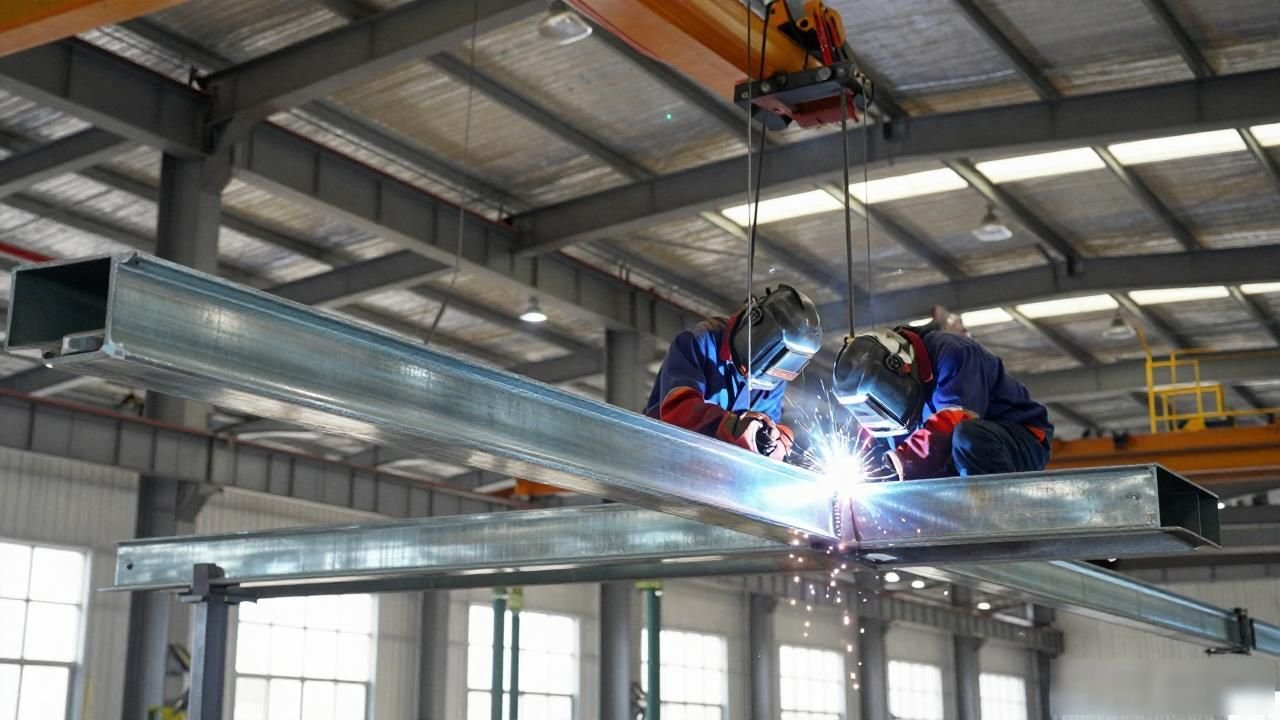
The operation of welding thick or thin plates is fully capable. Whether it is carbon steel, stainless steel, or aluminum, it can cover the scope of its application. Compared with riveting, it is wider, and its structural integrity and fatigue life are also better under normal circumstances.
However, high temperatures will cause the connected parts to undergo thermal deformation, so a second correction process is usually required after the welding is completed. Once these two things are completely fixed together through welding and become a dead structure, they cannot be disassembled for subsequent disassembly and maintenance. This will lead to very high costs for subsequent repairs or rework, and at the same time, there will be very little room for adjustment and modification in the design.
Active metal welding pits
Very reactive metals such as aluminum and magnesium will undergo oxidation reactions on their surfaces at high temperatures. Ordinary welding guns cannot completely melt it from the inside out. Therefore, two methods, argon arc welding or laser welding, must be used, and a protective gas that can isolate the air must be added. In this way, the suitable process range during the entire operation will become particularly narrow.
This imposes strict and uncompromising requirements on the worker's hand stability, gas flow, and welding wire matching. Even if the machining accuracy is only a little bit worse, defects such as pores and cracks will appear immediately. Therefore, the control of the yield rate is much stricter than that of carbon steel welding, and it is more difficult to achieve such a level by an order of magnitude.
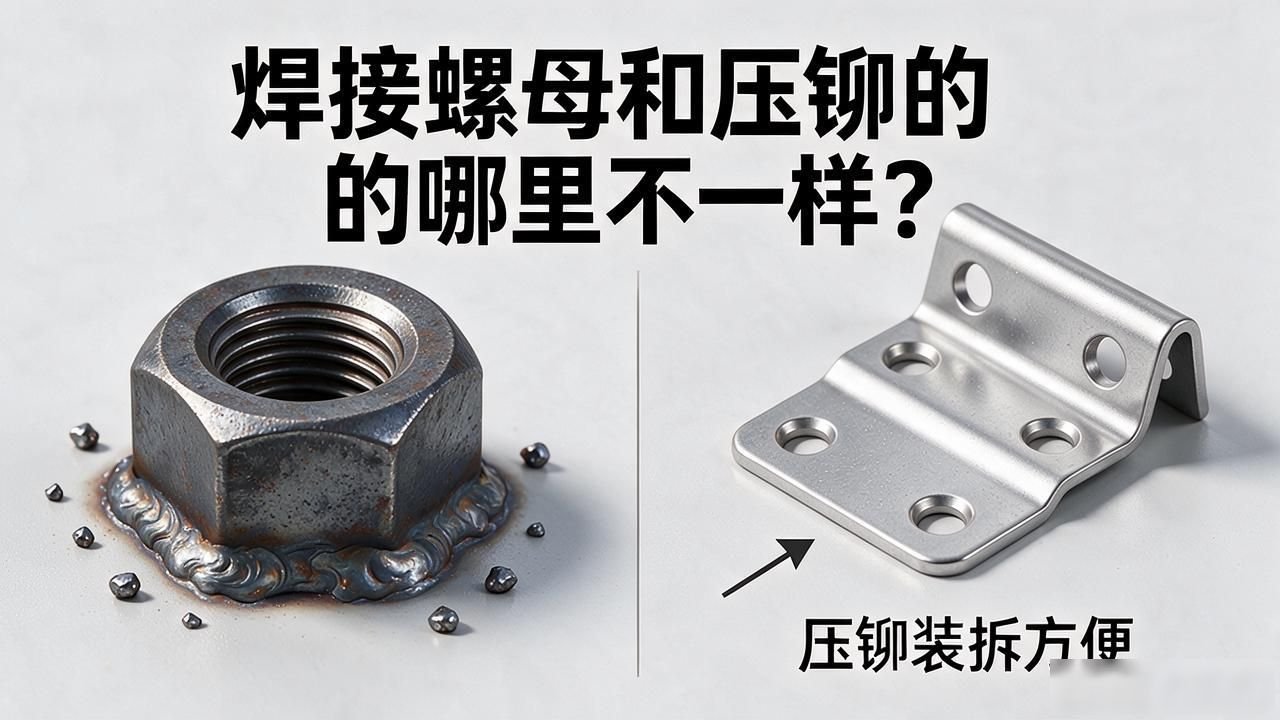
The biggest selling point is the ease of assembly and disassembly of pressure riveting
It is feasible to use a riveting gun to press the part into the hole. There is no need for heat treatment or additional measures such as protective gas. On-site workers can complete the assembly of a batch of workpieces in less than ten minutes.
During the transportation stage, parts and components are separated. After the goods arrive at the destination, the press connection action is performed. The result of this is that logistics costs and warehousing costs have shown a significant downward trend.
Convenient disassembly is a very core advantage. After the nut is tightened, although the hole of the mother body will be slightly deformed, which is different from a welded nut and a pressure rivet, it can still be reused. In this way, repair or replacement will become very friendly and easy, so it is particularly suitable for structures that require repeated disassembly and assembly operations.
Where riveting cannot be used
Pressure riveting is a process that is only suitable for use on thin-walled panels and sheet metal parts. The thickness of the panels is generally no more than two millimeters. If you get a thicker panel, it won't be able to press. As for the two materials, cast iron and cemented carbide, their hardness is too high, and they will directly fall apart during the press-in process.
When faced with usage situations such as heavy-loaded beams or columns, or flanges on thicker steel plates, the pressure riveting technology cannot withstand the force at all, so we can only use welding methods or bolt connections to fix them. The scope of application of this technology is relatively narrow, which is a very big flaw and flaw. No matter how sophisticated the craftsmanship is, it cannot make up for this shortcoming.
Do you choose one of the two methods of welding and riveting in your project, or do you mix them together? Have you ever encountered a case of overturning because you chose the wrong connection method? Feel free to talk about it in the comment area. If you think this thing is good, give it a like and forward it to your peers.


暂无评论内容