

A brief discussion on welding construction technology of steel structure in construction engineering.docx
Once there is a problem with the steel structure weld, the acceptance of the entire project will be stuck, and the cost of rework can easily reach hundreds of thousands. Next, we need to explain the practical key points of welding parameters, low-temperature construction and mixed riveting at once, so that they can be used directly on site.
How to choose welding method
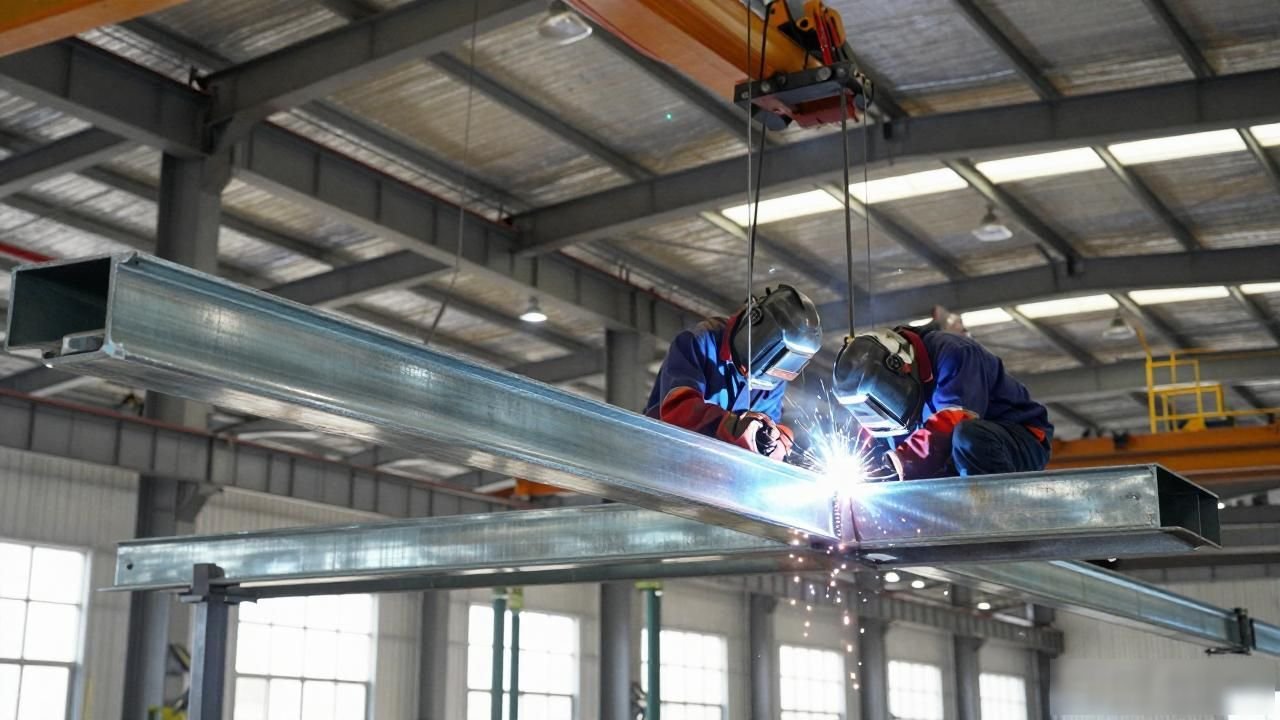
In steel structure construction, manual arc welding, CO₂ gas shielded welding and submerged arc welding are usually regarded as the three mainstream technical methods. The manual arc welding operation is very flexible, so when repairing scattered parts on the construction site, people usually give priority to using this method.
CO₂ gas shielded welding is very efficient and is the preferred welding method for mass-produced components such as beams and columns. The characteristic of submerged arc welding is that the penetration depth is very large. When dealing with the butt jointing of thick metal plates, many situations rely on it. Which welding process should be chosen in actual work?
The first thing you need to look at is the thickness of the metal plate, and you also need to observe the specific spatial location of the weld.
According to the statistical analysis of some large-scale steel structure projects in China in the past two years, it can be seen that the usage of gas shielded welding accounts for more than 60% of the total usage, while the usage of manual welding accounts for about 30%. During the actual construction process, the two are often used together. A common practice is to use gas shielded welding for base work and then use manual welding for cover processing. This can help to compress the construction period and related material costs.
How to determine welding parameters
There are mainly four core elements, namely current, voltage, welding speed and power supply polarity. We can take the E4303 welding rod as an example. When the diameter of the welding rod is 3.2mm, the matching current intensity should be controlled between 110 and 160 amps, and the arc length needs to be maintained within the range of 2 to 3 mm.
If the parameter is set too large, it will easily cause welding penetration; if the parameter is set too small, it will lead to poor fusion effect. Therefore, the operation must be strictly carried out in accordance with the requirements in the welding evaluation report, and arbitrary adjustments must not be made solely based on feel.
When using acidic welding rods, you must use direct current connection, while for alkaline welding rods, you must use direct current reverse connection. This is a rule that everyone must abide by.

In the relevant technical regulations updated in 2025, there are clear requirements, that is, according to the specific conditions of each weld, the actual parameters used need to be recorded, and they must be traceable and verifiable, so that the supervision unit can conveniently access and inspect them at any time. During the on-site construction process, this step must not be omitted.
Grooving and welding preparation
As long as the thickness of the board is less than 10 mm, a V-shaped groove is required. If the thickness reaches 10 mm or more and does not exceed 20 mm, then use a U-shaped or X-shaped bevel solution. After cutting the bevel surface, it must be polished to remove rust.
As for the oil stains, isn't it possible to wipe them clean with acetone? No, it must be wiped clean. Within a width of 20 mm on both sides of the welding joint, no rust or moisture is allowed. If this is not possible, the porosity will increase significantly.
Many people unknowingly miss the preheating step before welding. If it is steel with a carbon equivalent higher than 0.4%, or the thickness of the plate exceeds 25 mm, the temperature must be raised to between 100 and 150 degrees before welding.
For example, in a cross-river bridge project in 2023, the preheating process was not implemented at all, which eventually led to cold cracks in the welds. The rework and inspection work to deal with this problem cost a total of nearly 400,000 yuan.
Weld quality inspection
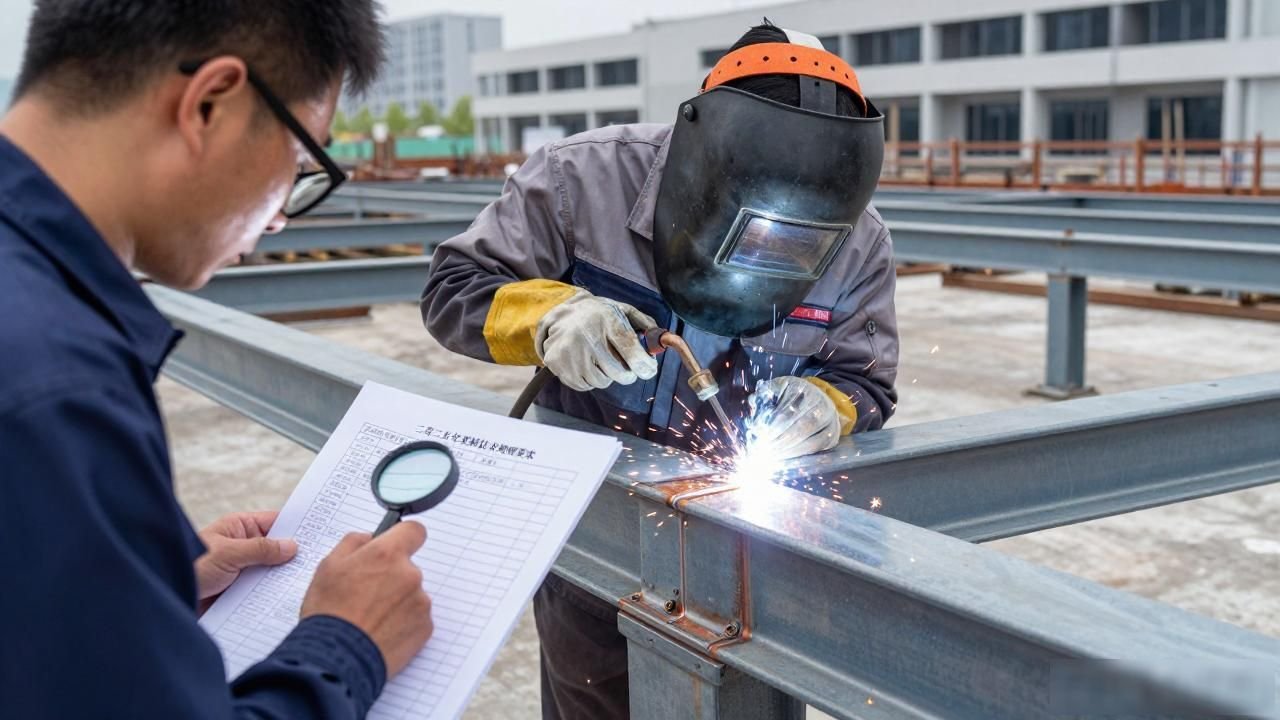
Regarding the appearance inspection, you need to check whether there are cracks, pores, undercuts, and incomplete welding. The specific method is to use visual inspection and magnetic particle detection. For those key weld parts, ultrasonic waves must be used for testing, or rays must be used for testing. The standards for determining whether they are qualified are strictly in accordance with the regulations of GB/T 3323.
According to the random inspection data of market supervision and management in 2024, the average one-time pass rate of welds in steel structures fluctuates around 92%, which is still a certain gap compared with the 100% perfect state.
The number of times that the same part can be reworked can only be twice at most. If this limit is exceeded, it must be reported to the design unit and they will reissue a treatment plan. On-site quality inspectors need to record the results of the flaw detection in detail bit by bit. These archive materials must be kept until the end of the quality assurance period. In this way, once a traceable problem occurs, there will be records for investigation. Don't wait until something really happens to look for records.
Low temperature environment welding
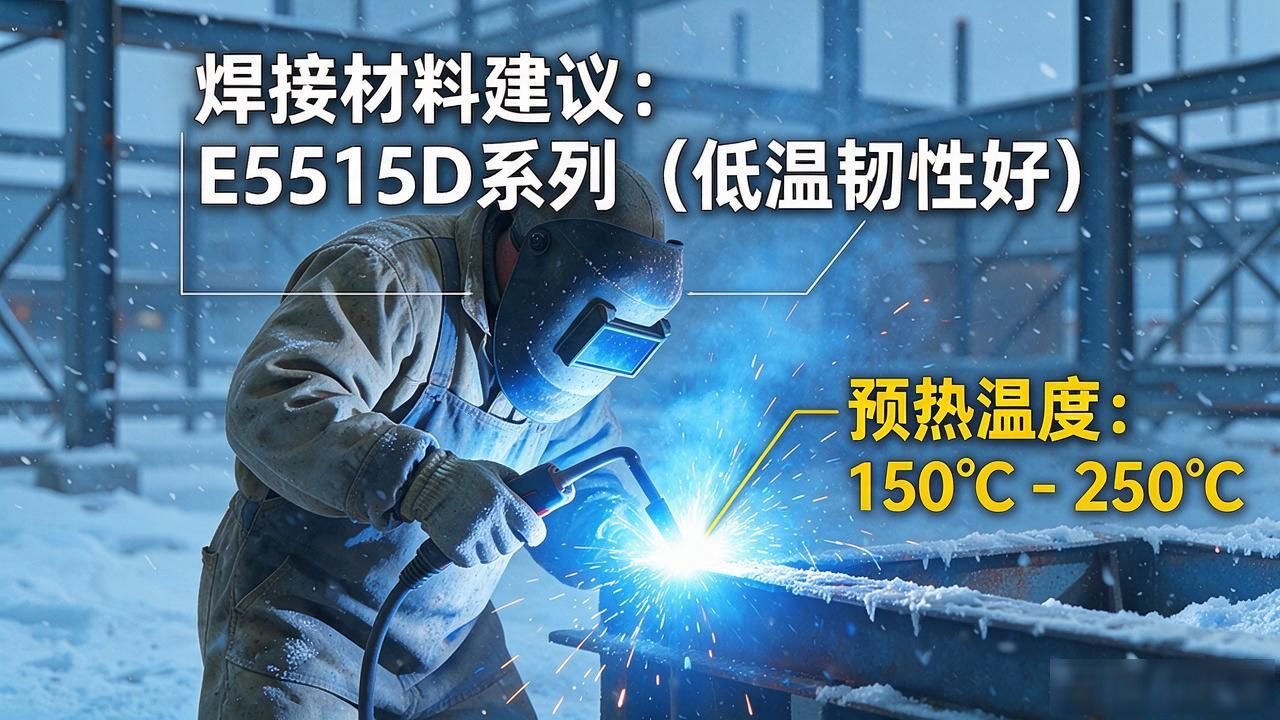
When the ambient temperature is below minus 20 degrees, the toughness of the steel will decrease significantly, so it must be replaced with welding materials with better low-temperature toughness. You can choose the E5515D series as an example, and the preheating temperature should be increased to the range of 150 to 250 degrees.
During the construction of a wind farm project in Northeast China in 2025, the on-site temperature reached minus 30 degrees. At this time, there were clear requirements for the impact energy of the weld, which must not be less than 27 joules. In this case, the use of corresponding welding materials and preheating measures are indispensable and important links.
When welding at low temperatures, it is not allowed to cool the weld too quickly, so the interlayer temperature must not be lower than 150 degrees Celsius. If it is lower than this value, brittle cracks may occur.
In order to ensure safety, during the actual operation, quilts or heating plates need to be placed on both sides of the welding joint for heat preservation. Only when the low-temperature impact test is carried out immediately after the welding is completed and the result is qualified can the next construction process be carried out. There must be no blind rush to speed up the progress.
Mixed use of welding and riveting
In actual projects, old factory buildings often use riveted structures, while newly added nodes use welds, so the transition zone phenomenon where these two connection methods coexist is very common.
However, if these two situations are to be mixed, the distance between the edge of the rivet hole and the weld must not be less than four times the diameter of the rivet. Otherwise, stress concentration will lead to the occurrence and appearance of fatigue cracks. In response to this situation, the new version of the General Specifications for Steel Structures released in 2024 has made clear requirements, stipulating that such coexisting nodes must undergo fatigue verification operations.
Whether to install rivets first and then weld, or to weld first and then rivet, needs to be determined based on the node diagram. Normally, the rivets should be assembled first, and then the surrounding welds should be welded. At the same time, it should be noted that the rivets cannot be used as positioning pins.
When performing flaw detection operations, the shadows produced by rivets will affect the quality of radiographic imaging. Therefore, it is best to use ultrasonic waves to scan the nodes where the above situation occurs one by one. Do not forcefully rely on radiographic detection methods, because that will result in no detection results.
At the project construction site, have you ever encountered an unexpected situation such as cracks at the junction of the weld area and the rivet installation position? You are welcome to describe in detail in the comment area, what methods were used to deal with these problems at that time, if you think the content you shared is useful, please like it and help forward it to your colleagues.



暂无评论内容