

Carbon dioxide shielded welding wire types literature
Holding a certificate to work is the bottom line
Only operators with electric welding licenses are allowed to work. This is an ironclad rule. If you use a welding gun without a certificate, it will not only violate the regulations but may also cause an accident. When regulatory authorities conduct an inspection, the first thing they do is to check the operating certificate. If a company hires undocumented personnel, all responsibility will fall on the management if something goes wrong. Therefore, if someone wants to learn secondary welding, he must first obtain a certificate, which is a certificate for entering this field.
At present, it is relatively simple to obtain a welder certificate. Find a formal training institution, sign up, and carry out theoretical study and practical training. You can usually get the certificate in half a month. Be sure not to get a fake ID. Once it is discovered, it will really cost you more than you gain, and it will delay your work and have an impact on your credit record.
Gas flow must be accurate
The flow rate of carbon dioxide gas has a direct impact on the quality of welding. When the flow rate is too small, the shielding gas cannot achieve full coverage, and the weld seam is prone to pores due to oxidation. When the flow rate is too large, the air flow will be turbulent and air will be drawn in. Under normal circumstances, it is recommended to control the flow rate at fifteen to twenty liters per minute.
After opening the gas bottle, first adjust the flow knob and wait until the flow meter stabilizes before proceeding with welding. The gas supply switch needs to be turned to the "welding" position to ensure a continuous supply of gas. When carrying out the inspection, you must first confirm whether there is air leakage in the air pipe and whether the joints are loose. If these details are not handled well, there will definitely be problems with the welding work.
Solid wire and flux cored wire

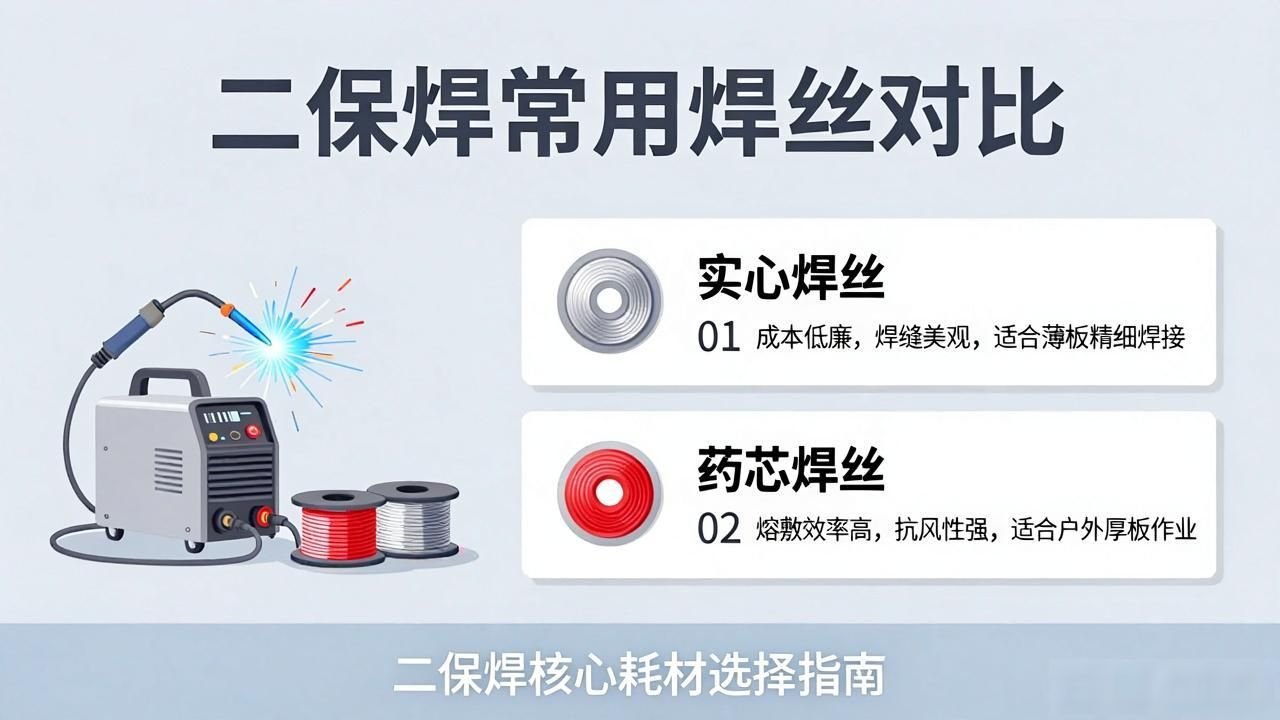
Solid welding wire and flux-cored welding wire are the two most commonly used materials for secondary welding. Solid welding wire is low-cost and the welded seam shape has beautiful features and is suitable for thin plate welding and precision work. Flux-cored welding wire has higher deposition efficiency and strong wind resistance, and is suitable for outdoor operations and thick plate welding.
When considering welding wire selection, several factors need to be taken into consideration, namely the thickness of the workpiece; the location of the welding; and the surrounding environmental conditions. For thin plates, 0.8mm solid welding wire should be used for welding; for medium and thick plates, 1.0 or 1.2mm solid welding wire should be used for welding. In outdoor environments with windy conditions, flux-cored wire should be considered first. The wire feed wheel must also match the wire diameter, otherwise, the wire will easily get stuck or the wire feed will be blocked and not smooth.
How to adjust welding parameters
When welding, the current and voltage must match. If the current is too high, the weld will be too wide, and if the voltage is too high, spatter may easily occur. Typically, for 1.0 mm solid wire, adjust the voltage to 18 to 22 volts when using 100 to 140 amps. For 1.2mm wire, use 140 to 180 amps and 22 to 26 volts.
The position of the switch for arc closing must be selected based on actual needs. The arc closing function can prevent arc craters from appearing at the end of the weld, thereby reducing the risk of cracks. The operation of the welding gun switch also has corresponding tips. When it is pressed, it is the arc starting state, when it is released, it is the normal welding state. Press it again to enter the arc closing mode, and finally release it to stop the arc. Once you are familiar with this process, you can improve your work efficiency.
The finishing touches after welding cannot be missed
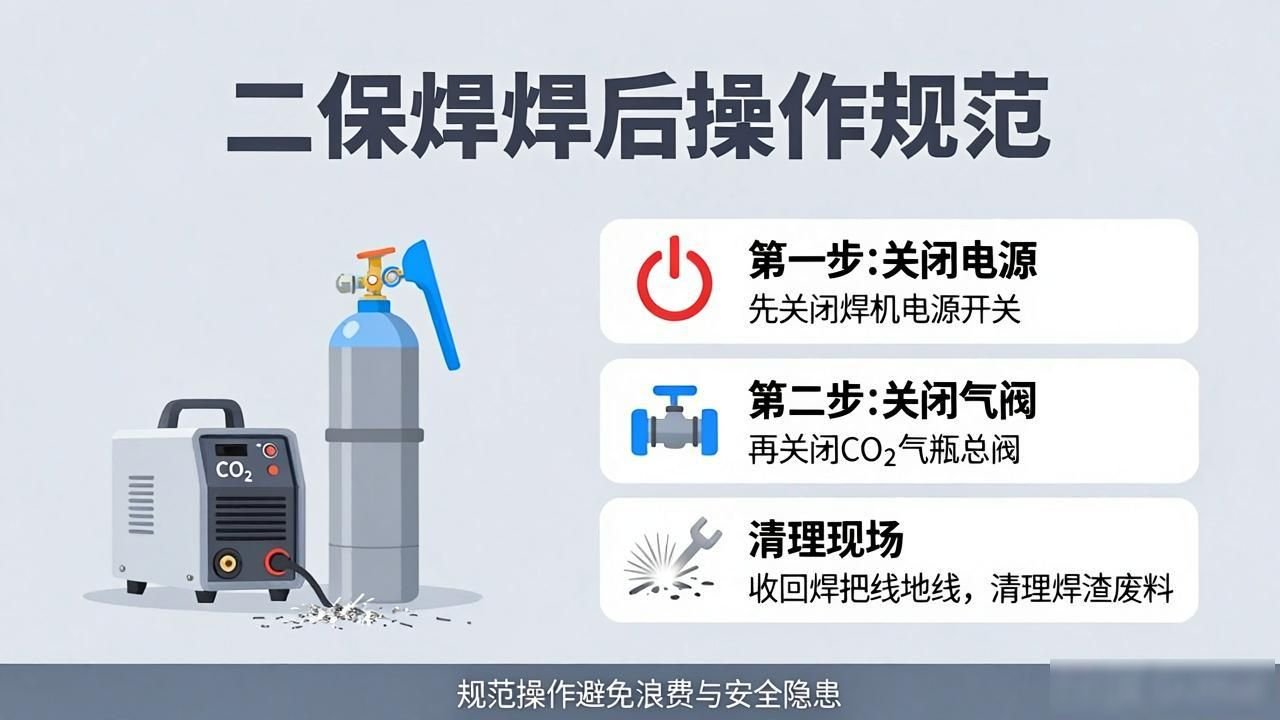
After the welding work is completed, first turn off the power switch, and then turn off the main valve of the CO2 cylinder. This is a basic operation category. However, when many people leave directly after welding, the gas valve is still open. This not only causes a waste of gas, but also poses safety risks. It is necessary to retract the welding wire and ground wire, arrange the tools properly, and clean up the welding slag and waste materials on site.
Clean the dust inside the welding machine no less than once a week. Use an air compressor or oxygen to blow away the dust accumulated in the machine core, and clean the debris in the air inlet and air outlet. If the cleaning work is not carried out for a long time, the accumulation of dust will lead to poor heat dissipation, accelerate the aging of components, and shorten the service life of the equipment. Regular maintenance can make the machine more durable.
Operating regulations to ensure safety
There is only second-level welding that is simple to operate, but it covers many safety hazards. Strong light radiation can cause damage to the eyes, flying sparks can easily cause fires, and carbon monoxide and ozone are harmful to the human body. Therefore, protective equipment must be worn completely. Masks, gloves, and labor protection shoes are all indispensable.
When welding, you need to choose an environment with good ventilation. For confined spaces, forced ventilation must be implemented. When multiple people are working at the same time, attention should be paid to arc flash protection and boards with shielding functions should be installed. Once an abnormality is detected in the equipment, the machine should be stopped immediately and inspected, and it must not be allowed to run with malfunctions. Safety is not a trivial matter, and procedures are by no means just a decoration. Only by operating in strict accordance with the regulations can the work be completed safely.
During actual welding, have you ever encountered problems with porosity or large spatter? Please leave a message to share your own experience and solutions.






暂无评论内容