

Structure and component diagrams: get to know these “standard building blocks”
Combinational logic of universal building blocks
In traditional manufacturing, every time a workpiece is replaced, a set of fixtures needs to be redesigned, which not only consumes time but also consumes energy. In addition, it is often difficult to keep up with the pace of production. The combination clamp was created precisely to deal with this pain point. It standardizes all the key components of the clamp, just like a box of building blocks, and you can build whatever you want.
The biggest advantage of this modular idea is "fast". When the workshop receives an urgent order, it no longer needs to wait for the machine shop to manufacture special tooling. Instead, it can directly select the appropriate parts from the component library and assemble a set of special fixtures in a few hours or even dozens of minutes.
A precision puzzle of eight components
This standardized component library is the core of the combined fixture. It mainly covers eight categories of components. Among them, the basic part forms the foundation of the entire set of fixtures, usually a square or circular bottom plate, which can provide the installation reference surface and the main supporting force. The supporting parts include gaskets, backing plates and angle irons of various thicknesses to build support platforms of different heights and angles.
Positioning parts have the function of accurately positioning the workpiece, and common ones include positioning pins, positioning keys, and V-shaped blocks. It is the adjustment piece that plays the role of fine-tuning the position to ensure that the assembly accuracy is up to standard. The responsibility of the hold-down part is to firmly fix the workpiece on the positioning surface. Commonly used ones include pressure plates, bolts and nuts. Fasteners are used to connect various components. Independent functional parts that will not be disassembled during the assembly process are called joint parts. The other parts are various auxiliary tools.
Technical distinction between groove system and hole system

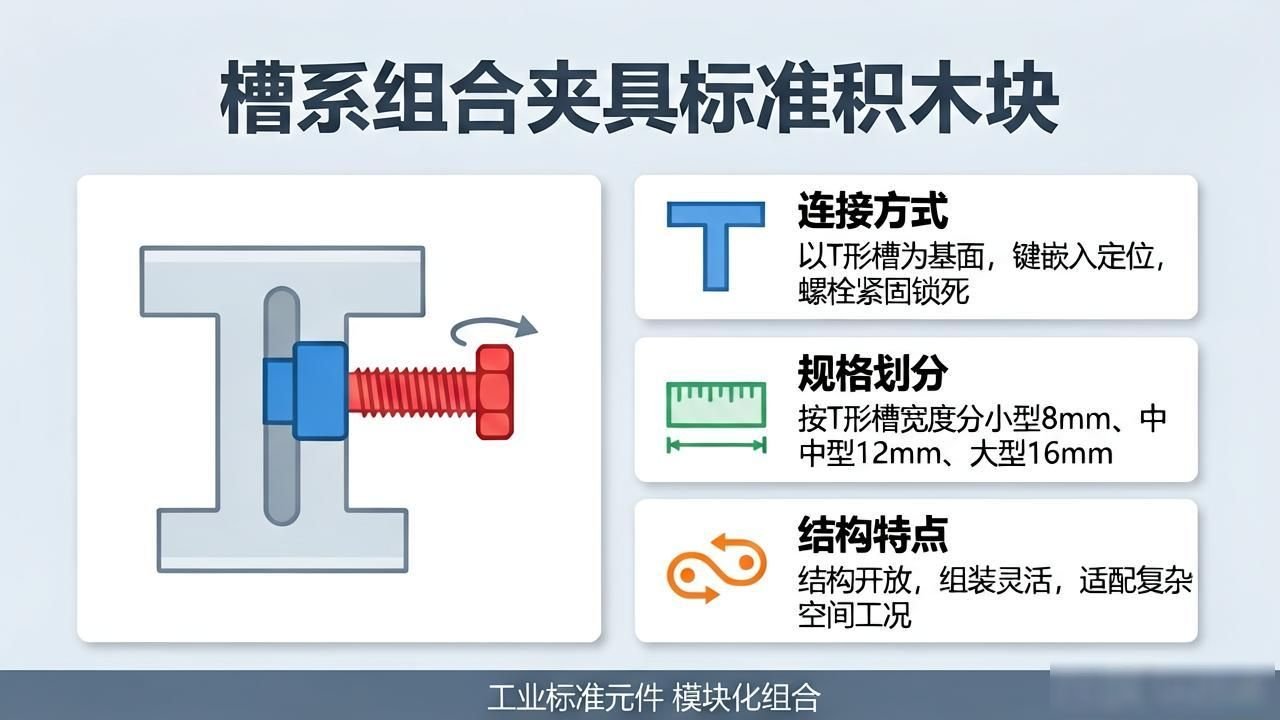
As for the combination clamp of the slot system, the T-shaped slot is used as the base surface for connection. The components are embedded into the slot through keys to achieve positioning, and then tightened with bolts and locked. It is divided into three specifications according to the width of the T-shaped slot: small is 8mm, medium is 12mm, and large is 16mm. Its structure is relatively open, and it is highly flexible during assembly, suitable for working conditions with complex spatial layout.
The connection base surface of the hole system combination fixture is a coordinate hole system composed of high-precision cylindrical holes. The components are inserted into the holes with the help of cylindrical pins to achieve precise position locking. The aperture accuracy of the optical hole has reached H6 level, and the hole center distance error can be controlled within plus or minus 0.01 mm. This structure has better rigidity, more accurate positioning, and a more compact overall design. The special micro-deformation tooling fixture designed for precision riveting has already occupied a dominant position in the field of CNC machine tools and machining centers.
Deformation problems in precision riveting welding
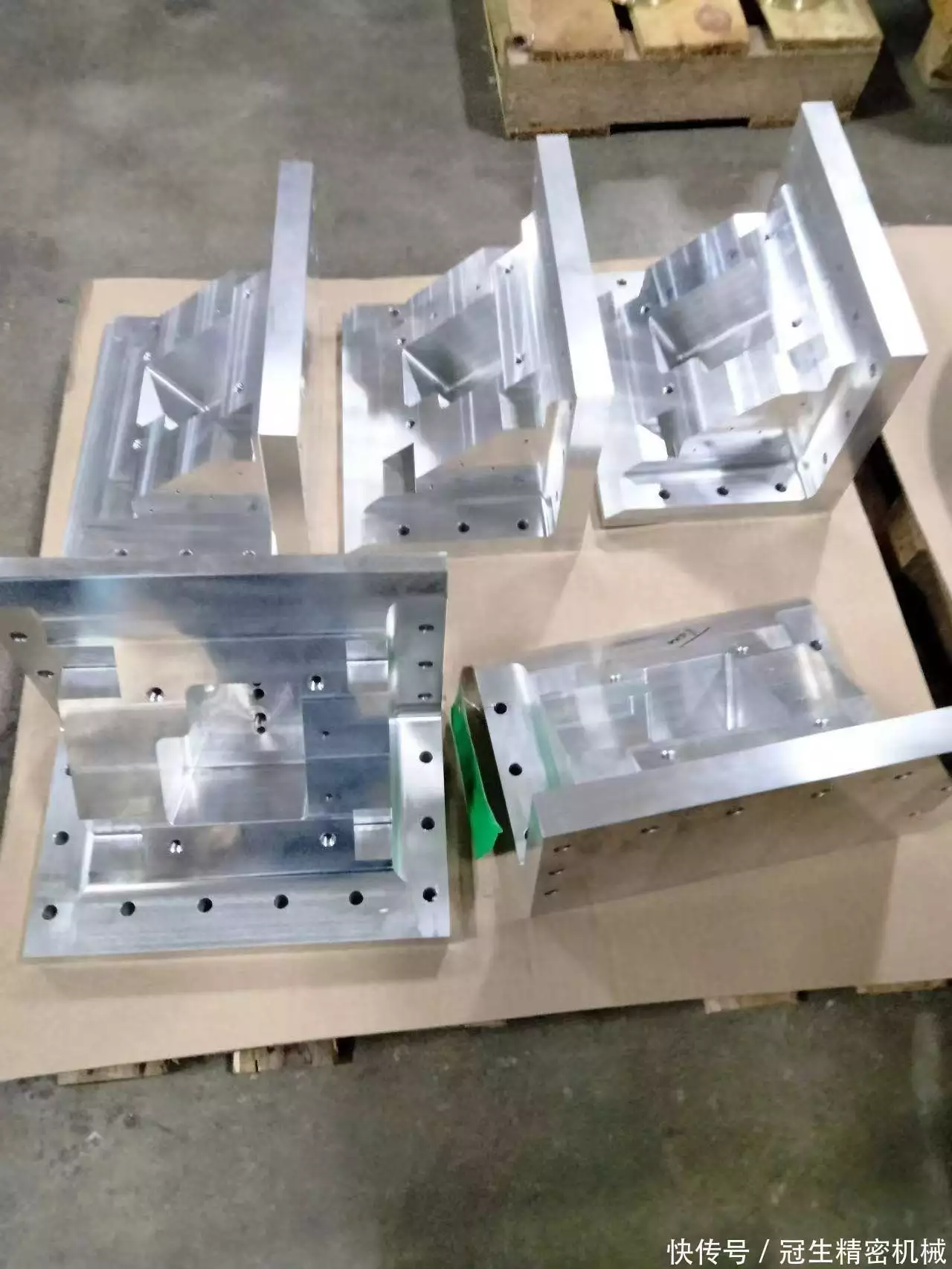
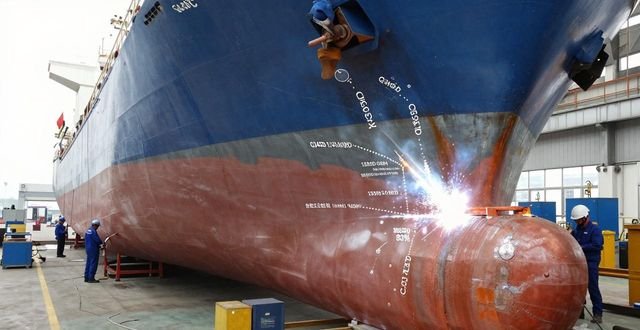
Since the high temperature during welding causes the metal to thermally expand, and the shrinkage and deformation after cooling are difficult to predict, the riveting process has extremely strict requirements on the fixture. Traditional fixtures can often only ensure the positioning accuracy of the workpiece at room temperature . Special micro-deformation tooling fixture designed for precision riveting welding . Special micro-deformation tooling fixture designed for precision riveting welding. Illustration of the structure and components of the fixture: Understanding these "standard building blocks", but there is no way to effectively control the amount of deformation during the welding process, resulting in finished product dimensions exceeding the tolerance range and a high rework rate.
The use of combined fixtures can provide a reliable solution for precision riveting welding. The high-precision fit of standardized components, coupled with the reasonable layout of positioning points, can effectively constrain the thermal deformation of the workpiece. Especially in the riveting and welding of thin plate parts, precise control of force distribution can prevent local stress concentration, thereby controlling the deformation within the millimeter or even micron range.
Key points in the design of micro-deformation fixtures
When designing a micro-deformation fixture, the positioning reference point must first be determined based on the structure of the workpiece and the welding sequence. Generally, the key mating surface or mounting surface is selected as the main positioning reference point. As for the secondary positioning point, it is necessary to take into account the restraint degree of freedom to prevent the workpiece from being displaced under the action of welding stress.
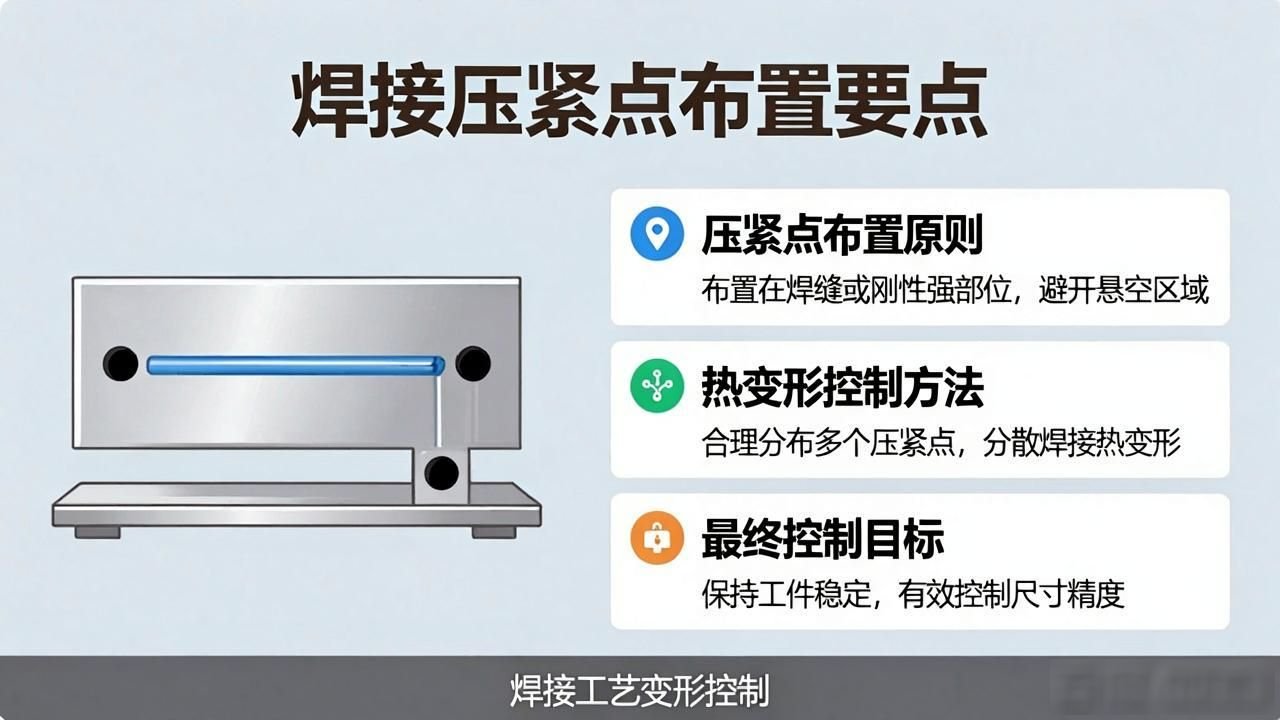
The position where the pressing force is applied is also critical. The pressing point needs to be arranged close to the weld or in a relatively rigid part, and avoid pressing on the suspended area. It is necessary to reasonably distribute multiple compression points to evenly disperse the trend of thermal deformation during welding, so that the workpiece can always maintain a stable posture, and ultimately achieve effective control of dimensional accuracy.
Actual application cost reduction data
A medium-sized machinery manufacturing company is engaged in the mass production of precision chassis. It uses combination fixtures to replace traditional special tooling. The assembly time of a single set of fixtures has been reduced from two days to three hours. The tooling cost has been reduced by more than 60%. What is more critical and important is the emergence of this result. The digital display of the welding deformation caused by this result has been reduced from plus or minus two millimeters to plus or minus 0.5 millimeters. As a result, the first-time pass rate of products has increased to a high of 95%.
Another auto parts supplier applied combined fixtures to the welding production line of body structural parts. After that, the tooling preparation cycle for new products was reduced from one week to two days. At the same time, the welding accuracy and stability were significantly improved. This alone saves more than 500,000 yuan in rework costs every year.
Enterprises producing small and medium-sized batches can enjoy efficient and precise clamping solutions due to the flexibility of combined fixtures. Unlike mass production, which requires huge investments in the manufacture of special tooling, the economy and efficiency of small-batch, multi-variety production can truly be achieved.
Are you still worried about changing tooling in your workshop now? You are welcome to tell us about your situation in the comment area, like and share so that more colleagues can avoid making mistakes and have markers.





暂无评论内容