

tiny meaning
Why is a clean workshop for micro parts processing important?
In many high-precision industries, the production of tiny parts has a direct impact on product performance. For example, in the field of semiconductors or medical devices, a micron-sized dust particle may cause a chip short circuit or implant failure. The clean workshop provides basic guarantee for this type of micro-processing by controlling environmental factors such as airborne particles, temperature and humidity. According to industry statistics, in an ISO Class 5 clean workshop, the number of ≥0.5 micron particles allowed in each cubic meter of air does not exceed 3520, which significantly reduces the risk of impurity contamination. Without such an environment, the yield rate of tiny parts may drop by more than 30%.
Core control parameters of clean workshop
To achieve high-quality processing of tiny parts, several key data must be strictly monitored in the clean workshop. The first is the air cleanliness level, which generally adopts the ISO 14644 standard, from ISO 1 to ISO 9. ISO 5 to ISO 7 are commonly used for processing small parts. The second is temperature and humidity control. For example, for precision optical components, the temperature should be maintained at 22±0.1℃ and the humidity at 45%±5% to prevent the material from expanding and contracting due to heat or electrostatically adsorbing particles. In addition, pressure difference management is also very critical. The pressure difference between the clean area and the non-clean area is usually set at 10 to 15 Pascals to ensure that the air flows from the clean area to the outside of the clean workshop for processing small parts , thereby blocking the intrusion of contamination.
Management details of personnel and materials

People are one of the biggest sources of pollution inside a clean workshop. An adult sheds thousands of skin cells and microorganisms every minute. Therefore, operators must wear a complete set of dust-free clothing and all supporting assembly items and small parts processing clean workshops before entering the corresponding workshop, including jumpsuits, masks, gloves and shoe covers, and they must be purged by the air shower for at least 15 seconds. There are also strict procedures for the entry and exit of materials. For example, raw materials must be wiped or vacuumed, and then transferred into the clean area through the transfer window. The practice of a factory in Suzhou that produces precision parts in 2023 shows that after strengthening personnel training, the number of pollution accidents caused by human operations was reduced by 45%.
Key points for equipment selection and maintenance
The selection of micro parts processing equipment is directly related to processing accuracy and cleanliness. For example, in the processing of micro bearings, the spindle rotation accuracy must be within 0.5 microns, and anti-rust and anti-static materials must be used on the surface of the equipment to prevent the generation of particles. During routine maintenance, the equipment must be calibrated with laser interferometers every week, and high-efficiency air filters must be replaced every month to ensure that the dust removal efficiency is no less than 99.97%. An electronics factory in Shenzhen once neglected filter replacement, causing the cleanliness of the workshop to drop from ISO level 5 to ISO level 7, and the product scrap rate once sharply increased to 12%!
Special challenges in machining tiny parts
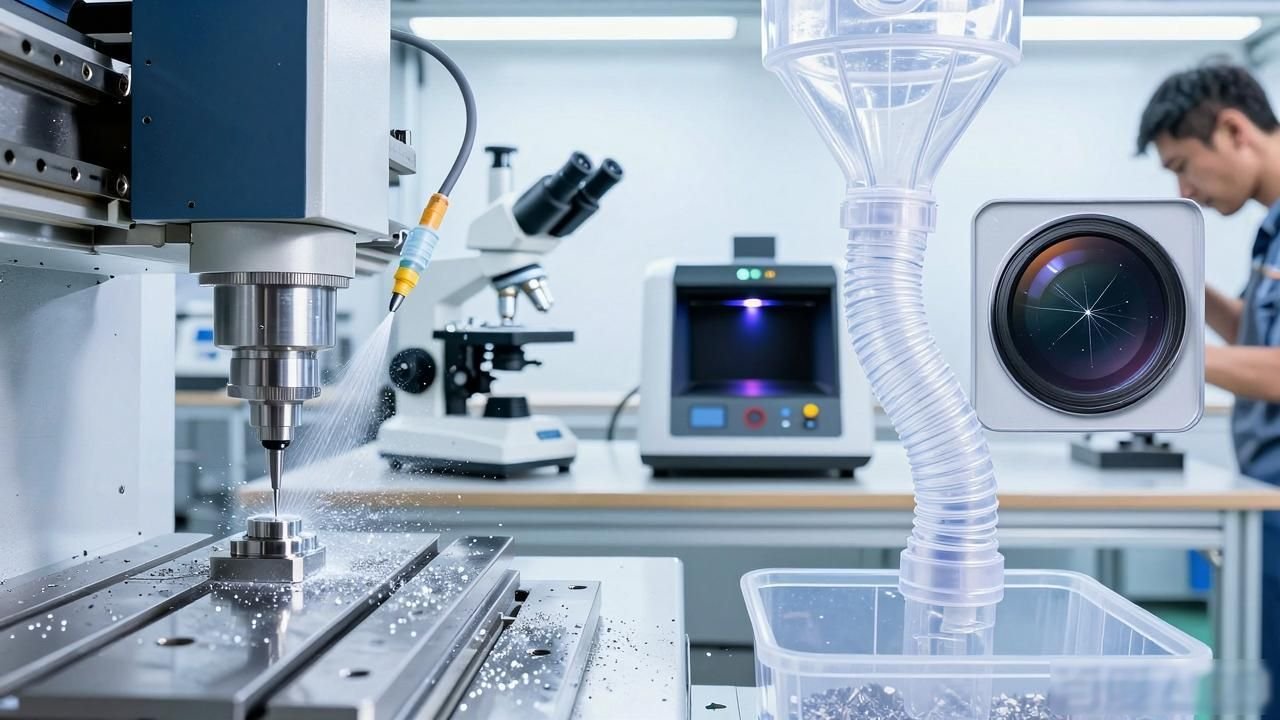
Regarding tiny parts, their dimensions are generally measured in millimeters to microns. When processing, they will face problems such as tool wear and difficulty in chip removal. In a clean workshop, if the chips are not removed in time, the surface of the parts may be scratched or the environment may be polluted. Its solutions include the use of minimum quantity lubrication technology to control the usage of cutting fluid to less than 50 milliliters per hour, and a vacuum chip suction system to increase the chip collection rate to over 95%. At the same time, high-powered microscopes or laser scanners are also required in the processing and inspection process. Just like during the manufacturing of mobile phone camera lenses, scratches with a diameter of 0.1 millimeter need to be detected. These challenges put forward higher requirements for workshop management and technology.
The balance between costs and benefits
The initial investment in building a clean workshop that meets the processing needs of tiny parts is quite expensive. Take an ISO Level 5 workshop of 100 square meters as an example, covering civil engineering, purification equipment and air-conditioning systems. The cost is generally between 800,000 and 1.2 million yuan. However, from a long-term perspective, improving yield can significantly reduce waste. According to the records of a medical accessories company in Shanghai, after upgrading the clean workshop, the product qualification rate increased from 78% to 96%, which can save up to about 2 million yuan in rework and waste costs every year. Enterprises must select the appropriate cleanliness level based on their own parts accuracy requirements and output to prevent over-investment.
In the scope of micro parts processing, which environmental parameter in the clean workshop do you think has the most critical and decisive influence on the quality of the final product? You are welcome to share your experience in the clean workshop for micro parts processing in the comment area. Like and forward this article to more colleagues in the industry.
Leave a Reply
You must be logged in to post a comment.