
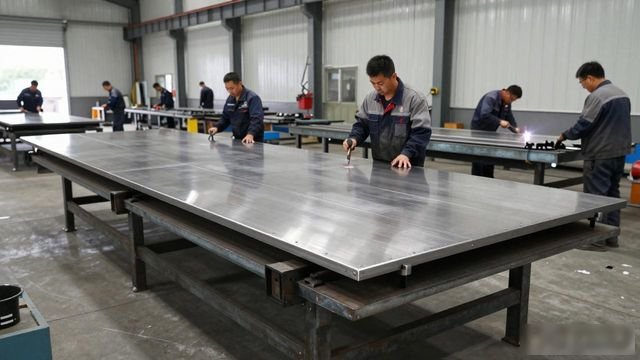
Hebei riveting and welding flat plate
The uses and classification of riveted welded flat plates
The riveting and welding flat plate used in the fitter workshop is a common piece of equipment. Its working surface is processed with T-shaped grooves, and its main function is to fix the welding parts. This flat plate is specially used as the basic platform for large-scale equipment. It is often found in mechanical processing plants, tool workshops and machine repair workshops. According to the difference in usage scenarios, the riveting and welding flat plate is mainly divided into three types: assembly platform, welding platform and welder platform. Each platform has a slight emphasis on functions, but its core function is to provide a stable working reference surface.
Marking lines are also drawn on the platform and plane of the welding operation. The specific dimensions of these marking lines are determined by the user based on the usage situation. Fitter workers use these marking lines to inspect the workpiece and carry out precise marking operations on the workpiece. The cast iron platform is suitable for all kinds of inspection work. As a reference plane for precision measurement, it is an indispensable basic tool in the machinery manufacturing inspection process and can be used to check the dimensional accuracy or behavioral deviation of parts.
Platform material and hardness standards
The riveted welding plate selected as the raw material is high-strength cast iron HT200-300, and the hardness of the working surface will be controlled within the range of HB170-240. This hardness range has been verified by many tests. It can ensure that the platform has good wear resistance and will not cause brittleness due to excessive hardness. The platform undergoes two manual treatments before leaving the factory. The treatments include manual annealing at 600 to 700 degrees, and natural aging for 2 to 3 years, so as to ensure stable accuracy.
The riveted welded flat plate formed after such strict process has extremely excellent wear resistance. Feedback from many customers shows that the accuracy of platforms that have been used for more than three years has always remained stable and within the qualified range. Based on our experience, we advise our customers that when purchasing, they should pay special attention to material reports and heat treatment records, because these data will directly play a key role in determining the service life and accuracy maintenance capabilities of the relevant platform.
Design standards and processing technology

According to the "Machinery Industry Standard of the People's Republic of China" JB/T7974-2000, this is the main basis for the design technical requirements of rivet-welded flat plates. At the same time, it is manufactured in accordance with the national-85 standard. Its accuracy levels are divided into levels 00, 0, 1, 2, and 3, and fine planing is divided into six levels. For this reason, customers can choose the appropriate accuracy according to actual needs. In addition, there are two types of flat plate structures: ribbed type and box type, and the working surface shape has options such as rectangular, square and circular.
The scraping process is used when processing the working surface, which can ensure that the flatness reaches a high standard to a high extent. The working surface can also process V-shaped, T-shaped, U-shaped grooves, round holes, long holes and other types of structures to meet the fixing needs of different workpieces. We provide customized services such as drawings and samples. Customers only need to provide drawings or samples, and we can produce riveted welded flat plates that meet the accuracy requirements as needed.
Daily use and maintenance points
Before riveting and welding flat plates, you must use non-corrosive gasoline to clean the anti-rust oil on the working surface, and then wipe it clean with absorbent cotton gauze. Changes in temperature will affect the measurement accuracy. It is recommended to use it within the range of 20±5℃. When using it, use a level to adjust it to a level state to ensure that the fulcrums are evenly distributed at each fulcrum. Pay careful attention during operation and strictly prevent damage to the working surface caused by collision.
After use, wipe the working surface clean, apply anti-rust oil with anhydrous acidic characteristics, cover it with moisture-proof paper, and then place it in a clean and dry place for storage. The weekly inspection period for riveted and welded flat plates is generally 6 months to 12 months. The specific period can be determined according to the frequency of use and working conditions. Regular inspections can detect problems as early as possible and prevent workpieces from being scrapped due to deviations in accuracy.
Packaging, transportation and splicing applications
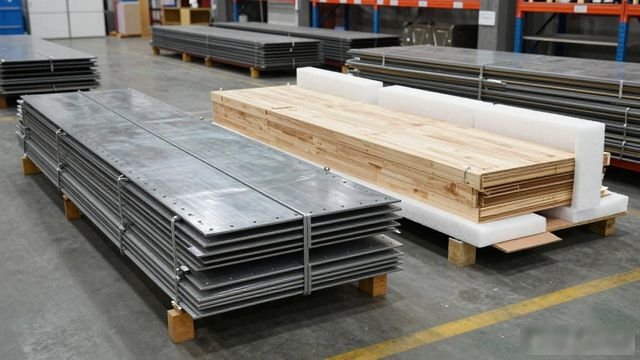
The use of iron plate packaging and wooden packaging to package riveted flat plates must be done in accordance with corresponding standard protection measures. When large platforms leave the factory, we will design special lifting solutions based on size and weight to avoid deformation or damage during transportation. The holes on the working surface are mainly used to clean iron slag and welding waste generated during riveting and welding. Practicality and convenience are taken into consideration in the design.
With a reasonable design, the structure is quite stable, has high precision characteristics, is wear-resistant and can achieve unlimited flat plate splicing. For large equipment bases or ultra-long workpieces, the working area can be expanded by splicing multiple flat plates. This splicing method is widely used in heavy machinery manufacturing and large equipment installation, and can effectively reduce customers' investment costs.
Accuracy inspection and cost balance
The key point in use is to check the flatness of the riveted plate. There is no need to blindly find the number of contact points. The number of contact points is closely related to the processing cost. The more contact points, the longer the processing time will be, and the higher the price will naturally be. Under normal usage conditions, just focusing on flatness inspection can meet the needs of most working hours. Flatness inspection can use standard inspection tools, and the operation is easy and intuitive.
For customers, our advice is to select the accuracy level based on the actual application scenario. For example, for a platform used for ordinary welding and fixation, it is enough to choose level 2 accuracy or level 3 accuracy; while for a platform used for precision inspection and measurement, it is necessary to choose level 00 accuracy or level 0 accuracy. When customizing drawings and samples, we will provide the most cost-effective processing plan according to the requirements of the drawings to achieve a balance between accuracy and cost.
What accuracy problems have you encountered when using riveted and welded flat plates? You are welcome to leave a message in the comment area to share your experience. If you find the article useful, please like it and forward it to friends who need it.
Leave a Reply
You must be logged in to post a comment.