
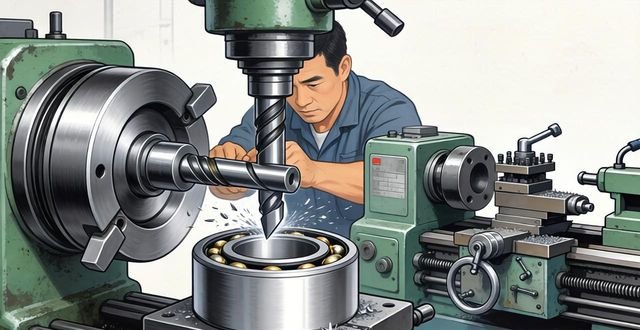
Turning, planing, milling, grinding, boring, drilling, drawing, bending, what are these?
In the mechanical processing workshop, many operators have worked in boring processing for three to five years and still cannot figure out when to use a lathe and when to use a boring machine. Such confusion directly leads to low processing efficiency, high scrap rate , boring processing operator skills requirements , and even damage to the equipment. Today we will use straightforward words to explain the essential differences between these five common processing methods.
The core of turning processing is the rotation of the workpiece
During turning, the workpiece is tightly clamped by the chuck and rotates at high speed, and the tool moves linearly along the surface of the workpiece. Both lathes and boring machines can complete turning operations, and their main uses are for processing shaft parts, discs, and threads. For example, to process a drive shaft with a diameter of 50 mm, the operator has to clamp the workpiece on the lathe spindle, adjust the tool angle, and control the feed speed.
In actual production in 2025, turning is still the primary method of choice for rotary parts. Operators must master important skills including: correct selection of cutting parameters, reasonable installation of workpieces, and selection of appropriate tool angles based on the workpiece material. The surface obtained by turning processing will have uniform spiral patterns . The skill requirements of boring processing operators are the key basis for determining whether to use the turning process.
Boring processing is specially used to deal with inner holes

This rotation of the workpiece or tool is unique to the boring process, and the inner cylindrical shape is ultimately formed on the workpiece. Boring machines specialize in this work, but lathes can also perform the actual boring operations. When the operator is processing a box bearing hole with a diameter of 100 mm, he first needs to make the boring bar penetrate deep into the inside of the workpiece, and then use the rotation of the spindle to drive the tool to perform cutting.
In March 2026, a heavy machinery factory received a batch of boring orders for excavator booms, with the hole diameter tolerance set to plus or minus 0.01 mm. Operator Master Li uses a horizontal boring machine, first using a rough boring tool to remove the allowance, and then using a fine boring tool to ensure dimensional accuracy. Boring processing has high requirements on the operator's skills. The reason is that the tool is inside the workpiece and cannot be seen. Quality assurance relies entirely on experience and measurement.
Milling processing relies on cutterhead rotation to form
During milling, the tool is in a rotating state, and the workpiece is fixed on the workbench and moves in a linear direction. Milling machines, boring machines and high-strength drilling machines are all capable of milling operations. Machining flat surfaces, keyways, and gear tooth shapes are all aspects that milling is good at. When an operator mills a keyway with a width of 20 mm, he must select an end mill of appropriate diameter, set the spindle speed and feed rate.
The surface obtained by milling is relatively smooth, which is the most significant difference from planing. In 2025, data from a mold factory showed that the efficiency of using high-speed milling to process complex surfaces was three times higher than that of traditional planing. Operators must understand the difference between down milling and up-cut milling. In down-milling, the cutting thickness gradually decreases from thick to thin, while in up-cut milling, the cutting thickness gradually changes from thin to thick. These two methods have a great impact on tool life and surface quality.
The planing process leaves a distinct texture
Planing is a method of obtaining geometric shapes by reciprocating motion between the tool and the workpiece. Planers, slotting machines, and gear shaping machines can all perform planing operations. However, sawing machines are not called planing. During the processing process, when the tool contacts the workpiece, iron particles will fly out, leaving clear stripes on the surface of the workpiece. For example, if a plane with a width of 30 mm is planed, a layer of metal will be removed each time the planer advances.
In actual processing, planing is often used for flat surface processing of large parts and processing of grooves. Operator Master Wang, when processing a two-meter-long machine tool guide rail surface, what are the turning, planing, milling, grinding, boring, drilling, drawing and bending? , using a bull-head planer, the depth of each cutting is only 0.5 mm, and it has to be run back and forth dozens of times to complete this operation. Although the efficiency of planing cannot keep up with milling, for the processing of narrow and long surfaces, planing has the advantage of lower equipment costs.
Grinding processing pursues the highest precision
The grinding wheel rotates around the center at high speed, and it quickly passes over the surface of the workpiece. The amount of feed carried out each time is only about 0.1 mm. There are grinders specially designed for this work, which can process the corresponding inner and outer surfaces of circles, parallel planes, and various surfaces with precision properties. The surface precision obtained by grinding is even higher than that of milling, and the roughness can reach less than Ra0.8 microns.
In the first quarter of 2026, a precision bearing factory asked operators to grind a batch of bearing rings with an inner diameter of 30 mm that must comply with the roundness error limit of not exceeding 0.002 mm. Operator Xiao Zhang uses an internal grinder to operate. The operation process is to perform rough grinding first and then carry out fine grinding. However, each machined part must be measured three times. Grinding processing undoubtedly places extremely high demands on the technical level of the operator. The reason is that the grinding wheel will continue to wear, so timely dressing actions are required to ensure that dimensional accuracy is maintained.
After reading the detailed comparison of these five processing methods, which two processing methods do you think are most likely to be confused in actual use? Feel free to share your experience in the comment area and like it to encourage more peers to see this practical content.
コメントを残す
コメントを投稿するにはログインしてください。