
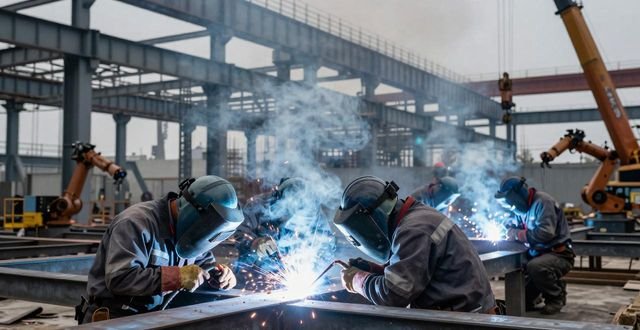
Riveting and welding processing manufacturer: high strength plate welding process
When welding high-strength plates, many manufacturers encounter problems in current control. After the process parameters are determined, it is strictly forbidden to increase the current at will during the execution, otherwise the internal stress of the plate will rapidly change greatly, which will directly lead to cracking of the weld or damage to the base material. Some experienced manufacturers will use centralized control to lock the current range from the starting point.
Workers are absolutely not allowed to adjust welding parameters without authorization. This is an extremely important red line in workshop management. In 2025, there was a company engaged in heavy industry production in Shandong. Because the welding technicians deliberately increased the current value, a batch of brackets for mining equipment worth up to 800,000 were all scrapped. For foreign projects, the requirements for protective gas flow control will be more stringent. Take the standard conditions set by Australia for mines, which stipulate that the error range of the hourly flow rate cannot exceed the range of plus 0.5 liters and minus 0.5 liters.
It is necessary to distinguish between hot and cold riveting processes
There are two basic methods of riveting welding, namely cold welding and hot welding. Cold welding mainly uses rivets to perform mechanical connections, and is suitable for heat-sensitive materials or components that need to be disassembled, such as temporary fixing points for building steel structures. Heat welding is the process of melting the contact point between two metals into a liquid form through high temperature. It then cools, solidifies and merges into a whole.
Not limited to metals, which are materials used for heat welding, some non-metallic materials can also achieve heat-melt connection under certain conditions. In the Swedish mining equipment order undertaken by Dalian Dongxing Industrial Group in 2024, high manganese steel and carbon steel were connected using a heat welding process, and the weld strength exceeded 90% of the base material. Cold welding is usually applied to stainless steel sheets to prevent thermal deformation.
The hazards of electric welding are not without cost

Many people say that there is no harm in the riveting and welding process. This is actually a misunderstanding. Large-scale steel structure on- site riveting and assembly construction teams have been engaged in electric welding operations for a long time. High temperatures will cause complex chemical reactions between the electrode coating and the base material, thereby producing ozone, nitrogen oxides and other toxic gases. A report by the Shenyang Occupational Disease Prevention and Control Institute in 2023 shows that the incidence of pneumoconiosis and manganese poisoning among welders is 3.8 times that of ordinary workers.
The strong ultraviolet rays produced by arcs can also cause damage to vision and cause electro-optical ophthalmia. Therefore, regular factories must be equipped with smoke exhaust and dust removal equipment and protective masks. Dongxing Industry, a 3A-level enterprise in Liaoning, requires welders to rotate every two hours. Air quality monitors must be installed in the workshop. Once the concentration of harmful gases exceeds the standard, forced exhaust must be activated immediately.
On-site inspection of high-strength plates cannot be saved
When high-strength plates enter the factory, they must be inspected batch by batch for chemical composition and mechanical properties. However, there are many small manufacturers currently skipping this process just to save costs and simplify things. Eventually, cracks appeared after welding, and they discovered that there was a problem with the base material. In 2024, there was a factory in Hebei that specialized in riveting and welding. It was precisely because of the use of a batch of Q690D steel plates that did not meet the requirements that all 32 structural parts had to be reworked.
Flatness inspection is also important. Use a ruler and feeler gauge to measure the flatness of the plate. Once the deviation exceeds two millimeters per meter, leveling measures must be taken. If the construction process of shot blasting and rust removal cannot be skipped, otherwise slag inclusion will easily occur inside the weld. The new factory owned by Dongxing Industrial is equipped with an automatic plate pretreatment line. Each steel plate needs to go through the three processes of shot blasting, leveling, and primer after entering the factory.
High-precision welding techniques to prevent deformation
The most troublesome problem in riveting and welding is welding deformation. The reason why this happens is because the raw materials are heated unevenly, and shrinkage and distortion will definitely occur after cooling. The key to preventing deformation is to set fixed points and use symmetrical welding or segmented de-soldering. For example, when welding a long weld, it is not possible to weld all the way from the beginning to the end. Instead, it must be divided into several sections and jump welded from the middle to both ends.
Many manufacturers, for the sake of efficiency, use cover software to automatically generate welding paths, but ignore the material characteristics. The thermal conductivity of high-strength steel is about 30% lower than that of ordinary carbon steel. The welding speed must be slowed down. When segmenting materials, priority should be given to longitudinal cutting to reduce the number of transverse welds. In 2025, Sany Heavy Industry's welding workshop will introduce a laser tracking system to monitor deformation in real time and automatically compensate.
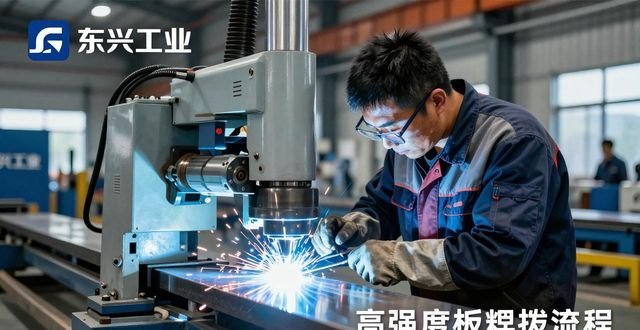
Thirty years of practical experience of Dongxing Industry
Dongxing Industrial (Dalian) Group, established in 1988, has two branches. It mainly produces and sells large-scale steel structure on-site riveting and welding assembly construction teams for construction machinery and mining equipment connection structures. After more than 30 years of development, it has become one of the riveting and welding manufacturers with the largest scale and processing capabilities in the Northeast. The group has obtained the 3A-level enterprise certification in Liaoning Province and currently has more than 400 production front-line personnel.
The old factory covers an area of more than 50,000 square meters, and the new factory covers an area of 75,000 square meters, with an annual output of 100,000 tons. In 2024, the group undertook the mining truck body welding project of Rio Tinto Group, using high-strength plate welding technology, and the products were exported to Australia and Chile. Each welder must undergo two hundred hours of practical training before taking up the job. Each welding machine is equipped with a current locking device, and private adjustments are strictly prohibited.
On-site construction management determines welding quality
Large steel structures are riveted and welded together on site, and the environmental factors can be more complex than in a workshop. When the wind is strong, a windproof shed needs to be set up. Once the humidity exceeds 85%, the operation must be stopped. The flow of shielding gas must be strictly controlled. The flow of carbon dioxide gas shielded welding is usually set at 15 to 20 liters per minute. If the flow is too high, turbulence will occur, which will bring air into the molten pool to form pores.
Any welder who is going to perform welding operations must properly adjust the preheating temperature before officially starting the installation work. When welding high-strength plates, they must be preheated to a range between 100 degrees Celsius and 150 degrees Celsius. After the welding work is completed, insulation must be carried out to promote slow cooling to avoid the occurrence of cold cracks. In the winter of 2025, a team engaged in bridge construction in the Jilin area failed to cover the welded components with insulation quilts, resulting in delayed cracks in more than 20 welds, causing losses of more than 600,000 yuan.
In the site where you are engaged in riveting and welding processing, which quality problem occurs most frequently? Is it the occurrence of pores in the welding seam, the occurrence of cracks, or the deformation of the plate? Feel free to share your experience in the comment area. When the number of likes exceeds 1,000, I will detail the remedy for each defect in the next issue.
コメントを残す
コメントを投稿するにはログインしてください。