
①It should be able to ensure the accuracy and precision of the workpiece being processed.
Common difficulties in inner hole processing
Internal hole machining is a technically demanding step in CNC turning. In 2025, there was a precision machinery factory in Suzhou. Its relevant data showed that the inner hole size did not meet the standards, accounting for 37% of the total waste in the workshop. The main problems involve difficulty in chip removal, insufficient cooling, and tool vibration. The operator needs to understand the material and hole depth of the workpiece in advance, and then formulate a corresponding strategy. For example, when processing deep holes in stainless steel, chip breakers and high-pressure cooling systems are indispensable configurations. Otherwise, chip entanglement and poor surface roughness will easily occur.
Tool selection and clamping
Choosing an internal hole turning tool will directly affect the processing efficiency and accuracy. Solid carbide boring tools are often used for small holes with a diameter less than 20mm, which have good rigidity and vibration resistance. In 2024, a mold factory in Dongguan increased the internal hole processing life from 80 pieces to 220 pieces by switching to coated inserts. When clamping, the overhang length of the tool should be as short as possible, and is generally controlled within 1.5 times the hole diameter. Excessive overhang will cause the tool holder to vibrate, resulting in vibration marks and dimensional deviations. Using a spring collet or hydraulic tool holder can significantly improve the rigidity.
Cutting parameter setting principles

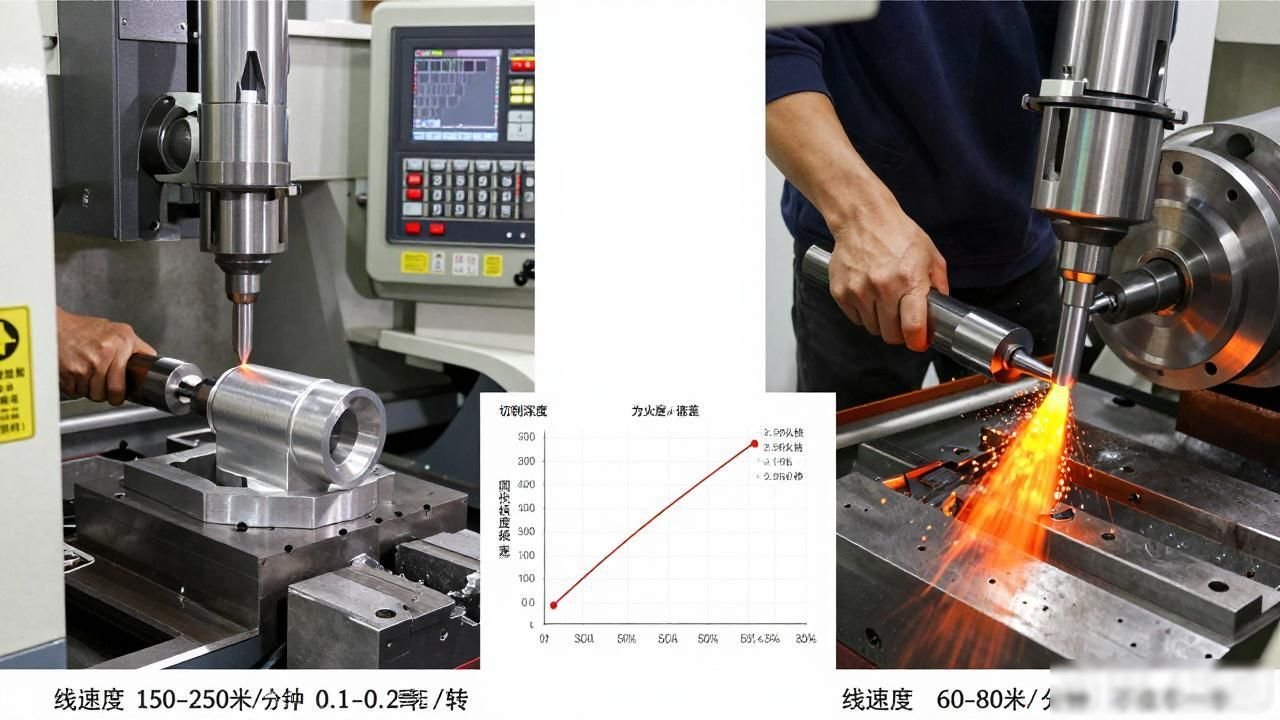
During the machining process, the cutting speed, feed amount and depth of cut need to be coordinated. When processing the inner hole of aluminum alloy, the linear speed is recommended to be in the range of 150 to 250 meters per minute, and the feed rate is 0.1 to 0.2 mm per revolution. If processing quenched steel, the speed needs to be reduced to 60 to 80 meters per minute. At the same time, the feed amount is halved. In 2023, ① should be able to ensure the accuracy and precision of the workpiece being processed. A company in Ningbo found through orthogonal experiments that when the depth of cut exceeds 0.5mm, the cylindricity error of the inner hole will increase significantly. Therefore, it is recommended that the depth of cut be controlled at 0.3 to 0.5mm during rough Bearbeitung and 0.1 to 0.2mm during finishing. And leave a margin of 0.05mm for making a light knife.
Cooling and chip removal techniques
During internal hole machining, the coolant must be sprayed directly towards the cutting zone. In 2025, a company in Changzhou uses a high-pressure internal cooling system (pressure is 5MPa), which increases the chip removal efficiency by 60% and extends the tool life to 1.8 times. For blind hole processing, pulse cooling can be used, that is, cooling is paused every few millimeters of processing, so that chips can be flushed out. If you are machining cast iron, dry cutting is more advantageous than wet cutting because the coolant may cause the cast iron chips to mix with the cutting fluid and turn into a sludge. This muddy object may clog the chip chute.
Dimensional control and inspection methods
The control of the inner hole size relies on real-time detection. During processing, an inner diameter dial indicator or a pneumatic measuring instrument is often used. In 2024, the Jinan factory introduced an online measurement system. The workpiece diameter accuracy is steadily maintained within the IT6 level. The operator must measure once after rough machining, after semi-finishing, and after finishing. Record the data and observe its trend. Changes in temperature have a significant impact on the hole diameter. The same process size may differ by 0.01 – 0.02mm in summer and winter, and the compensation value needs to be adjusted based on room temperature.
Frequently asked questions and solutions
Tool overhang and spindle runout are the first things to check when vibration marks appear on the surface of the inner hole. Loose tools, worn chucks, and unlocked blades are all common causes. In 2023, an auto parts factory in Guangzhou observed that the inner hole roughness of a certain batch exceeded the key points of standard CNC turning inner hole processing . The reason was that the blade was worn by 0.03mm. If the hole diameter is too large or too small, it needs to be checked whether the tool nose radius compensation value in the program is accurate. Low coolant concentration can also lead to increased cutting heat, triggering thermal expansion, cooling and shrinkage after machining, resulting in smaller hole diameter.
During the actual processing, have you ever encountered a situation where the surface roughness of the inner hole suddenly deteriorates? How did you check it and how did you solve it? Please leave a message in the comment area to share your experience, like and bookmark this article so that you can check it at any time.
Schreibe einen Kommentar
Du musst angemeldet sein, um einen Kommentar abzugeben.