
Is the efficiency of five-axis machining of complex stainless steel parts low? Tianxuan Seiko uses turning and milling to solve the problem of one-time clamping
When processing complex parts, circumferential features, end-face shaped holes and inclined surfaces must be processed at the same time. Traditional three-axis or four-axis equipment often requires repeated clamping, which ultimately leads to accumulated errors and low efficiency. The stainless steel cavity of a certain semiconductor device contains 6 beveled threaded holes, an internal annular groove and 3 radial cross holes. In the past, it took 3.5 hours to process, but now using five-axis linkage technology, one clamping only takes 1.2 hours, and the time is reduced by two-thirds.
The core advantages of five-axis linkage
Among five-axis machine tools, the B-axis milling head and the C-axis turning spindle work together to achieve five-axis linkage interpolation. This means that after the part is clamped, all feature machining can be completed without multiple positionings. For difficult and difficult-to-machine materials such as 316L stainless steel, this technology completely eliminates errors caused by datum conversion, and you no longer have to worry about concentricity deviations or positional deviations caused by multiple clampings.
One machine tool integrates turning and milling. Turning and milling are integrated on the same machine tool. This is CNC turning and milling composite processing. First, the outer circle and end face are processed by the precision CNC lathe, and then the power tool directly performs side milling and oblique hole drilling at the same position. The time of handling and repositioning is saved by this "one-time clamping" mode, and the relative position of each feature becomes more accurate. The six beveled threaded holes that previously needed to be processed in two steps are now processed in one go.
Material Cooling and Cutting Strategies

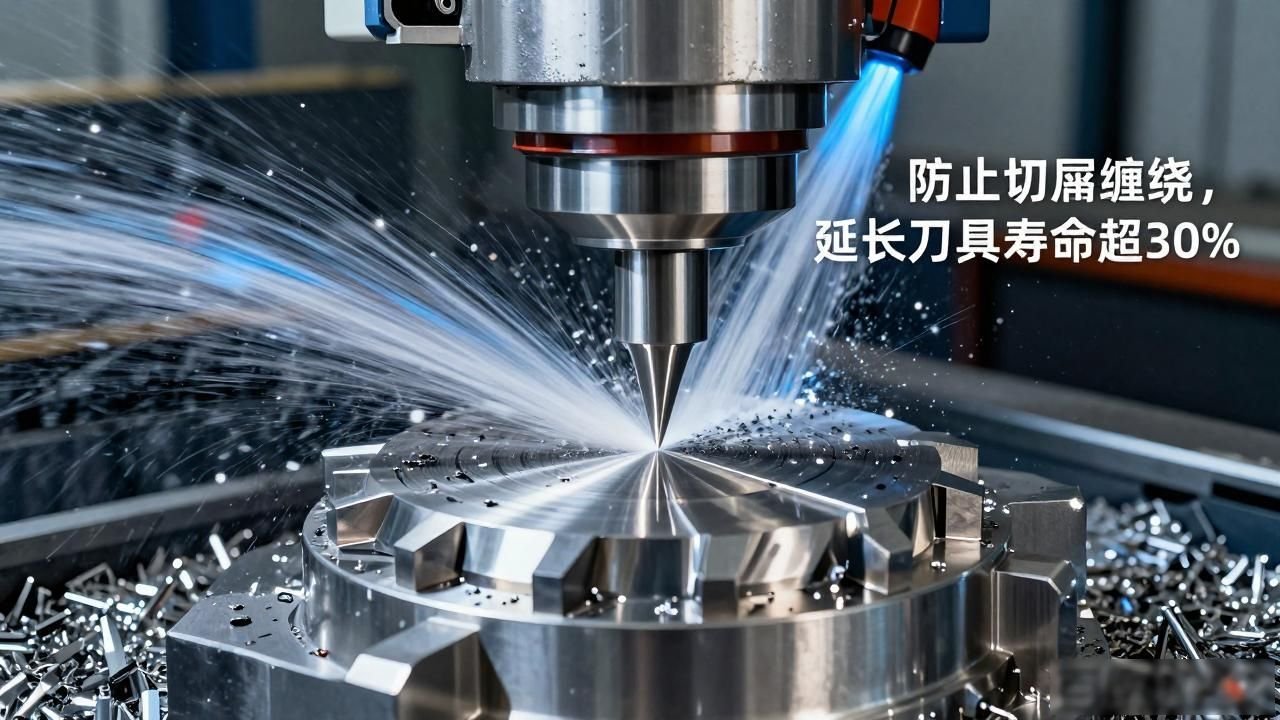
When processing 316L stainless steel, chips tend to wrap around the tool, thereby affecting the surface quality. We use a trochoidal milling strategy to reduce the peak cutting force through the arc motion of the tool path and prevent local overheating. At the same time, the spindle center water outlet system sprays coolant directly to the cutting area with a high pressure of 20 bar, forcibly breaking chips and taking away heat. This approach extends tool life by more than 30%.
When this strategy is applied to aluminum alloy parts, the effect will be more significant. Aluminum alloy has the characteristics of fast heat conduction and easy adhesion of chips. High-pressure coolant can quickly wash away the chips, thereby preventing the formation of built-up edge. This technology is also applicable when you are processing parts made of mixed materials of stainless steel and aluminum alloy, such as robot joint components. The combination of the turning and milling composite processing of the centering machine and the five-axis process greatly improves the dimensional consistency of the key mating surfaces.
Data validation and batch stability
We tested a robot joint part, which is made of a mixed material of stainless steel and aluminum alloy. After optimization through the five-axis process, the size CpK value of the key mating surface can reach 1.33, which shows that more than 99.7% of the parts are within the tolerance range. In a mass production of 2,000 pieces, only 22 parts are out of tolerance due to tool wear, and the quality rate is as high as 99.9%. This kind of stability is of great significance for high-precision equipment.
Batch-to-batch consistency of stainless steel parts has always been a processing problem. Traditional multiple clamping methods tend to introduce human errors, but five-axis clamping at one time can unify the datum plane of each part. Even for large orders of 2,000 pieces, you can ensure that the size of each part fluctuates very little. This is due to the strict process review and sample verification process. We will fully optimize the tool path, cooling parameters and clamping methods before mass production.
Full link technical support
Whether you are engaged in CNC machining of aluminum alloy parts or customizing complex stainless steel parts, the engineering team will provide full-link support from process review to batch stable results. The first step is to analyze your existing part drawings to conduct manufacturability exploration and troubleshoot potential problems, such as difficult-to-machine bevels or deep holes. Then it needs to be verified with samples to prove the feasibility of the solution, and finally mass production can be started.
Facing technical challenges alone, we won't let you. For complex parts, if you want to reduce the number of clamping times or improve the yield, you can directly provide the drawings. We will give detailed cost optimization suggestions for equipment selection, tool configuration and processing parameters. High-difficulty processing does not mean high cost. Don't let this happen. This is the value of five-axis technology.
Expansion of practical application scenarios
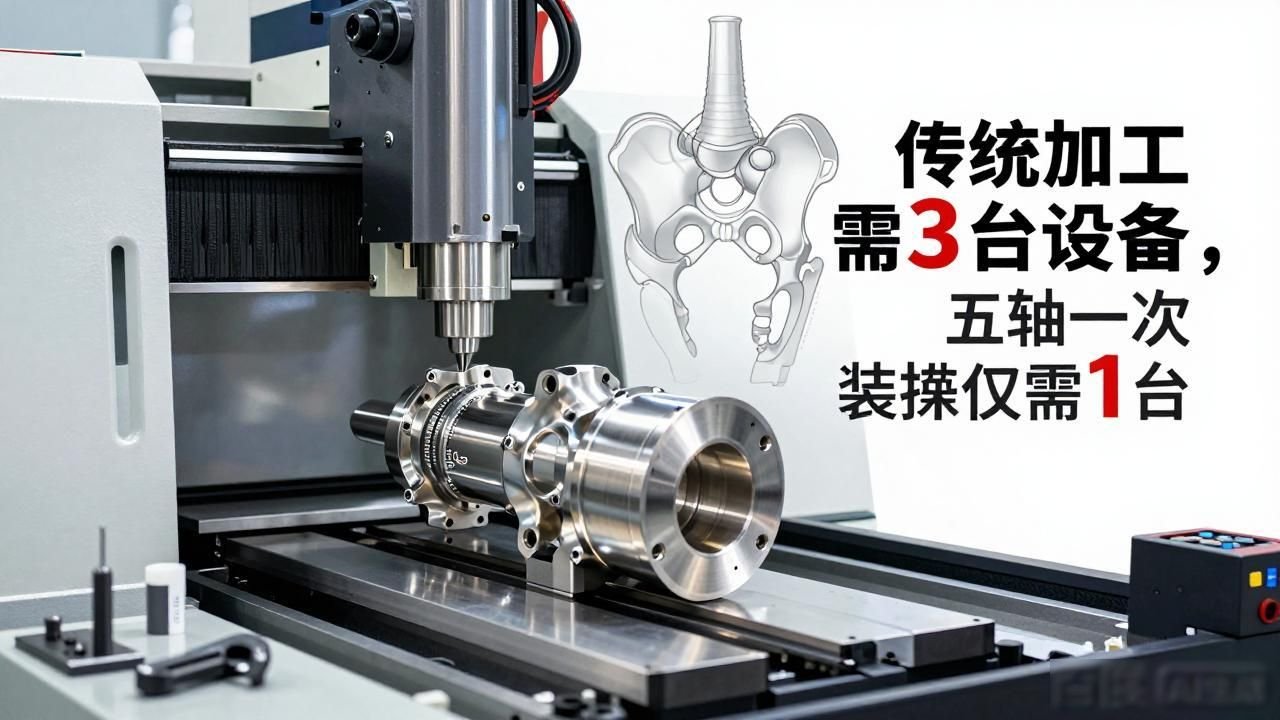
Semiconductor equipment cavities are just one example. In the fields of medical equipment, aerospace and precision molds, five-axis one-time clamping technology is changing the traditional processing model. For example, a hip joint component that requires processing of circumferential grooves, end holes and bevels may have required three pieces of equipment in the past. Now a five-axis machine tool can do it, and the time has been reduced from 8 hours to less than 3 hours.
As far as aluminum alloy machining is concerned, the efficiency improvement is more obvious. Aluminum alloy materials are soft in texture, but vibrations are prone to occur during high-speed cutting. Five-axis linkage can dynamically adjust the tool attitude so that the cutting angle is always in an optimal state, thereby reducing vibration and improving surface finish. This shows that higher-quality parts can be obtained in a shorter time.
Balance between cost and quality
Many people are worried that the cost of five-axis machining is high. However, in fact, one-time clamping reduces the cost of fixtures and reduces manual intervention time. Stainless steel parts generally need to be annealed and repositioned multiple times. Now these related links have been streamlined. Taking a batch with a specific quantity of 2,000 pieces as an example, the total processing time dropped from the original 7,000 hours to 2,400 hours, and the cost evenly divided into each part was actually even lower.
The hidden benefits brought by quality improvement cannot be ignored. The yield rate of 99.9% means that rework and scrap are basically zero. If you are worried about the dimensions of complex stainless steel parts exceeding the tolerance range or surface roughness problems, you may wish to try the five-axis one-time clamping solution. We are always ready to provide you with process review and manufacturability analysis reports.
Excuse me, do you have any complex parts that require lower clamping times? Please leave a message and share your processing problems, and we will give targeted five-axis optimization suggestions. If you find this article useful, please give it a like and forward it to friends in need.
Leave a Reply
You must be logged in to post a comment.