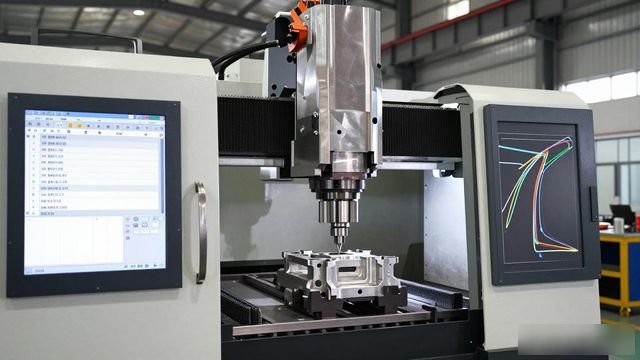


Four turning and milling composite machining programming technical knowledge points worth learning!
There are many programming types for titanium alloy processing and programming strategies . The craftsman’s efforts are not only in the operation.
In the combined processing of turning and milling, craftsmen must not only master the programming methods of CNC turning, but also be proficient in the programming logic of different processes such as multi-axis milling and drilling. Each process has its own unique advance and retreat tool paths and parameter settings, which shows that craftsmen must be familiar with multiple programming rules at the same time, otherwise the machining process is prone to errors. What’s even more troublesome is that the connection between different processes also requires precise control. For example, after turning is completed, how to smoothly transition to milling requires the craftsman to have an intuitive understanding of the currently processed model and margin distribution. For example, in 2025, there was an aerospace parts factory in Suzhou. Programmers there reported that when they were processing titanium alloy thin-walled parts, it took them three hours just to adjust the advance and retreat paths of the turning and milling connections, and even the slightest carelessness would cause the parts to deform.
The programming sequence must strictly match the process path

When a part is processed from a blank into a finished product, the results presented by program compilation must be completely consistent with the actual process path. For example, when processing a titanium alloy suspension part, whether to turn the outer circle first or start milling the inner cavity first? Once this order is disrupted, subsequent tool collisions and margin errors will appear one after another. At the same time, it is worth mentioning that turning and milling compound processing often involves multi-channel parallel processing, such as the main spindle and the sub-spindle being in working condition at the same time. At this time, the serial and parallel sequences during programming must be strictly determined based on the process path. Many factories have discovered in the actual production process that if they do not develop a system that integrates process programming simulation, craftsmen will have to repeatedly conduct trial cuts, which is time-consuming and will increase costs. Last year, there was an auto parts factory in Zhejiang. Due to an error in the programming sequence, a batch of shock absorber blanks were scrapped during the processing. The final direct loss exceeded 80,000 yuan.
General CAM software has limited support, and high-end functions are all manually added.
At present, the mainstream and general CAM software has not yet reached a comprehensive level of support for turning and milling combined processing. For example, the online measurement function is used to detect the dimensional changes of the workpiece in real time during the machining process. However, general-purpose software is often unable to directly generate the corresponding code. Another example is advanced functions such as sawing, automatic feeding, and tailstock control. The software either does not support them, or the generated programs require a lot of manual adjustments. Taking the processing of titanium alloy parts as an example, the program generated by general-purpose software often exhibits hysteresis when controlling the movement of the tailstock, resulting in unstable workpiece clamping force and a decrease in surface finish. Therefore, many craftsmen have to use manual or interactive methods to complete these codes, which not only increases the workload of programming, but also places extremely high requirements on the experience of the craftsmen. A medical device parts processing factory in Shanghai conducted statistics and found that after using general-purpose software programming, each process requires an average of 20 extra lines of manual code modification.
Processing program independent titanium alloy processing programming strategy , integration is a big problem
NC programs compiled by general CAM software are usually independent of each other. For example, turning programs are separate files, milling programs are separate files, and drilling programs are also separate files. To achieve automated and complete processing of turning and milling, these independent programs must be integrated according to the process route. First, it is necessary to clarify which programs can be run in parallel. For example, while the main spindle is processing, whether the sub-spindle can simultaneously clamp the next blank. Then it is necessary to give precise tool change instructions, give precise claw replacement instructions, give precise reference conversion instructions, and give precise instructions for advancing and retracting the tool. Take titanium alloy connector processing as an example of titanium alloy processing programming strategies . If there is an uncoordinated program integration situation and interference occurs between the tool and the workpiece during the tool change process, then the tool will be damaged in a minor case, and the machine tool will stop running in a serious case. In 2024, there was a factory in Dongguan engaged in electronic parts processing. It was precisely because the reference conversion instructions were omitted during program integration that all the radiator bases were offset, and the rework and scrap rate was as high as 15%.
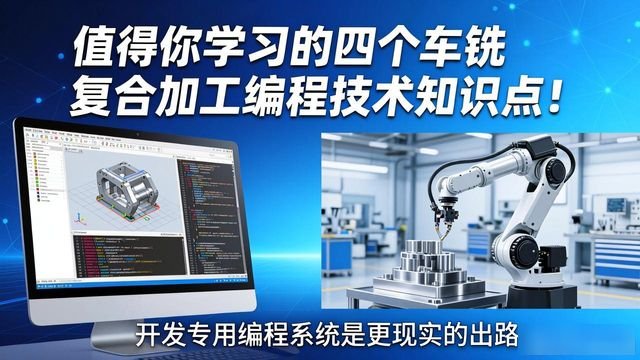
Developing a dedicated programming system is a more realistic way out
On top of existing general-purpose CAD/CAM software, developing a dedicated programming system suitable for specific product technologies and composite processing equipment can effectively make up for the shortcomings of general-purpose software. On the one hand, it can reduce repeated investments in software purchases. For example, it is not necessary to purchase high-end CAM modules separately for each composite processing machine tool. On the other hand, it can also avoid problems such as the inability to reuse process knowledge and more complicated staffing due to inconsistent programming platforms. For example, there is a factory in Shenzhen that specializes in aerospace parts processing. It has independently developed a set of turning and milling composite programming plug-ins. This plug-in is based on general-purpose software and specifically optimizes the advance and exit tool paths for titanium alloy and high-temperature alloy materials. The programming efficiency has been increased by 40%, and the processing qualification rate has increased from 82% to 94%. This solution is particularly pragmatic for small and medium-sized enterprises.
Materials and products are diversified, and programming strategies must be tailored to suit aptitude.
The types of parts involved in turn-milling composite processing are extremely complex and diverse, including aluminum alloy materials, stainless steel materials, then titanium alloy materials, then nickel-based alloy materials, then Invar alloy materials, and then there are Kovar alloy materials. Four turn-milling composite processing programming technical knowledge points worth learning! , and finally there are high-temperature alloy materials and engineering plastic materials. There are huge differences in the cutting characteristics of each material. For example, the thermal conductivity of titanium alloy is very poor. When programming, you need to deliberately reduce the feed speed and increase the cooling path; however, the thermal expansion coefficient of Invar alloy is extremely low. If you do not accurately control the machining allowance during programming, it will lead to out-of-tolerance phenomena in the dimensions, and you have to deliberately control the machining allowance accurately. In terms of products, it covers precision mechanical parts, medical precision parts, optical fiber communication parts, automotive shock absorbers, suspension parts, and finally connectors. Each type of product has different requirements for processing accuracy and surface quality. Therefore, programming strategies must adopt different methods according to different situations. For example, when processing aerospace parts, tool life and burr control are important considerations. However, when processing medical device parts, more emphasis is placed on surface finish and stress-free processing.
When you are in an enterprise, what is the most prominent pain point you encounter in the field of turning and milling composite programming? Is it a lack of functionality in the software itself, or is it an obvious lack of experience among the craftsmen engaged in this type of work? We sincerely welcome you to share your practical experience in the comment area, like it, and then forward it to more peers, so that everyone can explore more efficient programming solutions together!



暂无评论内容