

What are the riveting processes?
Manual riveting is the most basic and flexible
Manual riveting work, carried out directly by workers with the help of hammers or manual rivet guns, is suitable for small batch production or repair-related scenarios; according to data from a car modification factory in 2025, 70% of its aluminum alloy parts are repaired using manual riveting. This is because the cost of the tools involved in this method is relatively low, and it can be started quickly. Even an apprentice can master the basic operations in just half a day.
The strength of manual riveting is mainly controlled by workers' techniques. It is suitable for aluminum alloys, stainless steel, and titanium alloys. In construction sites, workers often use it to fix light steel keels. For a skilled worker, he can complete 300 riveting points every day. Although its efficiency is not high, it is flexible.
The efficient solution preferred by major hydraulic riveting manufacturers
Hydraulic riveting is driven by oil pressure and can rivet multiple points at one time. It is suitable for automobile and aircraft production lines. In 2024, after a domestic aircraft assembly workshop introduced hydraulic riveting equipment, the riveting time of a single aircraft was reduced from 72 hours to 48 hours, and the tensile strength increased by 15%.
This process has outstanding sealing properties and can effectively reduce vibration and noise. In the field of bridge construction, hydraulic riveting is used to connect thick steel plates. One hydraulic head can generate 50 tons of pressure to ensure that the joints will not loosen under long-term heavy load conditions, especially for high-strength nodes in multi-layer and multi-pass riveting technology for thick plates .

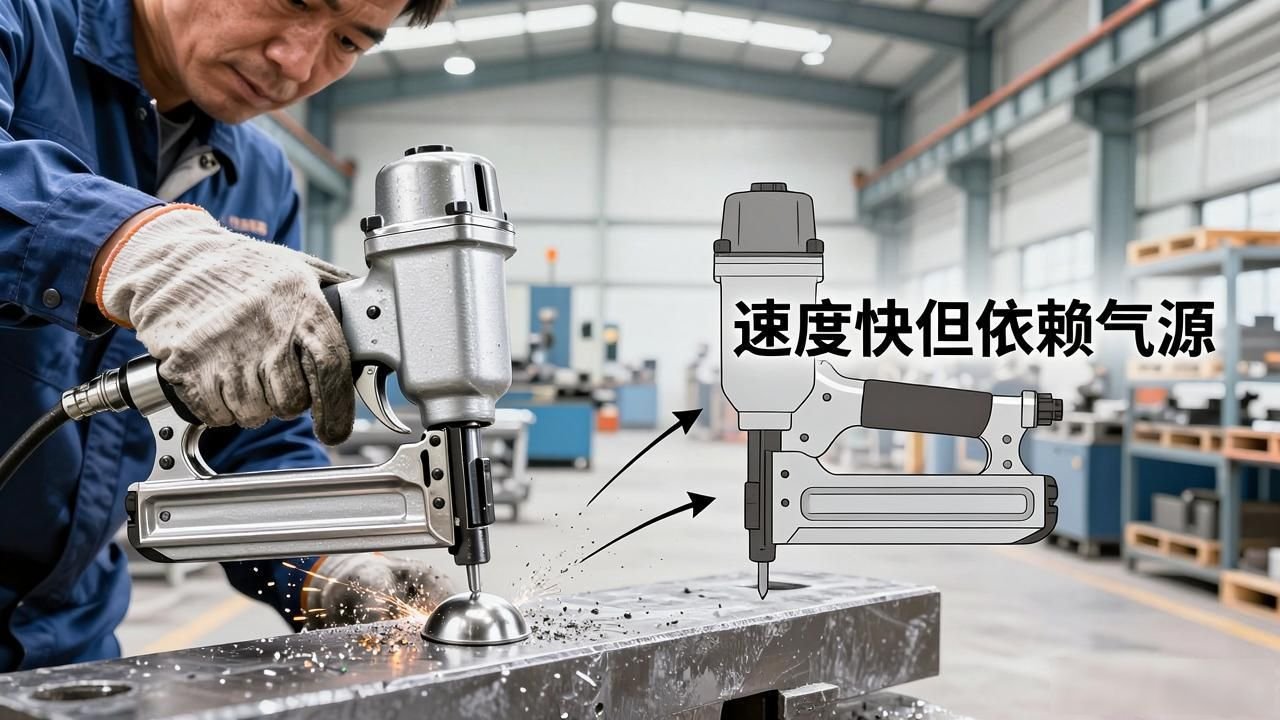
Pneumatic riveting is fast but relies on air source
For pneumatic riveting that requires compressed air supply, the compressed air is supplied by an air compressor. This method is suitable for factory assembly line operations. In 2023, a hardware factory in Zhejiang used a pneumatic rivet gun to produce tool boxes. It could achieve 8 riveting operations per minute, which was three times faster than manual operation. However, when the air source pressure is in an unstable state, it is easy to cause the rivets to deform.
This process focuses on small-pore materials, such as thin steel plates and plastic parts. When assembling car interiors, pneumatic riveting can quickly fix the seat bracket. The cost of a pneumatic tool is about 2,000 yuan. It is easy to maintain, but the noise is relatively loud, and workers have to wear earplugs.
An upgrade option for electric riveting smart manufacturing
A new technology that has emerged in recent years is electric riveting, which directly drives the rivets through a motor and does not require an external air source or hydraulic pump. In 2025, a smart home appliance factory introduced an electric riveting robot. After that, the yield rate increased from 92% to 98%, and each riveting cycle only takes 1.2 seconds. This technology is suitable for carbide connections.
During electric riveting, the torque can be precisely controlled, and it is suitable for large hole diameters and thick plates. In the process of manufacturing high-speed rail carriages, electric riveting can handle 10 mm thick steel plates. Its joint strength is 20% higher than that of manual methods, and it produces lower noise, making it suitable for workshops that have certain requirements for the working environment.
How to choose a suitable riveting method
The choice of riveting method depends on the material, output and cost. If it is for small batch repair or sample production, manual riveting is the most economical. For large-scale production of cars or aircraft, hydraulic or pneumatic riveting will be more cost-effective. In 2024, a heavy industry company found through comparison that the single-point cost of hydraulic riveting was less than 30% compared to manual, but its initial equipment investment required 150,000 yuan.
The automated production line is suitable for electric riveting, such as mobile phone cases or precision instruments. In the multi-layer multi-pass riveting technology of thick plates , hydraulic riveting and electric riveting are the mainstream, because they can ensure the tightness between multi-layer steel plates and prevent delamination or loosening.
Future trends: intelligence and multi-material compatibility
Relevant progress in riveting processes is continuing to develop in the direction of intelligence and multi-materials. In 2025, an equipment manufacturer from Germany launched an AI riveting system that can detect the deformation of rivets in real time and adjust the pressure, ultimately reducing the scrap rate to less than 0.5%. At the same time, more and more hybrid structures of carbon fiber and aluminum alloys have appeared, which requires riveting tools to be compatible with different hardnesses.
In China, battery packs for new energy vehicles use riveting extensively, and the industry’s usage will increase by 40% in 2024. In the future, the riveting process will be combined with welding and gluing to form a composite connection technology to achieve higher strength in multi-layer and multi-pass riveting welding of thick plates.
In the industry you are currently in, which riveting method is currently used, whether it is manual, hydraulic, or electric. I look forward to sharing my experience in the comment area, liking this content and forwarding this content so that more people can see it.




暂无评论内容