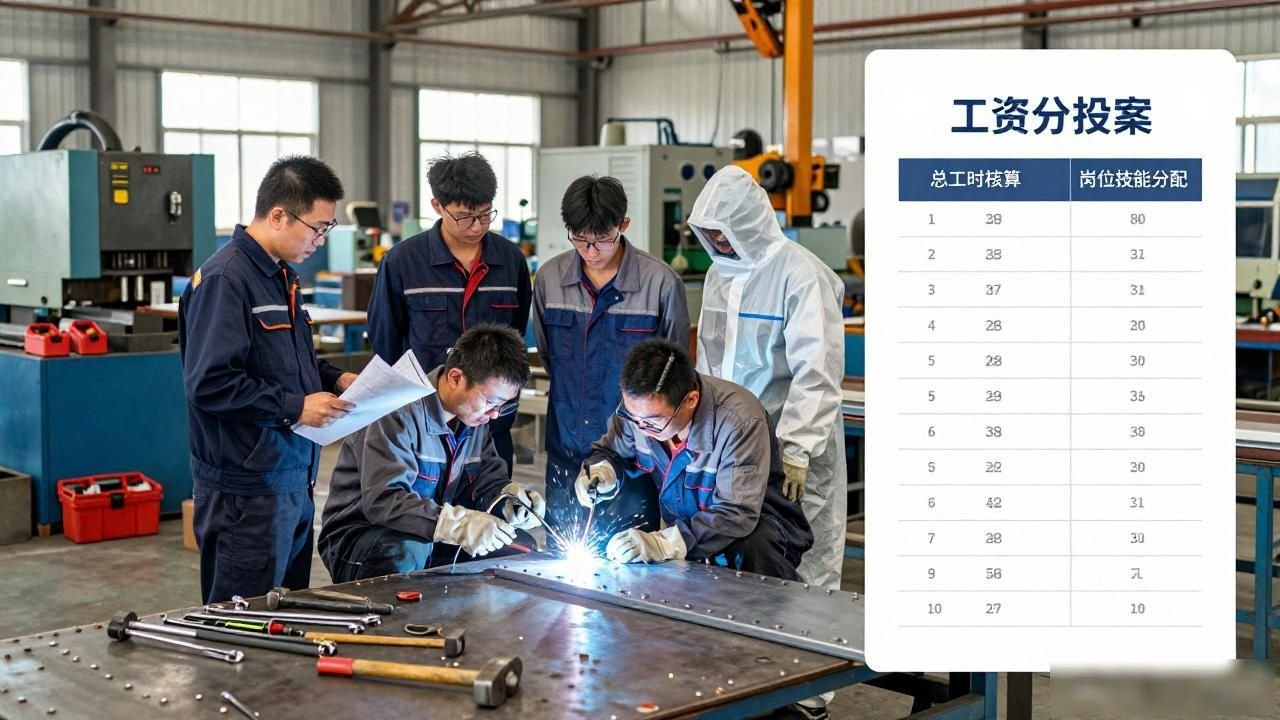


Riveting and welding man-hour quota plan
Working hours quota solves egalitarianism
There are many riveting and 焊接 teams that work but do not work hard. No matter whether they work more or less, they get the same money. This kind of egalitarianism causes an imbalance in the minds of employees with good skills, which ultimately leads to low production efficiency. The working-hour quota program is to break this situation, so that everyone's income is directly related to the amount of work completed, and truly achieve more work, more gain.
In 2025, there was a machinery manufacturing factory that implemented a fixed wage system in the riveting and welding workshop. After that, the monthly output of the team increased by 35%. After that, the gap between the highest and lowest workers' monthly income reached 2,500 yuan. However, it was this gap that actually inspired everyone's enthusiasm for work and good mood. Technical employees took the initiative to recruit new people, and ultimately the overall efficiency was significantly improved.
Job salaries are set in five levels
Each position is not a fixed dead salary model, but has five levels. The first level corresponds to the expected salary, the second level corresponds to the qualified status, the third level corresponds to the competency situation, and the fourth level corresponds to the super-competence situation. The level difference is between 5% and 25%, and the usually selected one is 12%. This way, employees can clearly know how much money they can earn based on their performance.
For example, if a riveter moves from a qualified level to a competent level, his salary can increase by 400 yuan every month. Such a ladder-style design not only gives employees short-term goals, but also avoids excessive wage growth. Every time employees advance to a level, they can notice a real change in their actual income, and they will have a stronger sense of direction when working.
Collective piecework is settled according to the team

The team is composed of five people, including one person as the team leader, two riveters, a general worker and a welder. At the end of each month, the total salary will be calculated based on the total working hours or total output achieved by the team, and the total salary will be paid in full to the team. Wages will be distributed within the team according to individual positions and skill levels, and the distribution ratio will be determined after review by the production department.
In November 2025, one of the riveting and welding classes completed 1,800 hours of work. Calculated based on the fixed unit price, the total salary was 54,000 yuan. The squad leader distributes the work based on each person's working time contribution. The welder gets the highest share, and the general worker gets 1.5 times the basic share. Such an internal settlement method gives the team autonomy.
Temporary tasks are also compensated
In addition to regular production tasks, the team will also receive temporary assignments or rework tasks. These tasks are not part of the plan, and this kind of labor cannot be done in vain. At the same time, the quota officer will issue a compensation order for the hours worked. Compensated working hours are calculated based on basic wages to ensure that employees do not do useless work.
In August 2025, a certain team had a problem with materials and a batch of workpieces needed to be reworked, which cost an additional 60 hours. This was one of them. The quota officer issued a compensation bill on the same day, calculated based on the basic salary of 28 yuan per hour, and the team received an extra 1,680 yuan, which was the second. The third reason is that employees feel at ease and will not suffer losses due to no fault of their own.
Insufficient production tasks guarantee basic salary
When faced with insufficient production tasks, the company cannot leave workers alone. The plan clearly stipulates that the company must guarantee basic wages and pay them in accordance with the monthly minimum wage per person. This gives employees the most basic sense of security and is targeted at workers who have just entered the company or whose skills are still in the improvement stage.
A certain riveting and welding team did not receive any major orders for two consecutive weeks after the Spring Festival in 2025, so the production department arranged for them to do on-site cleaning and equipment maintenance. During those two months, everyone's minimum salary was paid as usual, and no one chose to resign. Employees said that the company will not get rid of the burden just because there is no work. Everyone is willing to wait for orders to come back again and then work harder.
Unable to pay fixed quota and hourly salary
All riveting and welding teams must implement a working-hour quota contract system. If this system cannot be implemented for three consecutive months, the team leader must be replaced. This is a rigid rule. The purpose is to force the team to improve management in this way. If the team does not implement the quota system, wages will be paid according to hourly wage standards, which will significantly reduce income.
In June 2025, due to poor internal cooperation, a certain team was unable to complete the quota tasks for two consecutive months. The production department intervened to make adjustments, and then the team leader took the initiative to organize skills training. In the third month, the quota for riveting and welding hours was finally achieved. The workers said that the quota system stimulated potential, and now they can get 800 to 1,000 yuan more per month, and everyone is happy to work.
I would like to ask the last question: Is the riveting welder hour quota set by your factory reasonable? You are welcome to share your own practical experience in the comment area. If you find it useful, please give it a like and forward it to more colleagues.



暂无评论内容