
Detailed explanation of the differences between 16Mn, Q345 和 Q355 steel grades
The true identity of the third generation brand
Low alloy structural steel with a carbon content of 0.16% and a manganese content of about 1.5% is called "16 manganese". It is an old brand in the 1988 national standard GB 1591-88. Its full name is "16Mn". In the statistics of steel used in national steel structures in 2022, the content is about 0.16% carbon and about 1.5% manganese. It is called "16 manganese", and its full name is "16Mn". The old brand in the 1988 national standard GB 1591-88 was the main force in the industry before the 1990s. At that time, its output by steel plants accounted for more than 60% of the total low alloy steel. "Q", which represents the initial letter of the pinyin of the word "Qu" for yield strength, is combined with the minimum yield strength of 345 MPa to form "Q345". After the standard was updated in 1994, it replaced the previous content of 0.16% carbon and 1.5% manganese, which was called "16 manganese". The full name is "16Mn", which belongs to the 1988 national standard GB 1591 – As a new brand with the status of an old brand in 88, Q345 production has always accounted for about 35% of the national steel structure steel in 2022. Q355 is a brand new grade launched in 2018 according to the national standard GB/T 1591-2018. Its minimum yield strength has been increased to 355 MPa, making it the main variety under the current standard.
How is Q345 better than 16Mn?
The yield strength of Q345 is about 10% higher than that of 16Mn, from 315 MPa to 345 MPa. More importantly, the chemical composition of Q345 is controlled more strictly, such as the phosphorus content, which is reduced from the upper limit of 0.045% of 16Mn to 0.030%, and the sulfur content is reduced from 0.045% to 0.025%. This shows that the welding performance and resistance to brittle fracture of Q345 are significantly better. Taking the steel structure project of Beijing Daxing Airport as an example, all grades of Q345 and above are used, and the welding qualification rate reaches 98.5%, while under the same conditions, the qualification rate of 16Mn is only about 92%. There is a treatment method for stress relief of riveted weldments. In this treatment, after tempering at 600°C, the residual stress of Q345 material can be reduced to less than 15% of the original value. Compared with 16Mn, where the residual stress is reduced to 20% of the original value after the same treatment, the performance of Q345 is more stable.
Why Q355 can replace Q345

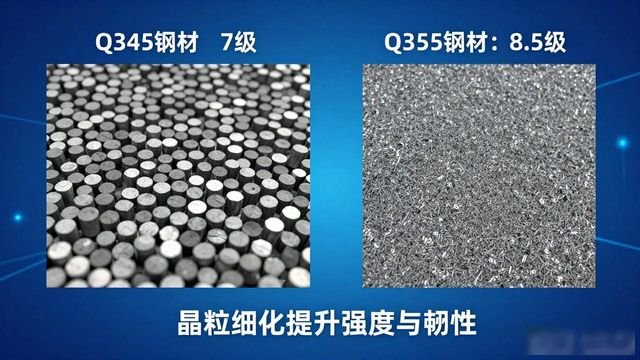
On the basis of Q345, Q355 adds trace elements such as vanadium, titanium, niobium, etc. These elements can refine the grains and increase the grain size of the steel from Q345 grade 7 to about 8.5. The smaller the grains, the higher the strength and better toughness. Actual tests show that the impact energy of Q355 at -20°C can reach 47 Joules. Compared with Q345's 34 joules, it is nearly 40% higher. During the construction of the 2023 Hangzhou Asian Games venues, the main structures were all made of Q355, and the low-temperature toughness index successfully passed the -40°C acceptance. For riveted weldments, the hardness of Q355 in the welding heat-affected zone shows a more uniform distribution, which can reduce stress concentration points. During the stress relief process, the required holding time can be shortened by 10% to 15%.
How to choose materials for new and old projects
New projects are given priority to use Q355, which is the grade recommended by the current national standard. Steel mill production is stable, the purchase price is 3% to 5% higher than Q345, and the performance is significantly improved. In 2024, the Q355 output of mainstream domestic steel plants such as Baowu and Anshan Iron and Steel will account for more than 55% of the total low alloy steel. For the renovation of old projects, the original design is 16Mn, which can be replaced by Q345 or Q355. Pay attention to grade matching. The impact energy level of 16Mn is 20 Joules (room temperature), and the impact energy level of Q235D is 27 Joules (-20°C). The two cannot be mixed directly. When carrying out modification operations, it is more appropriate to carry out a welding process qualification to ensure that the new materials match the old materials in terms of welding parameters.
Key Points of Stress Relief Treatment
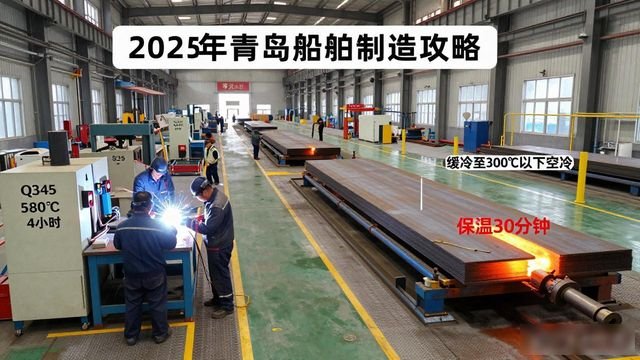
To eliminate the stress of rivet weldments of Q345 and Q355, we mainly rely on tempering heat treatment, which is very effective in removing stress. As for the processing temperature, it generally needs to be controlled in the range of 580°C to 620°C. The holding time is scientifically calculated as 1.5 minutes per millimeter of thickness. For a Q345 steel plate with a thickness of 20 mm, the heat preservation time is 30 minutes, and then slowly cooled to below 300°C and then air-cooled, the residual stress can be reduced to below 50 MPa. Since the grains of Q355 are finer, the tempering temperature can be appropriately lowered to 560°C to 600°C to prevent the grains from growing. A certain year is 2025. At a shipbuilding plant in the Qingdao area, during the welding of the Q355 hull structure, a tempering operation of 580 degrees Celsius was used for 4 hours. The stress relief rate reached 92%, which is much higher than the 80% of 16Mn. If there are restrictions in conditions that prevent overall tempering, then low-temperature stress relief treatment can be carried out in sections.
Welding process adjustment and testing
The welding parameters of Q345 and Q355 are slightly different. The key is to control the heat input. The recommended heat input for Q345 is 15 to 25 kilojoules per centimeter. In view of the presence of vanadium and titanium elements, the heat input for Q355 needs to be controlled at 12 to 20 kilojoules per centimeter. Otherwise, it is easy to produce coarse grains. In terms of welding material selection, Q345 uses E5015 electrodes, and Q355 uses E5515 electrodes. The strength level must match, and post-weld inspection must use ultrasonic flaw detection, which is performed in accordance with the GB/T 2970 standard and usually requires Level I qualification. The Q355 steel plates were welded piece by piece. In a certain bridge project in Shanghai in 2024, a 100% ultrasonic inspection was carried out. The results showed that the defect rate was only 0.3%, which was far less than the 1.2% of alloy structural steel 16Mn. In terms of stress relief for riveted weldments, the final result is that the blind hole method can be used to measure residual stress. The qualification standard stipulates that the residual stress must be less than 30% of the material's yield strength.
When faced with the decision between Q345 and Q355, what makes you most undecided is the price difference or the performance requirements? You are welcome to share your own actual operation experience in the comment area. Like and bookmark this article to help you avoid the traps caused by material selection and stress relief processing.
发表回复
要发表评论,您必须先登录。