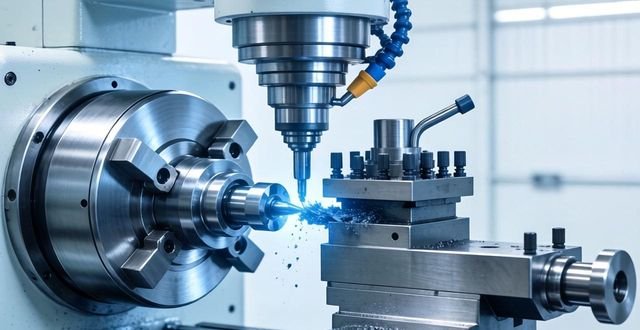


Application examples of turning-milling composite lathes in complex parts processing
Why the turning-milling lathe has become the new favorite in manufacturing
For turn-milling composite lathes, their popularity has risen sharply during this period of manufacturing industry upgrading in recent years, and they have become popular as a turn -milling composite processing industry application . It combines the functions of traditional lathes and milling machines into a whole, and uses a CNC system to control all movements. It turns out that you have to move the workpiece back and forth between the lathe and the milling machine. Now it is no longer necessary. The transfer time can be reduced in the turning and milling composite processing industry , and errors caused by repeated clamping can also be avoided. Many factories have noticed during the actual application process that such a device can shorten the production cycle by more than 30%, especially in small batches and multi-variety orders. The advantage of flexibility it possesses is even more obvious.
How turning and milling work together on one machine
Turning function realizes basic machining
The turning part relies on the spindle to drive the workpiece to rotate, and the turning tool makes feed movements in the axial or radial direction to achieve the processing operations of outer circles, inner holes and threads. The rotation speed of the spindle can generally reach thousands of revolutions per minute, and the high-rigidity tool holder can ensure the smoothness of the surface. In the actual operation process , when applied in the turning and milling composite processing industry , the operator only needs to include the processing parameters in the CNC system, and the system can automatically complete the rough turning and finishing turning processes. For example, when processing shaft parts with a diameter of 80 mm, a single turning operation can control the dimensional error within 0.01 mm.
Milling function expands processing dimensions
A high-speed rotating milling cutter is used to process a flat surface, an inclined surface, or a groove on the workpiece. This is the milling part. The milling cutter spindle is usually equipped with an independent drive system, and its rotation speed can reach more than 10,000 revolutions per minute. When processing complex shapes, the system will automatically switch tools and adjust the feed speed. For example, when processing aluminum alloy casings, the milling function can process the flange surface and positioning grooves in one go, without the need for secondary clamping. This multi-axis linkage capability allows the equipment to handle special-shaped parts that are difficult to complete with traditional machine tools.
How the CNC system becomes the brain of the equipment
The core control unit used for turn-milling lathes is the CNC system. After receiving programming instructions, it will calculate the tool trajectory in real time, and at the same time, it will coordinate the spindle to rotate, control the feed movement and the tool magazine change action. As for the mainstream Siemens 840D system on the market, its operation cycle is only milliseconds, and it can handle the synchronous control of multiple servo motors at the same time. As long as the operator designs the processing program on the computer, the system will automatically detect tool wear and adjust the cutting parameters. After an auto parts factory introduced this system in 2025, the processing qualification rate increased from 92% to 98.5%.

Four practical advantages brought by turning and milling combined processing
Efficiency improvements are visible
In traditional processing situations, for a complex part, it requires three clampings of a lathe, a milling machine, and a drilling machine. However, the turning and milling compound lathe is different. It can complete the entire process in one clamping operation. According to actual measured data from a mold factory, when processing a set of automobile engine brackets, the time taken was reduced from the original 6 hours to 3.5 hours. Moreover, the time of transfer and waiting is almost eliminated, allowing workers to take care of multiple pieces of equipment at the same time. This improvement in efficiency has directly translated into an increase in production capacity, helping the company to quickly complete deliveries when orders are in peak season.
Precision control is more stable
The CNC system eliminates random errors caused by manual operation. When processing precision shaft parts with a diameter less than 50 mm, the repeatability accuracy can be stable within 0.005 mm. In 2019, an aerospace parts supplier used turning and milling composite equipment to process turbine blades, and the dimensional consistency of the same batch of parts reached 99.7%. This precision advantage is particularly important in the military and medical fields, where failure of parts often leads to serious safety consequences.
Dual optimization of space and cost
It is often said that a turning-milling lathe generally only occupies 6-10% of the floor area of a traditional combined equipment. For factories with tight space, the freed space can be used to arrange more automated logistics vehicles or inspection stations. Although the purchase cost of this equipment is higher than that of a single machine tool, the cost of purchasing multiple machines and subsequent maintenance expenses must be deducted. In 2023, a machinery factory in Jiangsu calculated and found that after switching to this type of composite equipment, the total equipment maintenance costs dropped by 28% within three years.
Significantly enhanced processing capabilities
Turning and milling lathes with complex geometries that cannot be processed by ordinary old equipment, when manufacturing stepped shafts with unique threads and fine keyways, first use the turning tool to complete the circular and thread manufacturing on the outside, and then use the milling cutter to process the keyway and end surface. This continuous processing mode, It avoids the deviation of the standard position caused by re-installation of the clamp, and some models with high-end performance can also support the B-axis to display dynamic images, which can show the effect on milling according to the presented path, allowing it to directly manufacture curved surface shapes. In 2024, a factory in Switzerland specializing in the production of precision parts used this kind of specific equipment to complete the task of manufacturing complex types of cavities for the combustion space parts of engines used in aviation.
Real applications of turning and milling composite lathes in five major industries
High-precision machining of aerospace parts
In the field of aviation and aerospace, the requirements for parts accuracy and reliability are extremely high. For a certain aircraft landing gear part, the outer circle, inner hole and multiple oil holes need to be processed at the same time. The traditional method requires five pieces of equipment to be completed in relay. However, after using the turning-milling composite lathe, The entire processing process was compressed into one clamping and completed in 2022. When an aircraft manufacturer in Chengdu purchased imported equipment from Germany, when processing titanium alloy parts, the dimensional tolerance was controlled within 0.008 mm, which fully complies with airworthiness standards.
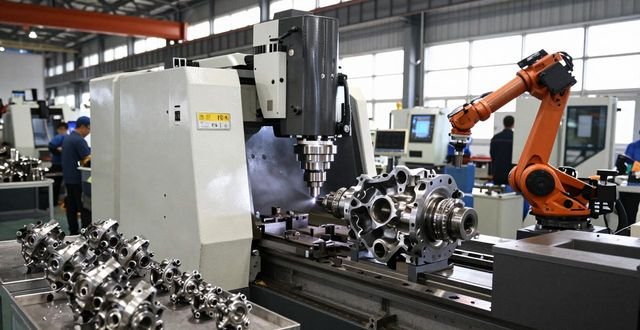
Batch application in automobile manufacturing
Automobile engine cylinders, gearbox casings and other parts have complex shapes and huge production volumes. The turning and milling compound lathe can complete all turning and milling processes of a cylinder within 8 to 10 minutes. In 2021, a certain auto parts company in Zhejiang increased its daily production capacity from 120 pieces to 180 pieces after introducing Japanese Yamazaki Mazak equipment. Moreover, due to the reduction in clamping times, the scratch rate on the surface of the parts has been reduced by 90%. This application example of a stable turning-milling lathe in complex parts processing is crucial to the zero-defect production model of the automotive industry.
Overcoming complex cavities in mold manufacturing
When processing molds, there are extremely high requirements for surface finish and shape accuracy. With the help of the linkage program, the turning-milling lathe can directly process three-dimensional curved surfaces without the need for an electrode discharge process. In 2020, there was a mold factory in Guangdong. When processing the injection mold cavity, after using composite equipment to replace the traditional engraving and milling machine, the surface roughness of the cavity was reduced from Ra1.6 microns to Ra0.4 microns. At the same time, the processing cycle was shortened from 14 days to 9 days, which greatly improved the speed of mold delivery.
Precision machining meets customized needs
Precision mechanical parts are often not in large quantities but have over-standard requirements. Turning and milling lathes can quickly change programs to adapt to the processing of different parts. In 2023, a precision instrument factory in Chongqing received a batch of fifty-piece optical frame orders. The traditional method requires controlling lathes and milling machines one by one. It takes a very long time to change tools and adjust machines. After using composite equipment, technicians completed program debugging in just one day, and completed delivery within three days, with a 100% quality rate.
Strict quality requirements for medical device parts
Medical device parts have mandatory regulations on biocompatibility and dimensional accuracy. Turn-milling lathes can process complex titanium alloy orthopedic implants, etc. In 2022, a medical device company in Suzhou used German Demag equipment to produce hip joint prostheses. The roundness error of all parts was less than an extremely tiny 0.002 mm. The thread length error is controlled within 0.01 mm. During the subsequent sterilization and assembly process, these parts do not need to undergo secondary processing, but directly enter the assembly line.
Future technology trends and purchasing suggestions
Turning and milling composite lathes are constantly advancing and developing in a more intelligent direction. At the Hannover Machine Tool Show in 2025, many manufacturers have demonstrated systems integrating AI detection functions. This system can monitor the wear of tools in real time and automatically perform compensation operations in a continuous and uninterrupted state. When purchasing, it is recommended to give priority to the two core parameters of spindle torque and tool magazine capacity. For those materials whose machining hardness exceeds HRC50, it is absolutely necessary to carefully confirm whether the machine bed is made of cast iron with high rigidity. In addition, it is also necessary to carefully verify whether the CNC system can support the import of post-processing programs, because this will have a direct and important impact on programming efficiency. Small businesses can carefully select equipment within five years from the second-hand market, which is the most cost-effective.
What processing difficulties have you encountered when operating a turning-milling compound lathe? You are welcome to share relevant experiences in the comment area, like and bookmark this article, so that more colleagues can benefit from it.





暂无评论内容