

An iron alloy
Key points of material matching between steel castings and rolled thick plates
In heavy machinery manufacturing, steel castings and rolled thick plates are frequently used in combination. The carbon content of steel castings is within the range of 0% to 2%. By adjusting the silicon content, the fluidity of molten steel can be improved, so that load-bearing parts with complex shapes can be cast. Rolled thick plates are manufactured through multiple rolling processes. Their internal structure is dense and their strength is quite stable.
When pairing them in practice, special attention should be paid to the differences in the chemical composition of the two specific materials. Steel castings often contain relatively high alloying elements, such as manganese and chromium, while the composition of rolled thick plates is relatively uniform. If the weldability of the two does not match, cracks or poor fusion may easily occur. We recommend that before carrying out the assembly operation, use a spectrometer to detect the composition of the materials on both sides to ensure that the carbon equivalent is controlled within a safe range, so as to avoid cold cracks during welding.
Preprocessing and size calibration before assembly
The first step in heavy-duty assembly is to pretreat steel castings and rolled thick plates. in 2025 In 2000, a heavy machinery factory noticed casting defects on the surface of the steel castings during the manufacturing of the rolling mill frame, such as pores and shrinkage. It had to first use a saw blade grinding wheel to remove impurities on the steel castings and rolling sheets, or gouging was used to plan with carbon arc gas to remove all the casting impurities present on the surface of the steel castings. After that, bevel processing had to be performed on the edges of the thick plates.
Also critical is dimensional calibration, as cast steel parts whose exact condition is unknown due to shrinkage may have actual specifications that deviate from the drawing range. Using laser tracking instruments or three-dimensional coordinate measuring instruments, it is necessary for operators to calibrate the relative positions of steel castings and thick plates under room temperature conditions. For example, in heavy assembling and riveting of cast steel parts and rolled thick plates in the assembly of load-bearing functional components of railway vehicles, if the size difference reaches more than one millimeter, it will make subsequent riveting welding impossible. It is absolutely necessary to strictly control the tolerance range and not exceed it.
Welding process selection and parameter control
For the assembly welding of steel castings and rolled thick plates, submerged arc welding or gas shielded welding is recommended. A construction machinery company used CO2 gas shielded welding in its production in 2024. The welding current performed at that time was controlled to 300 to 350 amps for heavy-duty assembly and riveting of steel castings and rolled thick plates . The voltage was in the range of 30 to 35 volts. It successfully achieved the butt jointing of steel castings and thick plates.
Different plate thicknesses require corresponding adjustments to the welding parameters. For rolled thick plates, if the thickness exceeds 50 mm, the preheating temperature must reach 150 degrees Celsius before welding, and the interlayer temperature must be kept below 200 degrees Celsius. Similarly, when welding such rolled thick plates, the welding speed cannot be too fast. Once it is too fast, the cooling rate of the molten pool will accelerate, which will lead to hydrogen-induced cracking. At the same time, choosing low-hydrogen welding rods and using low-hydrogen welding wire can effectively reduce the amount of hydrogen contained in the weld, thereby helping to improve the toughness of the joint.
Combined fixation method of riveting and welding
A type of ferroalloy used in heavy-duty assembly. It can combine riveting and welding to improve structural stability. Riveting is mainly used for temporary fixation. Its purpose is to prevent steel castings and thick plates from shifting during the welding process. For example, when assembling a rolling mill frame, high-strength bolts or rivets are first used to position key nodes, and then the welding operation is carried out.
It is also very important for the welding sequence. Weld the areas where stress concentration exists first, such as the corner joints of steel castings and thick plates, and then gradually expand to other welds. During 2023, one company used the segmented jump welding method in the process of manufacturing mining machinery parts. The length of each weld was controlled to be within 200 mm, and hammering was used to offset the stress, successfully avoiding welding deformation. Final tests on structural strength showed that the combined fixation method increased fatigue life by 15%.
Common defects and on-site remedies

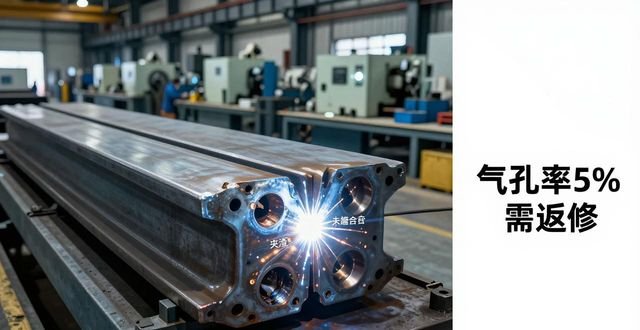
After welding steel castings to rolled thick plates, common defects include pores, slag inclusions and lack of fusion. Porosity is generally caused by insufficient protective gas flow or oil stains on the surface of steel castings. During the on-site inspection in 2024, it was found that the porosity rate in a group of riveted weldments reached 5%, so they had to be repaired.
Remedial measures should be selected based on the type of defect. For those with gas holes, carbon arc gouging can be used to clean and remove the area where the defect is located, and then repair welding is performed, and then preheating needs to be performed again. The problem of slag inclusion requires the speed involved in welding to be adjusted to ensure that the corresponding slag can fully float upward and exposed to the outside. If a lack of fusion is detected, the current used for welding should be increased or the length of wire extension should be reduced. After all repair welding work is completed, it is necessary to use ultrasonic waves to determine the flaw detection work to ensure that the quality can meet the standard requirements.
Cost control and efficiency improvement suggestions
The cost of assembly and riveting welding of steel castings and rolled thick plates is relatively high, which is mainly reflected in material costs and labor hours. Data provided by the market in 2025 show that the unit price of steel castings is about 8,000 yuan per ton, while the price of rolled thick plates is about 6,000 yuan per ton. The processing fee after the combination of the two will fluctuate upward by 20% to 30%.
If you want to control costs, it is recommended to give priority to standard-sized steel castings and thick plates to reduce custom processing. At the same time, it is necessary to optimize the welding process parameters, such as converting manual welding into automatic welding, which can increase efficiency by more than 40%. In addition, simulation assembly must be done before assembling this behavior to avoid rework. One company used 3D scanning technology to increase the first pass rate of assembly from 75% to 92%, significantly reducing the overall cost.
Faced with the situation of assembling steel castings and thick plates, do you think the most critical and prominent point in cost control lies in optimizing the process, or in simplifying the design? Please share your experience in the comment area. Please like this operation first, and then forward it to more colleagues in the industry for heavy-duty assembly and riveting of steel castings and rolled thick plates , so that everyone can communicate and discuss together.





暂无评论内容