Blog

  • From welding, sheet metal to assembly – the full range of riveting and welding processing service process unveiled

    Rivet weldingProcess, welding sheet metal assembly one-stop, full process service

    Article Outline:

    Introduction: Modern manufacturing requires integrated services. Revealing the complete journey of a part from drawing to finished product demonstrates the advantages of a one-stop shop.

    Step 1: Design and engineering review (starting point for customer collaboration): analysis of the drawing for manufacturability (DFM), optimisation recommendations, definition of the process route.

    Step 2: Raw material procurement and pre-processing: Procurement of plates/profiles according to requirements, cutting (laser/plasma), levelling and deburring.

    Step 3: Sheet metal forming process: bending, stamping, roll pressing, etc. to produce components of the required shape.

    Core link: welding and riveting:图片[1]-从焊接、钣金到装配——全方位铆焊加工服务流程揭秘-大连富泓机械有限公司

    Assembly and spot-fixing: Precise assembly using fixtures.

    Formal welding: Performed according to process cards.

    Riveting process: Riveting in the specified position.

    Step 4: Post-weld treatment and finishing: sandblasting/shot blasting to remove rust, grinding of weld seams, painting/coating.

    Step 5: quality inspection and assembly: size, appearance, performance inspection of the finished product, sometimes need to carry out multi-part assembly.

    Step 6: Packaging and Delivery: Rust-proof packaging according to customers’ requirements and arrange logistics.

    The core value of a one-stop shop:图片[2]-从焊接、钣金到装配——全方位铆焊加工服务流程揭秘-大连富泓机械有限公司

    Single point of responsibility with efficient communication.

    Shorten the overall lead time.

    Better consistency in quality control.

    Reduce your customers’ purchasing and management costs.

    Conclusion: Choosing a full process partner allows you to focus more on your core business.

    Call to action: Attach a clear “service flowchart” and provide a portal to “upload drawings and get a quote for the whole process”.

  • Customised riveting and welding solutions for large-scale structural steelwork.

    Large steel riveting, customisedrivet weldingSolutions, Engineering Welding Services

    Article Outline:

    Introduction: To present the challenges faced by large-scale structural steel projects (e.g. bridges, power stations, stadiums, high-rise buildings): oversized components, complex nodes, on-site work, and stringent standards.

    Analysis of the unique challenges of riveting large steel structures:

    Size and weight present lifting and positioning challenges.

    Deformation and residual stress control in thick plate welding.

    Environmental (wind, rain, height) impacts of on-site construction.

    Comply with mandatory requirements of building industry standards (e.g. AWS D1.1)

    Our four-part series of customised solutions:

    Stage 1: Joint simulation of design and process: Simulation of welding distortion using Finite Element Analysis (FEA) to optimise the welding sequence and process.

    Stage 2: Workshop prefabrication and modularisation: Precision welding of sub-units is completed in a controlled workshop environment where possible, reducing the amount of work on site.

    Stage 3: Hybrid Joining Techniques with High Strength Bolts and Welding: Explain when to use welding and when to use high strength bolts and the advantages of combining the two.

    Stage 4: On-site Welding Management and Quality Control: A team of licensed welders is dispatched with mobile equipment to implement a strict on-site QA/QC programme.

    Successful Case Study (illustrated): A detailed description of a specific bridge or construction project, describing the problems encountered and how our solution worked.

    Safety and Project Management: Emphasis is placed on our management systems for site safety and project scheduling.

    Conclusion: Co-operation with experienced and professional partners is the key to the success of large-scale steel construction projects.

    Call to Action: Large engineering contractors and turnkey contractors are welcome to contact us for an initial process plan and quote for your project drawings.

  • What is precision rivet welding processing? Its key technology and quality control points

    What is precisionRivet weldingWhat are the key technologies and quality control points? Key technologies and quality control points

    Introduction: A direct definition of “precision riveting and welding” – a generic term for a series of advanced welding and riveting processes to achieve high dimensional accuracy, strong connections and excellent appearance.

    Why do you need “precision” riveting? (Application Driven): Aerospace, Precision Instruments, High-end Electronic Devices, Medical Devices, Robotic Joints, etc.

    Four key technologies to achieve precision riveting:图片[1]-什么是精密铆焊加工?其关键技术与质量控制要点-大连富泓机械有限公司

    High-precision jigs and fixtures: Ensure accurate positioning and fixation of parts during machining.

    Advanced welding technologies such as micro-beam plasma welding/laser welding: Introduction of welding methods with low heat input, low distortion and high precision.

    Automation and Robotics Integration: How to ensure repeatability and consistency through robotics.

    Precision control of riveting process: Including force and stroke control of compression riveting and pulling riveting.

    Essentials of quality control throughout the process:图片[2]-什么是精密铆焊加工?其关键技术与质量控制要点-大连富泓机械有限公司

    Pre-control: Material inspection, process evaluation (WPS/PQR).

    Process control: Real-time monitoring of welding parameters, interlayer temperature control, cleanliness control.

    Post-control: Appearance inspection, dimensional three-coordinate measurement, non-destructive testing (X-ray, ultrasonic), pressure testing.

    Core differences between precision riveting and normal riveting (comparison table).

    The value of investing in precision riveting: Improve product reliability, reduce rework, and win high-end customers.

    Conclusion: It is emphasised that precision riveting is an integral part of modern high-end manufacturing.

    Call to Action: We have a full range of precision riveting solutions, click to view our precision machining case studies or download our process white paper.

  • Looking for services near you?2026 Rivet Welding Fabricators Ranking & Selection Guide

    Rivet Welding Fabricator, NearbyRivet welding, How to Choose a Rivet Welding Plant, Local Rankings

    Article Outline:

    Introduction: Emphasises the importance of choosing a local specialist manufacturer for communication efficiency, logistics costs and quality control.

    “Rationalisation of ”rankings“: This means that there are no absolute official rankings on the Internet, but they can be objectively assessed in the following dimensions (transforming ”rankings“ into ”assessment criteria”). (Translating “rankings” into “evaluation criteria”).

    5 core selection criteria (elaborated):图片[1]-寻找附近服务?2026年铆焊加工厂家排名与选择指南-大连富泓机械有限公司

    Technical and equipment capabilities: Examine the welding equipment they have (degree of automation), the thickness and type of material they can handle, and whether they have special qualifications (e.g., pressure vessel manufacturing qualifications).

    Quality control system: whether there is a perfect quality inspection process (such as NDT non-destructive testing), ISO certification, welder qualification certificate.

    Case Studies and Industry Experience: Showcase examples of past projects, especially in industries similar to your needs.

    Communication and Service Response: Engagement of design engineers, clarity and speed of quotes, post-sales support.

    Location and capacity: How distance affects transport and on-site service, and whether capacity can meet your schedule.

    How to find local manufacturers efficiently?

    Google Maps search for keywords (e.g. “precision riveting near me”).

    Browse B2B industrial platforms and industry catalogues.

    Ask supply chain partners for recommendations.图片[2]-寻找附近服务?2026年铆焊加工厂家排名与选择指南-大连富泓机械有限公司

    10 key questions to ask during a site visit or online counselling (in list form).

    Be alert to common traps: too low a price, vague offers, lack of qualifications, no physical samples.

    Conclusion: It is more important to summarise the “best fit” than the “cheapest”.

    Call to action: Provide a list of your company’s competences, certificates and links to your case library, with an “enquiry online” or “book a factory visit” button.

  • Core technology details: stainless steel and carbon steel riveting and welding processing technology comparison and industry applications

    INTRODUCTION: POSITIONING THE PROBLEM – Stainless steel and carbon steel are the most commonly used metal materials in theRivet weldingWhat is the difference between the two? What are the consequences of making the wrong choice?

    A quick look at material properties:

    Stainless steel: corrosion resistance, high strength, easy work hardening, poor thermal conductivity.

    Carbon steel: low cost, high strength, good toughness, easy to rust.图片[1]-核心技术详解:不锈钢与碳钢的铆焊加工工艺对比及行业应用-大连富泓机械有限公司

    Core Process Comparison Details (use of comparison table is better):

    Welding methods: Stainless steel (TIG/inert gas shielded welding is recommended to minimise oxidation), Carbon steel (MIG, manual arc welding etc. are more commonly used).

    Choice of welding consumables: Stainless steel (must use matching or higher grade wire/rod), Carbon steel (wide range of choices, need to match strength grade).

    Heat input and control: Stainless steel (tight control to prevent carbide precipitation and distortion), Carbon steel (relatively lenient, but need to prevent cold cracking).

    Pretreatment and post-treatment: Stainless steel (strictly clean, may require backside protective gas, pickling passivation), carbon steel (rust removal, oil removal is sufficient).

    Special considerations for the riveting process:图片[2]-核心技术详解:不锈钢与碳钢的铆焊加工工艺对比及行业应用-大连富泓机械有限公司

    Stainless steel rivet options (to prevent galvanic corrosion).

    Rustproofing (e.g. zinc plating) of carbon steel rivets.

    A guide to industry application scenarios:

    Preferred industries for stainless steel: food machinery, medical equipment, chemical equipment, marine components for ships, architectural curtain walls.

    Preferred industries for carbon steel: construction steelwork, heavy machinery, truck carriages, storage racks, general framing.

    Frequently Asked Questions and Myths: Can I weld stainless steel directly to carbon steel? What do I need to pay attention to? (Explaining the key points of welding dissimilar steels).

    Conclusion and Recommendations: Summarises how to make the right choice based on project budget, performance requirements (strength vs. corrosion resistance) and end-use environment.

    Call to Action: If you have a project with mixed materials or special requirements, please contact our engineers for a customised process solution.

  • The whole process of intelligent transformation of old stacker reclaimer: practical analysis from technology selection to investment recovery (for “intelligent stacker reclaimer transformation technology programme and investment return analysis”)

    When a large port in China decided to replace 12 units with an average age of more than 15 years in servicestacker and reclaimerThere was a lot of internal controversy when the intelligent transformation was carried out. The opponents made a calculation: the total budget of the transformation is 28 million, while the new equipment purchased is only 120 million, is the transformation worth it? Today, three years later, this transformation project has become an industry benchmark – after the transformation of equipment operating efficiency by 23%, energy consumption reduced by 18%, manpower reduction of 60%, payback period of only 2.8 years.

    This case reveals the core value of the intelligent transformation of the stacker reclaimer: it is not a simple technical upgrade, but a fundamental change in the operation mode by tapping the potential of the equipment through intelligence.

    I. Critical diagnosis before transformation: which equipment is worth changing?
    Not all old stacker reclaimers are suitable for intelligent transformation. We have summarised the principle of “four changes and four no changes”:

    Characteristics of the equipment proposed for modification:

    Good mechanical structure: no cracks or deformations in the main steel structure, which is the basis for retrofitting

    The original control system was a PLC architecture: it was relatively easy to upgrade, and a power plant’s 1998 Siemens S5 system was successfully upgraded to an S7-1500.

    Stable state of core components: the remaining service life of large parts such as slewing bearings and travelling mechanism is more than 5 years.

    There is a clear demand for intelligence: e.g. the need for unattended, automatic dosage, etc.图片[1]-老旧堆取料机智能化改造全流程:从技术选型到投资回收的实战解析(针对“智能化堆取料机改造技术方案与投资回报分析”)-大连富泓机械有限公司

    A situation where remodelling is not recommended:

    Serious fatigue of steel structure: a steel plant equipment dismantled and found that the main beam cracked as many as 17 places, the transformation fee is more expensive than new purchases

    The electrical system is old and deteriorating: it is still a relay-controlled device, so you might as well just replace it.

    Equipment to be phased out: remaining useful life <3 years

    Extreme operating environments: such as corrosive chemical material yards, it is difficult to operate stably even after retrofitting.

    Five tests that must be done before remodelling:

    Ultrasonic Flaw Detection of Steel Structures

    Track straightness and levelling measurements

    Electrical insulation resistance test

    Hydraulic System Pressure and Leakage Testing

    Gap measurement of mechanical drive systems

    II. Three tiers of options for the content of the transformation
    Intelligent transformation is not an “all or nothing” option, but can be implemented in tiers according to demand and budget:图片[2]-老旧堆取料机智能化改造全流程:从技术选型到投资回收的实战解析(针对“智能化堆取料机改造技术方案与投资回报分析”)-大连富泓机械有限公司

    Basic level retrofit (investment of $500,000-$800,000/unit):

    Positioning system upgrade: add encoder or GNSS to achieve positional accuracy ±10cm

    Video surveillance system: adding high-definition cameras and remote monitoring

    Data collection platform: collects equipment operation data and realises remote monitoring.
    Payback period: usually 1.5-2 years, mainly achieved by reducing inspection manpower and early warning of failures

    Progressive retrofit (investment of $1.2-2 million/unit):
    Added at the base level:
    4. Semi-automatic control: realising one-touch stacking and automatic picking up of materials
    5. Collision protection systems: laser scanning or millimetre wave radar
    6. Intelligent lubrication system: automatic lubrication according to operating conditions
    A power plant renovation case: investment of 1.65 million yuan / unit, operational efficiency increased by 15%, maintenance costs reduced by 25%, payback period of 2.2 years

    Advanced/fully automated retrofit (investment of $2.5-4 million/unit):
    7. Fully automated operation: unattended, automatic completion of stacking and picking tasks
    8. 3D scanning system: real-time 3D modelling of stockpiles
    9. Intelligent scheduling system: linkage with production systems, automatic optimisation of operational plans
    Port case: invested 3.2 million yuan/set, to achieve 24-hour unmanned operation, manpower cost reduction of 70%, payback period of 2.5-3 years

    III. Five paths to the realisation of core technologies
    Path 1: Selection of positioning technology

    Encoder positioning: low cost ($20,000-50,000), high accuracy (±2cm), but need to maintain track reference point

    GNSS positioning: easy to install ($80,000-150,000), but affected by weather and shading, accuracy ±10cm

    UWB positioning: emerging technology ($150,000-250,000), accuracy up to ±5cm, suitable for indoor or sheltered environments
    Practical application: Most users choose the “Encoder + GNSS” dual redundancy solution to ensure reliability.

    Path 2: Implementation of a collision avoidance system
    Traditional solution: mechanical limit switches, low cost but limited functionality.
    Advanced programme: laser scanner ($50,000-80,000 per unit), which creates a protected area and monitors intrusions in real time.
    An innovative approach in a port: RFID tags are installed in the travelling path of the stacker reclaimer, the equipment reads the tag position and combines it with an encoder to achieve precise positioning and collision avoidance.

    Pathway 3: Layers of automated control
    Layer 1: Programme control – preset action programmes, one-click execution
    Layer 2: Model control – builds a model of the stockpile and automatically plans the path of operations
    Layer 3: Intelligent control – machine learning to optimise job parameters, the more you use it, the smarter it gets
    It is recommended that you start at Tier 1 and work your way up.图片[3]-老旧堆取料机智能化改造全流程:从技术选型到投资回收的实战解析(针对“智能化堆取料机改造技术方案与投资回报分析”)-大连富泓机械有限公司

    Pathway 4: Construction of communication networks
    Wireline solution: fibre-optic cables laid along the track, stable but complicated to construct
    Wireless solutions: 5G private network or industrial WiFi, flexible but with interference considerations
    Hybrid solution: wired for critical control, wireless for video surveillance

    Path 5: Construction of a monitoring centre
    Local monitoring: monitoring station in the yard control room
    Remote monitoring: set up a monitoring centre at the company’s headquarters or at an off-site location
    Cloud platform: data uploaded to the cloud, support for mobile terminal access

    IV. Refined calculation of return on investment
    The returns on smart transformation come from multiple sources and need to be finely calculated:

    Direct economic benefits:

    Manpower cost saving: Calculated on the basis of 3 shifts with 2 persons per shift, the annual manpower cost saving after unmanned is about 360-480,000 RMB.

    Reduced energy consumption: Optimising the operating path can reduce energy consumption by 10-20%, saving 80,000-150,000 RMB in electricity costs annually.

    Maintenance cost savings: Predictive maintenance can reduce unplanned downtime by 30-50%, saving $60,000-120,000 in annual maintenance costs

    Efficiency Gains: Increased capacity resulting from improved operational efficiency, the value of which is the most difficult to quantify but is often the largest

    Indirect economic benefits:

    Increased safety: Reduced risk of safety incidents with less manual intervention

    Management refinement: real-time data to support more accurate decision-making

    Extended equipment life: Optimised usage can extend equipment life by 2-3 years

    Payback period formula:
    Payback period (years) = total investment in renovation ÷ annual comprehensive income

    Case calculation: $1.8 million invested in a stacker reclaimer retrofit

    Annual manpower savings: $420,000

    Annual energy savings: $110,000

    Annual maintenance savings: $90,000

    Value of annual efficiency gains: $200,000 (estimated)
    Annual consolidated revenue: $820,000
    Payback period: 180 ÷ 82 ≈ 2.2 years

    V. Full process management of transformation implementation
    Successful retrofit projects require rigorous project management, and we recommend the Five Stage Approach:

    Phase I: programme design (4-8 weeks)
    Key outputs: Retrofit technology programme, investment budget, analysis of expected benefits
    Common mistake: Over-idealised scenarios, ignoring actual site constraints

    Phase II: equipment selection and procurement (3-6 weeks)
    Core principle: do not pursue the most advanced, only the most appropriate
    Lesson learnt from a steel mill: a high-precision laser scanner was chosen, but the site was so dusty that false alarms were often raised, and it finally had to be replaced by millimetre-wave radar

    Phase III: Installation and commissioning (8-12 weeks)
    Best practice: step-by-step implementation, first stand-alone debugging, then system tuning
    Time allocation recommendation: mechanical installation 30%, electrical installation 40%, software debugging 30%

    Phase IV: commissioning and optimisation (4-6 weeks)
    Must complete: operator training, development of maintenance protocols, preparation of emergency plans
    Trial run indicators: system availability >98%, positioning accuracy up to standard, automatic operation success rate >95%

    Phase V: acceptance and handover (2 weeks)
    Acceptance criteria should include: technical performance indicators, verification of security features, documentation integrity

    VI. Guide to avoiding pitfalls: learning from failures
    Pit 1: Over-automation
    A coal mine in Shanxi hoped to realise full automation in one step, but as a result, the complexity of the system was too high, failures were frequent, and most of the functions were disabled in the end. Suggestion: Start with semi-automatic and upgrade after maturity.

    Pit 2: Neglect of personnel training
    The retrofit was completed and thought to be a success, but it turned out that the operators did not know how to use it and the maintenance staff did not know how to fix it. Training must be an important part of the project.

    Pit 3: Choosing the wrong supplier
    Looking only at low prices results in suppliers with no industry experience and unrealistic programmes. When choosing a supplier, examine its similar project cases.

    Pit four: data interface is not open
    The system is closed to data and cannot be integrated with other systems. It is required that data interface standards be specified in the contract.

    Pit 5: Neglecting Post-Maintenance
    Intelligent systems also require maintenance, and an annual maintenance budget is set aside, usually 3-5% of the retrofit investment.

    Final Recommendation: Smart retrofits are one-time investments with long-term benefits. When making decisions, don’t just look at the purchase cost, but calculate the total cost of ownership over five or even ten years. It is recommended to make a pilot unit first and then promote it after success. The process of transformation is also the process of team capacity enhancement, and this value is often more important than the upgrade of the equipment itself.

  • Slewing Bearing In-Depth Repair Guide: 126 Days from Early Warning to Repair Completion (for “Diagnosis and Repair Programme for Slewing Bearings in Stockpile Reclaimers”)

    When the slewing bearing of the No. 8 stacker reclaimer in a port in Liaoning Province made its first noise, maintenance team leader Xiao Wang didn’t pay much attention to it. After all, this equipment has been running for 11 years, a little sound “normal”. Three months later, the slewing appeared to be obvious stalling, they just stopped the machine to check. After dismantling everyone sucked a breath of cold air: bearing raceway spalling area of 40%, cage fracture, maintenance costs from the estimated 350,000 storm to 820,000, downtime extended by 26 days.

    This story is widely circulated in stacker reclaimer repair circles. Slewing bearings – thisstacker and reclaimerThe most central and expensive component, its failure is never sudden, but an accumulation of warning signs that have been ignored time and time again.

    I. Five stages of development of slewing bearing failures
    Damage to slewing bearings is a slow process that we have categorised into five identifiable stages using vibration monitoring data:

    Stage 1: Slight pitting (can continue to operate for 6-12 months)
    Characteristics: The characteristic frequency of bearing failures appears in the vibration spectrum, but the amplitude is very small. Data monitored at a power plant showed that the acceleration RMS values at this stage were typically between 0.5 and 1.0 m/s².

    Treatment: Strengthen lubrication, shorten the lubrication cycle from once a month to once every half a month, use high quality grease with EP additives

    Stage 2: Moderate flaking (recommended to schedule repairs within 3 months)
    Characteristics: Vibration amplitude increases significantly and harmonic components appear. Temperature monitoring shows that under the same ambient temperature and load, the temperature of the outer ring of the bearing is 8-12°C higher than normal.

    Real Case: A steel plant in Jiangsu decided to advance maintenance at this stage, with a maintenance cost of 280,000 RMB and 9 days of downtime. If it had waited until the next stage, the cost would have been expected to be more than 450,000 RMB and more than 15 days of downtime.

    Stage 3: severe damage (must stop immediately)
    Characteristics: Periodic jamming sensation during slewing, distinctive noise. Vibration acceleration RMS value exceeds 4.0m/s².

    Stage 4: Cage failure (potentially catastrophic failure)
    Characteristics: Shock peaks occur in vibration, and the sound changes from a continuous noise to an intermittent thumping sound.

    Stage 5: Total failure (equipment cannot be turned around)
    This is the last thing we want to see. A cement plant in Hunan has experienced this, and the final repair cost was as high as 18% of the original value of the equipment.

    II. Seven practical methods of on-site diagnosis (without professional instruments can also judge)
    Not every enterprise has a vibration analyser, but experienced teachers have summed up a set of practical on-site judgement methods:

    Method 1: Listening to the sound to recognise the position
    Use a long screwdriver or stethoscope to contact the bearing housing, with the other end close to your ear. The normal sound is an even “rustle”. If there is a “thump, thump, thump” periodic sound, it may be the raceway spalling; if it is a “clatter, clatter, clatter” noise, it may be a cage problem.

    A port maintenance worker Lao Zhao’s masterpiece: he can judge the damage location by the sound. He said: “Which angle the cantilever is pointing at when the sound is the loudest, the damage point is at the bearing position at that angle.”

    Method 2: Temperature comparison
    At the same ambient temperature and under the same load, measure the temperature at several points of the outer ring of the bearing with an infrared temperature measuring gun. The normal temperature difference should be ≤5°C. If the temperature at a certain point is significantly high, there is likely to be damage at that point

    Method 3: Slewing resistance test
    Remove the drive motor coupling and manually turn the slewing mechanism with a torque spanner. Record the maximum torque required to turn 360°. Test monthly to establish baseline data. Vigilance is required when torque increases above 20%.

    Method 4: Grease condition check
    Each time you lubricate, take a small amount of old grease from the grease discharge port and observe. Normal grease is uniformly greasy, if found:

    With metal chips: increased wear

    Turns grey-black: possible water ingress

    Lumpy: grease deterioration or contamination

    Method 5: Gap measurement
    Measure the slewing clearance with a percentage gauge. New bearing clearance is usually 0.3-0.8 mm. when the clearance is >1.5 mm, the preload needs to be adjusted; when it is >2.5 mm, the bearing may be severely worn.

    III. Four options for maintenance programmes and cost analysis
    Once the need for repairs is identified, four options are faced:

    Option 1: Adjustment of preload (lowest cost)
    Applicable conditions: No damage to the bearing itself, but only loss of preload due to prolonged operation.
    Method: Restore the preload by adjusting the shim thickness.
    Cost: about $20,000-$50,000 with 1-2 days of downtime.
    Success Rate: 85% or more if the raceway is in good condition.

    Option II: Replacement of damaged parts (medium repair)
    Applicable conditions: localised damage, other parts in good condition.
    Real case: Tangshan, a pile reclaimer only the inner ring raceway partial spalling, they used the “replacement of the inner ring + all the rollers” programme.
    Cost: $180,000 ($120,000 for new inner ring, $40,000 for rollers, $20,000 for labour), 6 days downtime.
    Key point: It is important to ensure the precision of the fit of the old and new parts, preferably operated by the original manufacturer or a professional repairer.

    Option 3: Bearing reconditioning (cost-effective option)
    This is an option that many users are unaware of. A professional bearing reconditioning business can recondition damaged bearings:

    Raceway grinding and polishing

    Replacement of all rollers and cages

    Reheat treatment (to restore surface hardness)
    Cost: about 40-60% of new bearings, service life up to 70-80% of new products.
    Note: You must choose a qualified restoration company and conduct a thorough inspection after restoration.

    Option 4: Whole bearing replacement (most complete)
    Applicable conditions: Severe or multiple damage to bearings.
    Cost Composition (Φ3000mm slewing bearing as an example)

    New bearings: $250,000-400,000 (varies greatly by brand)

    Lifting cost: $30,000-$60,000

    Labour cost: $40,000-80,000

    Auxiliary materials: $20,000-$30,000

    Total: $340,000-570,000
    Downtime: 10-20 days (depending on construction organisation)

    IV. 23 key control points for maintenance construction
    We tracked and recorded the whole process of a successful slewing bearing replacement in a power plant in Shandong, and summarised 23 points that must be controlled:

    Disassembly phase (first 3 days):

    Directions must be marked and photographs taken prior to dismantling

    The bolt removal sequence must be symmetrical

    Hanging point selection should calculate the centre of gravity to prevent deformation

    Measure the dimensions of the old bearings immediately after landing as the basis for acceptance of the new bearings

    Installation phase (2 days core):
    5. Requirements for cleanliness of mating surfaces: no stains when wiped with a white cloth
    6. Pre-tensioning of the bolt must be carried out in three stages: 30%-70%-100%.
    7. Every time after the pre-tensioning should be measured flatness, requirements ≤ 0.2mm / m
    8. The final torque value must be cross-checked by two persons.

    Commissioning phase (2 days after):
    9. Test run with no load for at least 4 hours, checking temperature every half hour
    10. Load test run to be performed in stages: 25%-50%-75%-100% loads
    11. Vibration tests shall be performed at all load levels.

    The three most error-prone links:

    Bolt tightening sequence: A steel mill had to re-machine the bearing housings due to deformation of the bearing housings caused by the wrong bolt sequence, which resulted in a delay of 7 days.

    Mating surfaces are clean: fine sand particles can lead to local stress concentrations, a port thus causing early damage to the bearing.

    Grease filling: New bearings must be lubricated with the specified grease, and should be filled in several times to let the grease penetrate fully.

    V. Gold standard for preventive maintenance
    The best maintenance is no maintenance. The average service life of the slewing bearings of the stacker reclaimer in a benchmark power plant in China is 16 years, which is 4 years longer than the industry average, and their practice is worth learning:

    Standardisation of daily inspections:

    Once a day: listen for sounds, check for leaks

    Weekly: temperature measurement, lubrication check

    Once a month: vibration measurement, gap check

    Lubrication management refinement:
    They use an automatic lubrication system, but keep the manual refill port. More grease is not better, their standard is to refill each time until fresh grease overflows from the grease drain, then let the unit run for 15 minutes to allow excess grease to drain.

    Intelligent condition monitoring:
    An online monitoring system is installed to monitor vibration, temperature, and rotary resistance in real time. The system is set up with three levels of warning:

    Level 1 Alert (email notification): Parameter exceeds baseline 20%

    Level 2 alert (SMS notification): parameter exceeds baseline 50%

    Level 3 Alert (telephone notification): Parameters exceeding baseline 1001 TP3T

    Data for maintenance decisions:
    They have established a bearing health scoring system that combines data on vibration, temperature, grease analysis, etc., and initiates the maintenance readiness process when the health score falls below 60.

    Final advice: Slewing bearing repair is not a simple disassembly and replacement, but a systematic project. When choosing a repairer, don’t just look at the offer, but see if they have repair cases of similar models, complete construction programmes and professional testing equipment. A successful repair can make the bearing service for another ten years, a failed repair may be half a year later to come back again.

  • Stacker selection practice: wheeled and arm seven-dimensional comparison and five selection traps

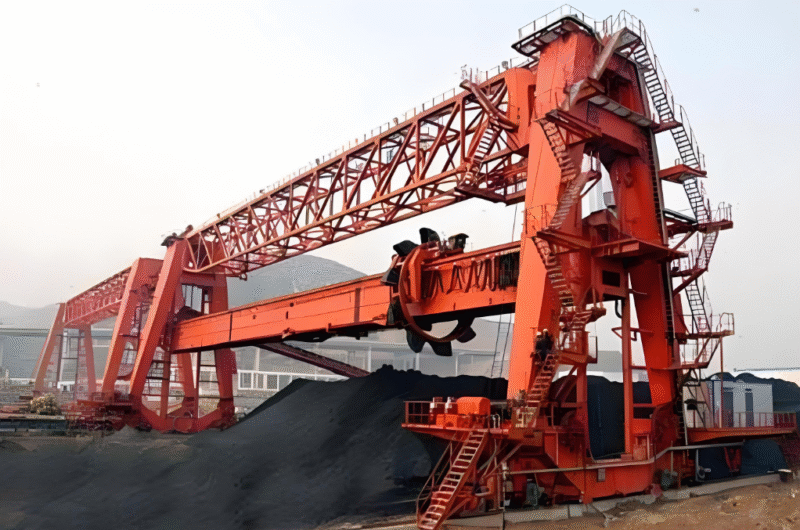
    When a large power plant in the south expanded its coal yard, there was a heated debate on equipment selection. One side insisted on choosing the mature technologyBoom type stacker reclaimerThe other side pushed for a more flexible wheeled stacker reclaimer. The debate went on for three months, and finally the power plant’s deputy chief engineer, Lao Chen, snapped, “Let’s go and look at real-life examples before we say anything.” They visited six power plants and harbours using different types of stacker reclaimer, and found many details that wouldn’t be in the technical manuals.

    Behind this debate is the classic problem of stacker reclaimer selection that has plagued countless project engineers. Choose the right one, the next ten years of operation smoothly; choose the wrong one, every day is trouble.

    First, the essence of the working principle of the difference: not “wheels” and “arm” so simple
    Many people think that a wheeled stacker is one with wheels, and an arm is one with a cantilever. This understanding is too superficial. The core difference between the two lies in the material flow control logic.

    The working logic of boom type stacker reclaimer (commonly known as cantilever type) is “fixed point stacking, mobile compensation”. The front end of the cantilever is the fixed working point, and the stacking and reclaiming operation is completed by cantilever pitching and rotating, and the whole machine travelling is only adjusting the working position. This is just like a person working with a shovel in a fixed position, and walking over when he needs to change the position.

    Real data from a port in Guangdong: when their boom stacker reclaimer is stacking coal, the whole machine needs to be moved only once every 8-10 hours, during which the cantilever completes all the fabric operations. This mode of operation is characterised by high precision (±150mm error at the drop point), but the coverage is limited by the length of the cantilever.

    The working logic of wheeled stacker reclaimer (gantry type, bridge type, etc.) is “mobile stacking and reclaiming, continuous operation”. Its reclaimer moves horizontally on the gantry, and the whole machine travels longitudinally along the track, forming a two-dimensional work plane. It is like a person pushing a shopping trolley between the shelves to pick up goods.

    Comparison test of a steel mill in Hebei showed that: in the 120-metre-long yard, the wheeled stacker reclaimer to complete the full area of the reclaimed material faster than the arm type 35%, but the amount of reclaimed material per unit of time fluctuates greatly.

    II. The truth about site suitability: the data don’t lie
    We tallied actual operational data from 47 domestic stacker reclaimer projects and found some counter-intuitive conclusions:

    Feedlot length in relation to selection:

    Yard length <80 metres: economic advantage of the boom type

    80-150 metres: each has its own advantages and needs to be assessed in a comprehensive manner

    >150 metres: wheeled for better overall efficiency

    But this conclusion has an important premise – the shape of the pile. If the shape of the pile needs to be changed frequently (e.g., multi-variety stacking), the arm type can be adjusted faster than the wheel type because of the flexibility of the cantilever, which is more than 40%.

    Differences in foundation requirements:
    A seaside power plant in Fujian had ignored this problem and installed a wheeled stacker reclaimer on a soft foundation. As a result, the track settled unevenly and the track foundation was repaired three times in two years, with the total cost exceeding 15% of the equipment’s payment. whereas the boom type has relatively low requirements for the track because its main load is transferred to the central area of the foundation through the centre column.

    Empirical formula: Wheeled stacker reclaimer requires ≤1/1000 for track flatness, boom type can be relaxed to ≤1.5/1000.图片[2]-堆取料机选型实战:轮式与臂式七维对比与五大选型陷阱-大连富泓机械有限公司

    III. The complete book of investment costs: don’t just look at the purchase price
    The purchase price is just the tip of the iceberg. The cost analysis of a mining company in Inner Mongolia is illustrative:

    They purchased a boom stacker reclaimer (purchase price $8.2 million) and a wheeled (purchase price $6.8 million) to compare the total five-year costs:

    Arm stacker reclaimer:

    Procurement cost: $8.2 million

    Foundation construction: $1.2 million (large concrete foundation required)

    Five-year energy consumption: $930,000 (average power 185kW)

    Maintenance costs: $0.67 million (including two major repairs)

    Total cost over five years: $11 million

    Wheeled stacker reclaimer:

    Procurement cost: $6.8 million

    Foundation construction: $1.9 million (full-length high-standard track required)

    Five-year energy consumption: $1.28 million (average power of 255 kW, high mobile energy consumption)

    Maintenance cost: $1.05 million (high failure rate of travelling mechanism)

    Total cost over five years: $11.03 million

    Amazingly, the total five-year cost of both is almost the same! But the equipment supervisor told me, “You can’t do the maths like that, the boom’s capacity utilisation is 18% higher than the wheeled, and that’s the key.”

    IV. Realistic Considerations of Maintenance Complexity: Voices of Maintenance Teams
    Whether the equipment is good or not, the maintenance team has the most to say. Lao Li, the maintenance team leader of a cement plant in Shandong, who also maintains two boom and one wheeled stacker reclaimer, has a very intuitive comparison:

    “The main repairs on the jib are in the slewing bearings and cantilever hinge points. Last month we repaired the slewing bearings and it cost us $21,000 for a two-day job by three people. The main problems with the wheeled type are in the travelling wheelset and the deflection correction device. The deflection correction device has to be adjusted every month, and although it only takes half a day each time, it is too frequent and affects production.”

    Comparison of failure rate data (annual failure downtime):

    Boom stacker reclaimer: average 120-180 hours/year

    Wheeled stacker reclaimer: average 180-260 hours/year

    But Lao Li added an important point: “Wheeled breakdowns are well handled, and most can be repaired on the track. The jib type has to be scaffolded if the cantilever hydraulics go wrong, which is more troublesome.”

    V. Key indicators of operational efficiency: empirical data to overturn perceptions
    A six-month comparative test was carried out at a port in Jiangsu province, where boom and wheeled stacker reclaimers were installed at adjacent locations in the same yard, handling the same type of coal:

    Stacking capacity:

    Boom: 1350 tonnes/hour average (limited by cantilever slewing speed)

    Wheeled: average 1620 tonnes/hour (continuous walking stockpile)

    Pick-up capacity:

    Arm: 980 tonnes/hour average (fixed cross-section of reclaim head)

    Wheeled: average 1150 tonnes/hour (large reclaimer width)

    Does it look like the wheeled type is winning? But the deputy director of the port’s technical department points out the key problem: “The wheeled type is not as good as the boom type in terms of reclaim uniformity, leading to frequent overload protection trips on subsequent belt conveyors. Taking this effect into account, the actual effective reclaim capacity is about the same for both.”

    VI. Space for future transformation and upgrading: room for intelligence
    Selecting equipment now must take into account future intelligent upgrades. The two models have different bases for intelligent upgrading:

    Boom stacker reclaimer retrofit focus:

    Addition of cantilever end vision system for automatic stacking control

    Upgraded rotary encoder accuracy from ±0.1° to ±0.02

    Retrofitting of material flow monitors

    Wheeled stacker reclaimer retrofit focus:

    Additional position reference points in the track for centimetre-level positioning

    Condition monitoring sensors added to travelling wheelsets

    Automated upgrade of the deflection correction system

    The transformation case of a Shanxi power plant shows that: the boom type stacker reclaimer to achieve semi-automatic transformation investment of about 450,000 yuan, wheeled need 680,000 yuan. However, after the transformation, the wheeled type in unattended operation hours than the arm type more than 30%.

    VII. Checklist for selection decisions
    Based on the 31 selection cases we have tracked, we have summarised seven issues that must be clarified before selection:

    Material properties: What is the angle of repose? What is the fluidity? Is it sticky? (Wheeling should be used with caution for viscous materials)

    Yard planning: will yard layouts change in the next five years? (Wheeled poorly adapted to layout changes)

    Climatic conditions: increased maintenance of wheeled tracks in rainy areas over 50%

    O&M team: which models are the existing team familiar with? (Training costs to be considered)

    Capacity fluctuations: how much does seasonal or cyclical capacity vary? (Wheeling is more adaptable to capacity fluctuations)

    Spare parts availability: Is there a reliable local supplier of spare parts?

    Expansion plans: Is there a need to add a blending function in the future? (arm type is easier to add a mixing unit)

    Final recommendation: organise a selection team of 5-7 people, including process, equipment, civil, electrical and purchasing professionals. Spend a week on site visits to at least three different types of user sites, and talk to operators, maintenance workers, equipment managers. Their practical experience is more valuable than any product samples. Remember, there is no such thing as the best equipment, only the most suitable equipment.

  • Intelligent mining new standard: 2026 mining excavator five intelligent system selection to avoid pit full strategy

    Last month in Shanxi to participate in a smart mine seminar, encountered an interesting thing: two neighbouring coal mines, last year, both purchased “Intelligent Excavator”. A year later, the equipment of mine A has become a “model project”, but the equipment of mine B is basically in the “intelligent dormant” state – in addition to the basic GPS positioning, other intelligent features basically did not Enable.

    In-depth understanding found that: A mine set up a five-member technical team before purchasing, and spent four months researching the match between the intelligent system and its own needs; B mine was attracted by the supplier’s “intelligent big screen” demonstration, and made a hasty decision. This comparison reveals the core of intelligent transformation of mining equipment – the right intelligence is more important than advanced intelligence.

    I. Intelligent Hydraulic Systems: From “Throttling” to “Predictive” Evolution
    Traditional excavator hydraulic system is “passive response”, while intelligent hydraulics is “active adaptation”. There are currently three technology routes on the market:

    First generation: load-sensitive systems (universalised)
    Adjusting the flow rate according to the joystick signal saves energy 15%-20% than the traditional dosing system. but the disadvantage is that there is a delay in the response and the composite action coordination is general.

    Second generation: positive flow control system (mainstream configuration)
    The displacement of the pump is proportional to the pilot pressure, and the response speed is increased by 30%. A national brand has added a “learning function” on the basis of this – the system records the habits of different operators and automatically optimises the flow distribution, so that the efficiency of operation for novices is increased by 25%. 25%.图片[1]-智能矿山新标配:2026年矿用挖掘机五大智能系统选型避坑全攻略-大连富泓机械有限公司

    Generation III: Electro-hydraulic Intelligent Synergy System (cutting-edge technology)
    This is truly intelligent and the system contains three core modules:

    Work condition identification module: identification of excavated material (soft soil, hard rock, ore) by means of pressure sensors

    Adaptive control module: automatic adjustment of digging trajectory and force/velocity ratio

    Predictive Maintenance Module: Predicts cartridge life based on hydraulic oil contamination trends

    The application data of a domestic gold mine shows that the third generation system improves the excavation efficiency by 18% and reduces the fuel consumption by 22%. However, the purchase cost is $350,000 higher than the common system. Their experience is that if the annual utilisation rate of the equipment exceeds 4,000 hours, the payback period is about 1.8 years; below 3,000 hours, the economy is not obvious.

    Remote control and autonomous driving: from “gimmick” to “practical” distance
    Remote control and autonomous driving are hotspots, but the landing situation is very different. We researched 27 application cases in China and summarised three application tiers:

    Tier 1: Remote Monitoring (Mature Applications)
    Transmission of equipment data via 5G or private network for fault warning and operational statistics. This is the basic configuration, and the payback period is usually no more than 12 months.

    Tier 2: Remote assisted manoeuvring (chosen with caution)
    The operator carries out routine operations in the control room and switches to local control when encountering complex conditions. The key success factors are low latency (≤100ms required) and high definition (at least 1080p) of the video system. In one coal mine, network latency of 200ms led to a remote operation crash and the system was subsequently abandoned.

    Tier 3: Fully automated driving (specific scenarios)
    Currently, only simple scenarios with a fixed “load point – discharge point” route are applicable. Even then, it requires centimetre-level high-precision positioning and 3D modelling support. The application of a domestic open-pit mine shows that under ideal conditions, the efficiency of automatic driving is 15% lower than that of manual operation, but it can be operated continuously for 24 hours, and the comprehensive efficiency still has an advantage.

    Suggestion for selection: Start with remote monitoring and consider upgrading after stable operation. Suppliers are required to provide 3 consecutive months of operation data of implemented projects, focusing on system availability (should be ≥99.5%) and false alarm rate (should be ≤1%).

    III. Intelligent diagnostic systems: the leap from “informing about failures” to “predicting failures”
    The electronic control systems of modern excavators can detect thousands of parameters, but the real intelligence lies in the depth of diagnostics. We compare four levels of diagnostics:

    Level 1: Fault code display (basic function)
    Fault codes are displayed and manual checking of the manual is required. This is twenty year old technology.

    Level 2: Troubleshooting and advice (current standard)
    Describe the cause of the fault and repair recommendations in Chinese, e.g. “Engine 3 cylinder injector circuit fault, recommend checking plug X12”.

    Level III: Healthiness assessment (advanced systems)
    Health scores for key subsystems, such as “hydraulic system health 87%, main pump wear needs attention”. A national brand’s system can predict hydraulic pump failure 200 hours in advance, with an accuracy of 92%.

    Level IV: Maintenance programme generation (top technology)
    The system not only diagnoses the fault, but also generates a complete repair programme containing a list of parts, repair steps, and estimated man-hours. It can even call on AR technology to display the disassembly sequence on the repairer’s glasses.

    Cost-performance analysis: The incremental cost of the Horizontal Three system is about $80,000 to $120,000, but it reduces unscheduled downtime by 30%-40%. For an excavator with an hourly production value of $5,000, avoiding 5 days of unscheduled downtime per year will pay for itself.

    IV. Data management and analysis platform: upgrading from “data stacking” to “decision support”
    The data generated by the device is only valuable if it is transformed into a basis for decision-making. A good data platform should have three capabilities:

    Capability 1: Multi-device collaborative analysis
    The management platform of a large mining group can simultaneously analyse the synergistic efficiency of excavators, mining trucks and drilling rigs. They found an interesting phenomenon: when the excavator’s operating efficiency increased by 15%, the waiting time of the mining truck increased, and the overall efficiency decreased by 3%. the platform automatically suggested adjusting the fleet ratio, which ultimately led to the optimisation of the system.

    Competency 2: Energy efficiency benchmarking analysis
    The platform has built-in industry energy efficiency benchmarking data and displays equipment energy efficiency rankings in real time. After using this feature, a coal mine in Shanxi, through operation training and parameter optimisation, the energy efficiency of all excavators in the mine was improved from the industry’s bottom 30% to the top 20% within six months.

    Capability III: Life expectancy prediction and replacement recommendations
    Based on the actual working condition data, it predicts the remaining service life of key components and provides early warning three months in advance. After applying this function, an iron ore mine changed its maintenance mode from “fault maintenance” to “predictive maintenance”, reducing maintenance costs by 28%.

    Key point for platform selection: require vendors to open up their data interfaces to ensure you can export raw data. Some vendors enclose data in their own cloud platforms, which is a straitjacket on future data analysis capabilities.

    V. Human-computer interface: from “complex and difficult to use” to “simple and intelligent” transformation
    A more advanced system is a design failure if the operator is unwilling to use it. There are four characteristics of a good HMI:

    Feature 1: Contextualised display
    The display automatically switches according to the stage of operation: digging depth and slope are displayed when digging, track tension status is displayed when travelling, and maintenance tips are displayed when servicing.

    Feature 2: Personalisation
    Allows the operator to save three sets of personalised parameters (Novice mode, Standard mode, Efficient mode) and switch between them at the touch of a button.

    Feature 3: Voice Interaction
    In a noisy environment, voice commands are safer than touch operations. The current level of technology has been able to recognise Mandarin with a local accent, with a recognition rate of ≥95%.

    Feature 4: AR-assisted
    The AR glasses display animations of parts disassembly and assembly during maintenance, reducing the time for complex repairs by 40%.

    A mine did a comparative test: let two operators with the same experience use the traditional interface and intelligent interface respectively, after one month, the operator using the intelligent interface efficiency increased 12%, and said “operation is easier”.

    VI. Intelligent Configuration Selection Decision Matrix
    In the face of a dizzying array of smart configurations, we suggest the following decision matrix:

    Intelligent Systems Incremental Investment Annual Benefits Applicable Conditions Priority
    Basic Remote Monitoring $80,000-$150,000 Reduced Downtime 5-8% All Mines Mandatory
    Intelligent hydraulic system 25-40 million yuan Energy-saving 15-22% Annual work >3500 hours High
    Advanced Diagnostic System $100,000 – $200,000 Reduction in maintenance cost 20-30% Number of equipment >10 Medium
    Remote control 500,000-800,000 RMB To solve special working condition operation High altitude, hazardous area Specific
    Autonomous driving $1 million or more Continuous operation capability Simple fixed route Pilot
    A final word of advice: Intelligence is not an end in itself, but a means to an end. Before selecting a model, be sure to identify the specific problem to be solved: is it to reduce fuel consumption, improve safety, reduce downtime, or optimise management? Choose the configuration with the problem, in order to avoid the waste of “intelligent for the sake of intelligent”. The best intelligent system is often those who “use hard, can not be separated from the system, the effectiveness of the system, rather than the most gorgeous technical parameters of the system.

  • Into the manufacturing workshop: mining hydraulic excavator five core process reveal and quality identification know-how

    Three years ago, I accompanied a coal mining purchasing team on a tour of twoExcavator Manufacturing PlantThe first factory had a shiny floor and brand new equipment; the second had grease stains on the floor and equipment that looked like it had been used. The first factory had a shiny floor, brand new equipment and a red carpet on the tour route; the second factory had grease stains on the floor, the equipment appeared to have traces of use, and the workers were using hammers to beat the jigs and fixtures. The mine’s director of mechanical and electrical engineering said on the spot, “We’re going to order the second one’s equipment.”

    His reason is very professional: “The first plant is to do appearance, the ground is so clean shows not much production; the second plant hammer knock fixture sound crisp, shows that the fixture is cast steel, not cast iron, which is really down to do the process.” This case reveals a truth of mining equipment procurement: the quality of manufacturing process, visible from the details.图片[1]-走进制造车间:矿用液压挖掘机五大核心工艺揭秘与质量鉴别诀窍-大连富泓机械有限公司

    I. Structural components welding: from the “fish scale pattern” to see the enterprise craftsmanship
    Welding quality is the lifeline of excavator structural components. The industry divides the level of welding into three levels:

    Primary level: The weld is flat but there are slag and porosity. A medium-sized manufacturer once caused a moving arm to crack during the warranty period, and analysed it afterwards to find that the welding wire was not dried thoroughly and the hydrogen content of the weld exceeded the standard.

    Intermediate level: Welds are uniform and pass inspection, but the heat-affected zone is poorly controlled. This can lead to stress concentrations and fatigue cracking of the equipment at around 15,000 hours.

    Advanced level: the weld is uniform and fine “fish scale pattern”, the width of the heat-affected zone is controlled within 3mm. A leading domestic enterprises use double wire double pulse welding process, weld strength up to 95% of the base material, fatigue life than ordinary welding to improve 40%.

    On-site identification skills: require a visit to the welding shop, randomly select a weld and observe the cross-section with a ten times magnifying glass. The melt depth of a high-quality weld should reach more than 70% of the plate thickness, and the fusion line is clear and straight. If this request is rejected, you have to put a question mark.

    Second, the hydraulic pipeline: from “messy as hemp” to “art” gap
    70% of hydraulic system failures originate from the pipeline.In 2019, we conducted statistics on domestic mining excavator failures and found that the downtime caused by pipeline problems accounted for 23% of the total downtime.

    Quality manufacturer’s standard of pipework:

    Hard tube production: the use of three-dimensional laser measurement of the material, bending radius error ≤ ± 1mm, which is to ensure that the joints do not leak the basis of the

    Hose selection: multi-layer steel wire-wound hose, pulse life should be ≥ 1 million times (international standard is 500,000 times)图片[2]-走进制造车间:矿用液压挖掘机五大核心工艺揭秘与质量鉴别诀窍-大连富泓机械有限公司

    Piping layout: follow the principle of “vertical and horizontal, layered arrangement”, the distance between adjacent pipelines is not less than 2 times the diameter of the pipeline, to facilitate maintenance.

    The director of a mining equipment shared his inspection methods: use a torch to illuminate the pipeline seams and observe whether there are traces of interference friction; shake the pipe bundle by hand and listen to whether there is a collision sound. These details can reflect the rigour of the manufacturing process.

    Assembly process: the “digital revolution” of torque spanners”
    Bolt fastening seems simple, but actually determines the long-term reliability of the equipment. The traditional assembly relies on the worker’s sense of touch, pre-tightening force error can reach ± 30%. modern factories have achieved “digital tightening”:

    Initial screwing: Use an electric constant torque spanner to achieve a standard torque of 30%.

    Repeat tightening: Use a digital torque spanner and tighten to 100% in three stages in a criss-cross sequence.

    Final screwing: torque review after 24 hours to compensate for torque degradation due to stress relaxation

    We have compared two brands of slewing bearing mounting bolts, using the same strength level of bolts, but brand A used a digital tightening process and had a bolt loosening rate of 0.31 TP3T over three years, while brand B used a traditional process and had a loosening rate of 2.11 TP3T. For a large excavator with 368 slewing bearing bolts, this difference means a completely different level of reliability.

    IV. Painting process: the science behind three layers of protection
    Mining environments are highly corrosive, and the quality of the coating has a direct impact on the life of the equipment. Quality painting should be a “systematic project”:

    The first layer: phosphating treatment: the whole phosphating after the structural components welding is completed, the film weight should reach 2.5-3.5g/m². A company had skipped the phosphating directly spray paint, the result is that the paint film in 18 months a large area of peeling.

    Second layer: epoxy primer: airless spraying process, dry film thickness ≥80μm. 120μm is required for critical parts (e.g. welding seam).

    Third layer: polyurethane top coat: weather resistance ≥ 2000 hours (QUV test), light retention rate of five years not less than 80%.

    On-site inspection tips: 20 random measurements with a magnetic thickness gauge, the thickness is required to be uniform, the extreme difference does not exceed 30%. torch oblique illumination of the paint surface, observe whether the orange peel pattern is uniform – this is a visual reflection of the level of spraying process.

    V. Factory tests: from “going through the motions” to “extreme challenges”
    Factory testing is the last quality check before equipment is delivered. I have seen three levels of testing:

    Formalisation test: 2 hours of no-load operation to check for leaks and noises. This is the minimum standard and is essentially meaningless.

    Standardised test: 8-hour load test according to national standards, including basic movements such as digging, slewing and walking.

    Liminalisation tests: a lesson to be learnt from one of the country’s top manufacturers:

    Continuous digging test: 4 hours of continuous digging with full bucket capacity, monitoring the temperature rise curve of hydraulic oil.

    Overload protection test: artificially created overloads to verify the response time and accuracy of the protection system

    Thermal balance test: continuous operation at 35°C ambient temperature to verify cooling system capability

    Electrical interference test: start a high-power walkie-talkie next to the equipment to verify the system’s anti-interference capability

    One of their factory test reports is 86 pages thick and contains 1274 data points. When you buy such equipment, you are not only buying a machine, but also a complete set of data endorsement.

    VI. Supply chain quality control: “final elimination” of suppliers”
    The quality level of machine manufacturers depends on the level of supply chain management. Komatsu Japan’s supplier quality control method is known in the industry as “harshness”:

    Access evaluation: new suppliers must pass 153 evaluations, any one of which scores zero is a one-vote veto

    Process monitoring: Quality engineers are assigned to key components to monitor the production process in real time.

    Quality traceability: each part has a unique code, problems can be traced back to specific production lines, operators, raw material batches

    A domestic excavator manufacturer learned this method, the early failure rate of hydraulic cylinders from 3.2% to 0.8%. their purchasing director revealed a detail: for seal suppliers, they not only check the product, but also check the supplier’s “constant temperature and humidity warehouse” — seal storage environment requires 23 ± 2 ℃, humidity 50% ± 5%, which can ensure stable material performance –The storage environment for seals requires 23±2°C and 50%±5% humidity, which ensures stable material performance.

    Advice to buyers: Next time you visit a factory, look not just at the assembly line, but also at the supplier management Kanban boards, quality gate control points, and non-conforming product isolation areas. The reality of these places says more about a company’s quality culture than any publicity. Remember, good manufacturing process cannot be bought with money, it is the precipitation of time, experience and craftsmanship.