

Two milling paths on drilling and milling machines: the difference between circumferential milling and end milling
Circumferential milling and end milling are the two most common CNC milling tool path types on drilling and milling machines. Many novices are confused about which one to use.
Principle of circumferential milling method
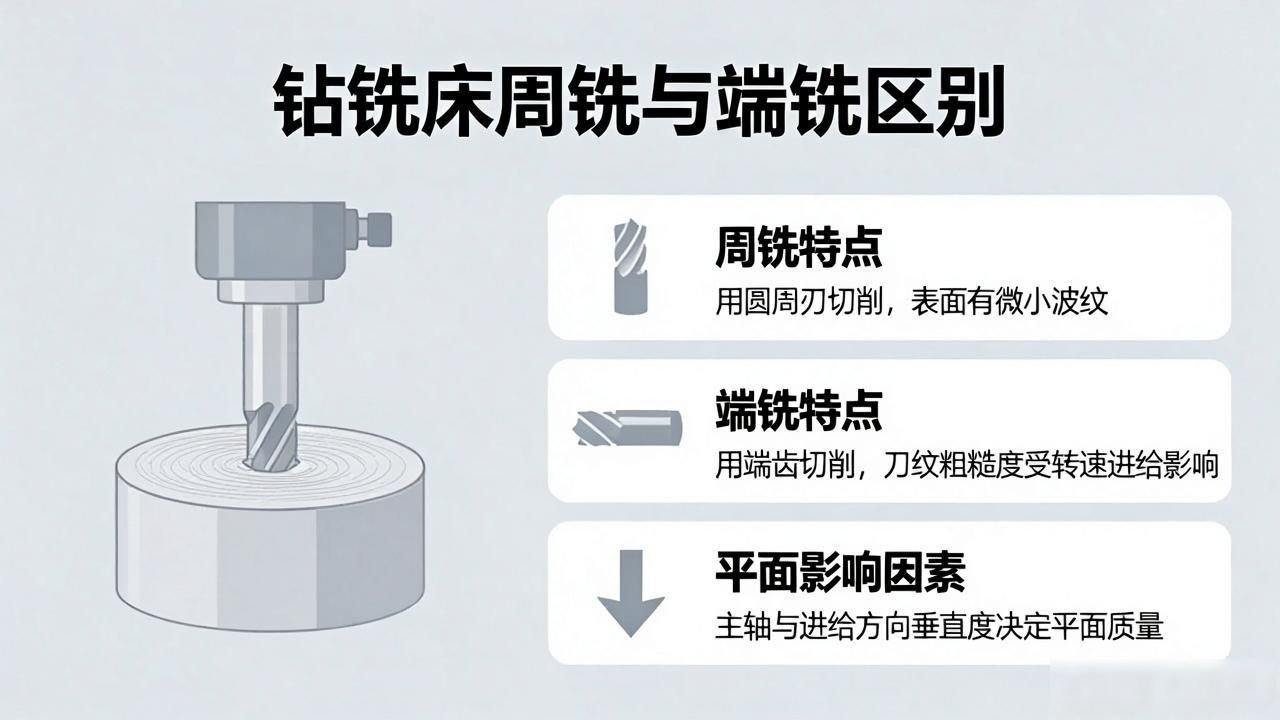
Circumferential milling, which uses the cutting edge on the circumference of the milling cutter to perform processing, is also called peripheral milling. Because the cylindrical milling cutter has multiple teeth, the milled plane will have extremely small ripples.
The quality of cylindricity will have a direct impact on the specific flatness of the milling plane, and this is a feature of circumferential milling.
Principle of end milling method
The method of using the teeth at the end of the end mill for processing is called end milling, which is also called end edge milling. It uses the tip on the end face of the milling cutter to create a plane, thus leaving tool marks on the machined surface.

The roughness of the tool pattern is related to factors such as rotation speed and feed speed. The perpendicularity of the spindle axis and the feed direction of the workpiece will also play a decisive role in the quality of the milling plane.
Rigidity comparison between the two methods
The face milling cutter has a short tool shank, good rigidity when clamped, a large number of cutter teeth, and low vibration. The cylindrical milling cutter has a long tool shank, a small shaft diameter, and equally small cutter teeth, which are prone to bending deformation and thus vibration.
This difference directly affects the stability and surface quality of the two processing methods.
Carbide blade applications
Face milling cutters that are easy to install carbide inserts for high-speed milling have high production efficiency and good milling quality. For cylindrical milling cutters that are difficult to insert carbide inserts, this limits their application scope.
High-speed milling is the mainstream direction of modern machining. CNC milling tool path type . There are two milling paths on drilling and milling machines: the difference between peripheral milling and end milling. Face milling has obvious advantages in this aspect.
The difference in processing width
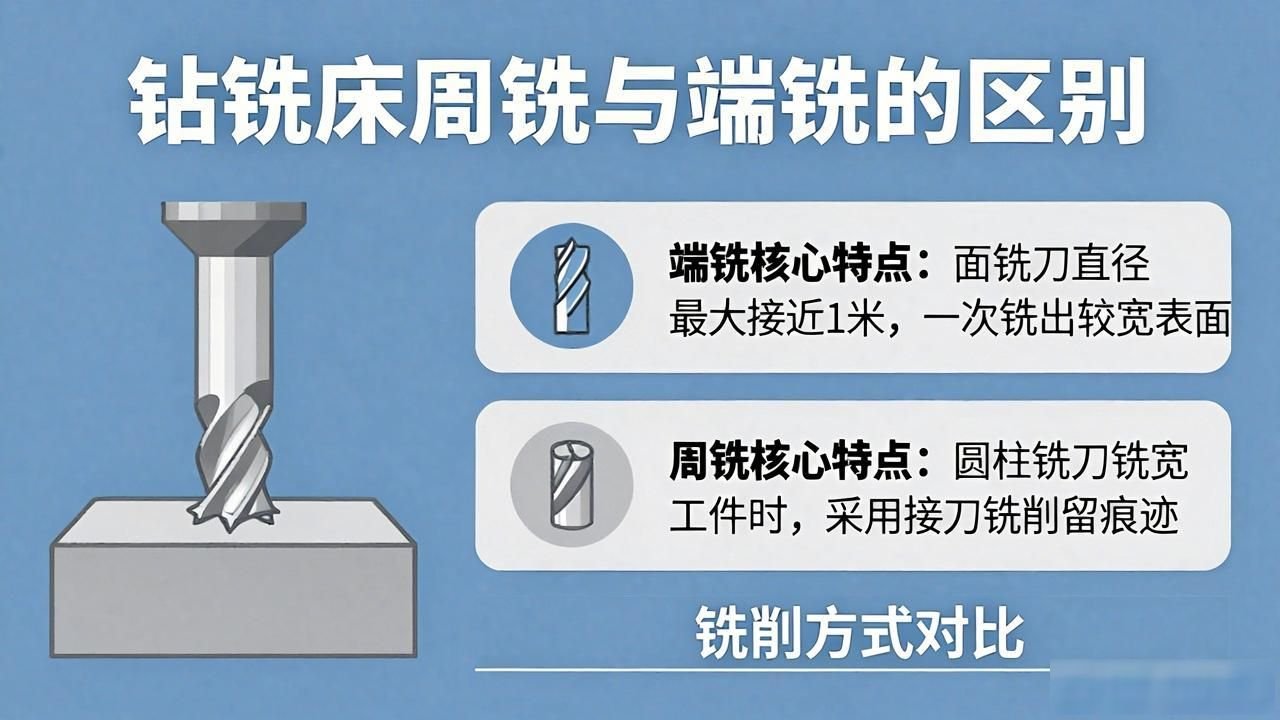
Face milling cutters with a maximum diameter of almost one meter can mill a relatively wide surface in one pass. When cylindrical milling cutters are used to mill workpieces with relatively large widths, they are generally milled with the tool connected, which will leave traces of the tool connected.
The difference in effect between one-time molding and multiple-joint CNC milling tool path types is clear at a glance.
How to choose actual processing
The use of cylindrical milling cutters with large blade angles is helpful for milling difficult-to-machine materials. Taken together, the processing quality of end milling is higher than that of circumferential milling, and the production efficiency is also higher than that of circumferential milling. When processing flat surfaces, end milling is generally used.
![图片[3]-Two Milling Paths On Drilling And Milling Machines: The Difference Between Circumferential Milling And End Milling-Dalian Fuhong Machinery Co., Ltd](/wp-content/uploads/2026/08/1787501184427_2.jpg)
However, complex processing such as steps and grooves often requires two methods to be used together. When it is actually used, the key is to be flexible in choosing.
Are you engaged in machining work, or are you in the process of learning milling and drilling operations? Which milling method is most frequently used?








暂无评论内容