

Welding process parameters of high-strength steel for engineering machinery
How to determine the preheating temperature to avoid cracks
When welding Lianyuan Steel grade steel, the plate thickness plays a direct role in the preheating temperature. Thin plates below 10 mm do not need to be preheated at all. This saves trouble and cost. Once the plate thickness is between 10 and 15 mm, the preheating temperature should be controlled within the range of 90°C to 125°C. If the thick plate exceeds 15 mm, the preheating temperature must be increased to 125°C to 150°C.
And environmental factors cannot be ignored. If the humidity on site has reached above 65%, or the temperature is lower than 10℃, then the standard preheating temperature must be increased by another 50 to 80℃. Just like welding 20 mm thick plates in the workshop in winter, the original preheating temperature of 125°C must be increased to above 175°C, otherwise cold cracks will easily occur.
Poor interlayer temperature control will destroy the weld
During the welding process, the temperature between layers is also very critical. Regardless of whether it is grade steel or grade steel, the temperature between layers cannot be lower than the temperature during preheating, and its upper limit is uniformly controlled below 200°C. If the interlayer temperature is too low, the weld will cool too quickly, which will easily produce a hardened structure, thereby reducing the toughness.
In order to save trouble, some welders perform continuous welding without measuring the interpass temperature, which generally results in the hardness of the weld exceeding the standard. It is recommended to use an infrared thermometer to check after each welding is completed to ensure that the temperature is always between the preheating temperature and 200°C. This ensures that the microstructure of each layer of weld is uniform.
Wrong selection of welding wire equals nothing.

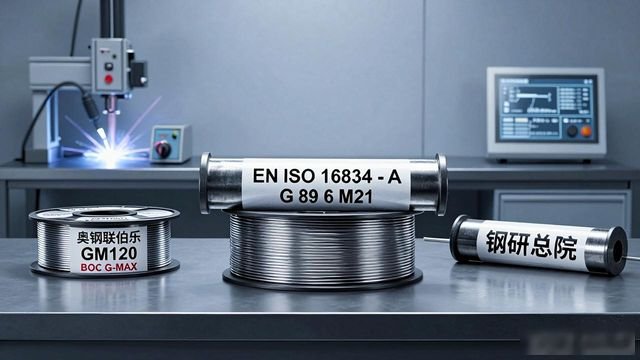
The recommended grade steel is G 89 6 M21 welding wire that complies with the EN ISO 16834-A standard. Some are /aws A5.28-G type, and the domestic equivalent is GB/T 8110's ER83-P. The specific products covered are such as voestalpine Böhler GM120 and welding wire from the General Institute of Steel Research, which are all mature options.
For higher grade steel, we recommend TZ 2 M M21 1 H5 flux-cored welding wire of EN ISO 18276-A, or G 89 6 M21 solid welding wire of the same standard. Bole 1100L-MC and GM120 are commonly used models. The strength grade of the welding wire must match the base metal, otherwise the weld strength will be lacking.

Welding parameters directly affect mechanical properties
Current, voltage, speed, gas flow, etc. are welding parameters. The data provided by Valin Liangang shows that when 溶接 grade steel with Bole GM120 wire, the current is generally in the range of 250 to 320 amps, the voltage is 28 to 34 volts, and the welding speed is controlled at 30 to 45 centimeters per minute.
The gas used for protection is a mixture of 80% argon and 20% carbon dioxide, with a flow rate of 20 to 25 liters per minute. Improper parameter settings will cause pores or lack of fusion in the weld. It is recommended to make a trial version for verification first, and then adjust the parameters before starting formal welding work to avoid batch rework.
Weld performance is supported by data
The coordination between the welding wire and the process determines the performance of the weld. After being welded with GM120 welding wire, the tensile strength and strength of Lianyang Steel can reach standards above 890 MPa, and the yield strength exceeds the limit of 800 MPa. Grade steel uses 1100L-MC welding wire, and the tensile strength can exceed the value of 1000 MPa.
These data are derived from the actual test reports of Valin Lianyang Steel. However, it should be noted that there will be slight differences in different batches of steel plates and welding wires. After users get the welding wires, it is best to check the guaranteed value on the material sheet. If necessary, conduct re-inspection yourself to ensure compliance with the riveting requirements for thick plates with a thickness of 60 to 100 mm used in mining machinery.
Environmental considerations must be incorporated into process planning

Many factories ignore the impact of ambient humidity on welding. In the workshop, when the humidity exceeds 65%, even if the plate thickness is only ten millimeters, it is still recommended to perform appropriate preheating. If the corresponding conditions are met, it will be safer to use a dehumidifier to control the ambient humidity for riveting and welding of mining machinery thick plates (60-100mm) .
Usually, thick plate welding of mining machinery is carried out in the processing workshop. However, the temperature is low in winter and the humidity is high in summer. Therefore, it is recommended that the environmental conditions be clearly and detailedly indicated in the welding process specifications, and the temperature and humidity be tested before operation. Only in this way, the welding process parameters of high-strength steel for thick plate welding engineering machinery can ensure the quality of the weld no matter what season we are in or under certain working conditions.

When you are welding thick plates of high-strength steel, what is the most headache problem you encounter? Feel free to share relevant experiences in the comment area, like and bookmark this article to prevent mistakes from happening next time.
コメントを残す
コメントを投稿するにはログインしてください。