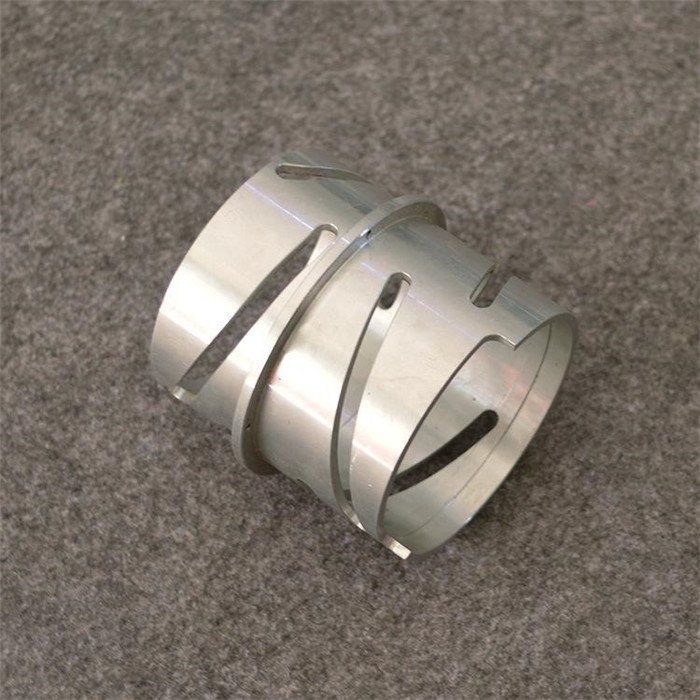


Precautions for titanium alloy processing and production
Choose the right path to avoid detours
Conventional milling and drilling of titanium alloys with high hardness and high thermal strength are prone to "suffering" from the tools. Many factories initially chose the wrong method, causing the tools to break or be scrapped. In 2024, an aerospace parts factory switched to laser cutting to replace traditional milling. The self-processing yield rate increased from 78% to 96%. The processing method must be selected based on the shape and size of the workpiece. Non-contact processing such as EDM and laser cutting is considered a "good partner" for titanium alloys.
When programming, it is necessary to think about the tool path earlier, in order to avoid having the tool repeatedly perform cutting actions in the same area. For example, when processing thin-walled parts, choose to adopt the layered ring cutting strategy, which will greatly effectively reduce heat accumulation. For example, after a certain ship parts company adjusted the programming parameters, the processing time of a single piece was shortened by 40% of the original calculation, and the life of the tool was extended by as much as three times.
Cutting parameters are vital
The key factor in the poor performance of titanium alloy cutting is that its thermal conductivity is very low, causing all the heat to rush away to the tool. A large number of masters set the speed and feed based on experience, which ultimately leads to rapid tool wear and extremely rough surfaces. Research conducted by the industry in 2025 shows that 70% of scraps produced by titanium alloy processing are directly related to improper cutting parameter settings. The standard approach is to reduce the cutting speed and increase the feed rate, for example, using a linear speed of 30 meters/minute and a feed measure of 0.15 mm per tooth.
When programming, the cooling strategy needs to be written into it. The method of spraying high-pressure coolant directly towards the cutting area can take away 80% of the heat. There is a certain type of factory that manufactures medical implants as a product category. Programming is used to control the specific time points when the coolant starts and stops, causing the thickness of the oxide layer on the surface of the workpiece to decrease from the original 0.05 mm to 0.01 mm. The subsequent polishing process is thus directly eliminated.
Don’t make mistakes when it comes to heat treatment
![图片[1]-Precautions For Titanium Alloy Processing And Production-Dalian Fuhong Machinery Co., Ltd](/wp-content/uploads/2026/06/1780603607751_0.jpg)
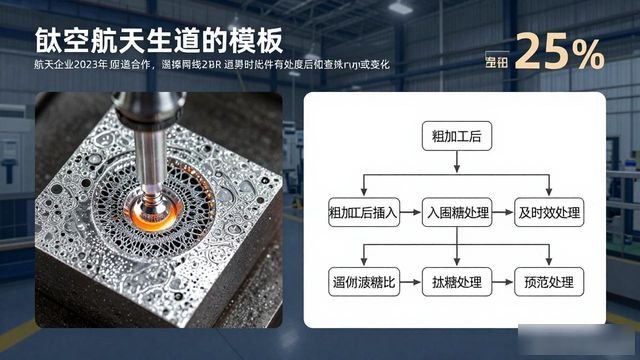
Titanium alloys will undergo phase transformation and grain growth under high temperature conditions . Titanium alloy processing and programming strategies . Precautions for titanium alloy processing and production. Its performance will show a cliff-like decline. Many people think that as long as processing is carried out first and then heat treatment is enough, the final deformation exceeds the standard. The correct programming strategy is to reserve a place for the heat treatment process. For example, after roughing is completed and before finishing, solution treatment and aging treatment are inserted. In 2023, an aerospace company followed this process and the fatigue strength of parts was greatly improved to 25.
When programming, it is also necessary to consider the dimensional changes after heat treatment. The heat treatment shrinkage of titanium alloy is about 0.2%. If the program does not compensate, dimensional deviation will occur during finishing. A certain mold factory added a heat treatment allowance compensation module during programming, and the subsequent processing pass rate increased from 82% to 99%.
Surface treatment cannot be omitted
Because of its high chemical activity, titanium alloys will quickly form an oxide film when exposed to the air. If no surface treatment is performed, the corrosion resistance of the parts will be greatly reduced. During programming, a time window must be set aside for the pickling and polishing processes. In 2024, a chemical equipment factory arranged an online pickling program after the processing was completed, thus extending the service life of the product from 3 years to 8 years.
Surface treatment will have an impact on subsequent assembly. For example, if the threaded hole is directly assembled after being machined, it will most likely cause seizure. There is a medical device company that added a surface micro-arc oxidation process during programming. The thread connection torque stability was significantly improved by 60%, and the customer return rate was subsequently reduced to zero.
Safety red lines must be guarded
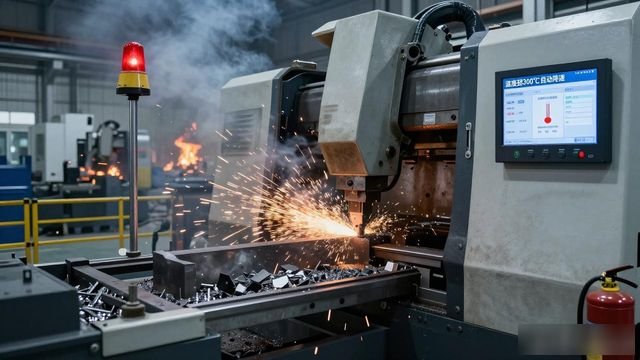
Sparks and debris generated during titanium alloy processing are extremely easy to burn, and once a fire breaks out, it is difficult to extinguish it. When programming, the logic of safe shutdown must be taken into consideration. For example, a temperature sensor monitoring point must be set. When the temperature of the cutting area exceeds 300°C, the speed will be automatically reduced. In 2025, a factory caused a fire because it failed to set cooling interruption protection in relevant procedures, causing direct losses of more than 5 million yuan.
Within the scope of programming, there is ventilation. If the concentration of titanium alloy dust reaches 40 grams per cubic meter, there is a possibility of explosion. For an aerospace engine factory, it added an exhaust system linkage command during programming, which automatically turned on the dust removal equipment during processing. The dust concentration in the workshop was always stable below the safe value, and no accidents occurred for three consecutive years.
Programming strategy determines success or failure
To sum up the above points, programming for titanium alloy processing is not simply about drawing tool paths, but it is necessary to incorporate the characteristics of the material, as well as the heat treatment process, surface treatment, and safety protection aspects into the logic contained in the code. Data presented by the industry in 2024 shows that companies that use systematic programming strategies have achieved impressive improvements in overall processing efficiency, with an increase of 50%, and the scrap rate has dropped significantly, with a decrease of 70%!
Have these key parameters been optimized for the titanium alloy processing procedures carried out in your factory? Welcome to share your own experience in the comment area, like this article and bookmark the Titanium Alloy Processing Programming Strategy Titanium Alloy Processing Programming Strategy so that more colleagues can reduce detours!




暂无评论内容