
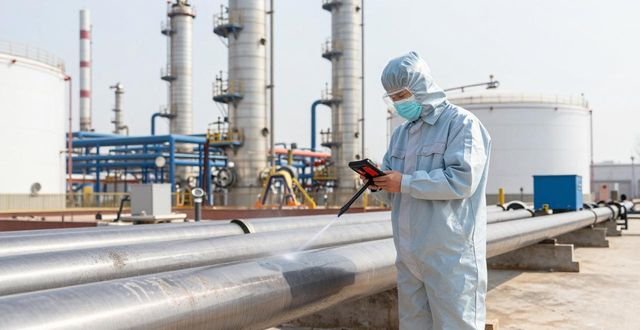
Standards for surface treatment of steel before coating with anti-corrosion and wear-resistant adhesive
Whether anti-corrosion and wear-resistant glue can firmly adhere to the metal surface is 90% determined by the treatment of the surface before painting. At many construction sites, coating peeling, coating peeling, and coating bubbles appear. Whether the surface of wear-resistant steel plate rivet weldments needs to be treated is not a problem with the quality of the glue itself, but rather that the metal surface treatment work is not done properly and is not good. Today we will directly explain how to treat the surface of steel pipes, what are the standards for valve surface treatment, and what are the standards for tank surface treatment. If you make a wrong step, all subsequent efforts will be in vain and will be ineffective.
No trace of welding slag, burrs, oil or dirt should be left behind
Does the surface of the wear-resistant steel plate rivet weldment need to be treated during the steel pipe factory and transportation? There will be welding slag, burrs, oil stains and grease attached to the surface. If these things are not cleaned to a clean level, the anti-corrosion and wear-resistant glue will not be able to stick firmly. In November 2025, an accident occurred at a pipeline project site in Jiangsu where a large area of coating peeled off. Afterwards, an investigation found that the anti-rust oil on the surface of the steel pipe had not been removed.
The correct treatment method is: first use a scraper or angle grinder to remove welding slag and burrs, and then use special cleaning agent or industrial alcohol to wipe away the oil stains. On-site operator Liu Gong summed up an experience during the actual construction: use a white cloth to wipe the treated metal surface. When there is no oil stains and dust on the white cloth, it will be deemed qualified. This link cannot be omitted, nor can it be sloppy because of the deadline.
Sand blasting and rust removal must reach Sa2.5 level
The rust removal level is a hard index that cannot be loosened, and it must reach Sa2.5 level according to national standards. What exactly does this standard mean? When viewed with the naked eye, the metal surface should exhibit a uniform metallic luster. And there should not be any visible oil stains, rust scale should not appear, oxide scale is also not allowed, and rust spots are absolutely not allowed. Under this permissible situation, although there will be slight dot-like or stripe-like stains, there should be no obvious undulations when touched by hand.

The time during the storage tank anti-corrosion project of a chemical plant in Tianjin was March 2026. When the supervisor randomly inspected the steel pipes after sandblasting as part of the project, it was found that the rust removal level of 3 pipes only reached Sa2 level. Whether the surface of the wear-resistant steel plate rivet weldment needed to be treated , they immediately required rework. The reason is that about 5% of such attachments on the Sa2 level surface are oxide scales, which will directly reduce the adhesion of the anti-corrosion layer by more than 40%. Remember, make no mistake, the bottom line is Sa2.5, not the upper limit.
Roughness 40 to 75 microns is the optimal range
The metal surface that has been sandblasted should neither be too smooth nor extremely rough. If it is too smooth, the glue will not stick; if it is too rough, the thickness of the coating will be uneven. The roughness range required by the standard is 40 to 75 microns, and this value is measured with the help of a roughness meter. Test data in August 2025 showed that when the roughness is about 50 microns, the pull-out adhesion of anti-corrosion glue is the highest and can reach more than 12 MPa.
How to control it during actual construction? The particle size of the sand is one aspect, the angle of the spray is also critical, and the distance of the spray cannot be ignored. The parameter of air pressure must also be matched with the appropriate steel surface treatment standards before anti-corrosion and wear-resistant adhesive coating. These four parameters must be matched just right. Under normal circumstances, it is recommended to use quartz sand with a particle size in the range of 0.5 to 1.5 mm. The spray angle needs to be maintained between 70 and 80 degrees, the distance is set to 100 to 200 mm, and the pressure is 0.5 to 0.7 MPa. During on-site construction, it is best to test a few points every time a batch of spraying operations is completed, and use rubbing paper or roughness comparison blocks to make quick and accurate judgments.
Compressed air and sand must be dry and clean
Several construction teams often neglect to pay attention to a subtle point: compressed air carries moisture and also contains grease. In a pipeline anti-corrosion project carried out in Qingdao, Shandong Province in December 2024, rust spots quickly appeared on the metal surface after the sandblasting operation was completed. The reason was that the air compressor was not equipped with an oil-water separation device, and the humid air brought moisture to the metal surface that had just been treated properly.
The following standards clearly stipulate that compressed air must be dry and clean, and should not contain oil or moisture. You can choose white paper or a glass plate to be placed at the air outlet for testing on site and let it stay for one minute. If there are no oil stains or water mist, it will be considered qualified. The sand needs to be river sand or quartz sand, which must not contain soil and debris, and the moisture content should be less than 1%. If the sand becomes damp, it must be dried or dried in advance. Wet sand must not be used directly.
Rust removal from power tools is only suitable for small parts
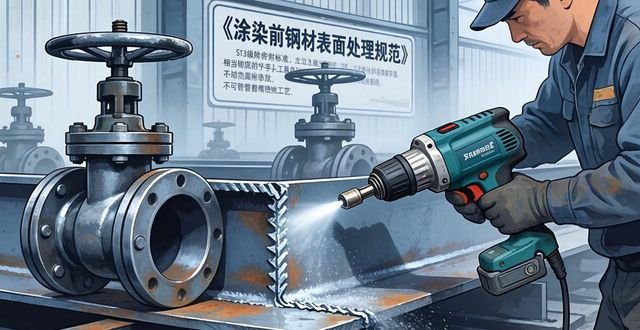
At locations such as valves, flanges, and weld corners where the sandblasting gun head cannot be extended, power tools can be used to remove rust. However, it should be noted that rust removal with power tools can only be used as a supplementary method and cannot replace sandblasting. The level of rust removal should be carried out in accordance with the "Specification for Surface Preparation of Steel Before Painting", usually St3 level, which is quite thorough hand and power tool rust removal.
During actual operation, it is recommended to use a grinding wheel or a wire brush with a rotation speed of not less than 5,000 rpm. The treated metal surface must show the true color of the metal and be free of rust and oxide scale. In September 2025, surface treatment records at a valve factory in Zhejiang showed that the rust removal efficiency of power tools was only one-fifth that of sandblasting, and it was easy to cause partial omissions. Therefore, it is necessary to check with a magnifying glass after treatment.
There should be clear distinction between the three layers of coating colors
Anti-corrosion coatings are usually divided into three layers: primer, intermediate paint and topcoat. The color of each layer must not be the same. This implementation has two benefits: first, it can clearly identify whether there is any missed application during construction; second, it can accurately determine which layer has the problem during subsequent maintenance. The construction specifications formulated by a petrochemical enterprise clearly require that the primer should be iron red, the intermediate paint should be gray, and the topcoat should be yellow or blue.
First, make sure that the metal surface is completely free of moisture and dust, and double check before proceeding with painting. If the metal equipment on the ground in the station has factory primer, then when operations such as sandblasting are involved, the primer must be completely removed, and painting must not be carried out directly on the surface with such primer attached. There must be sufficient time between each coat. Under normal circumstances, the primer can be dried for about four hours before the middle layer can be applied. After the middle layer has dried for 24 hours, the top layer can be applied. The specific parameters involved must be implemented with reference to the document "Technical Requirements for Anti-Corrosion Construction".
In your construction site or factory, is the metal surface treatment step strictly controlled according to the Sa2.5 standard, or is it perfunctory based on a similar feeling? Welcome to share your actual operating experience in the comment area, and like it so that more people in the engineering field can see this standard.
コメントを残す
コメントを投稿するにはログインしてください。