

Characteristics and content of CNC machining
Many people think that CNC programming is just a matter of pressing a few buttons against the drawings. In fact, from the process of process arrangement to the confirmation of samples, each step has more than a dozen more technical details than ordinary machine tools. If you are not careful, the entire batch of parts will become scrapped.
Why CNC programming requires more details
Ordinary machine tool operators can adjust the tool position during processing, but CNC machine tools operate automatically according to program instructions. This shows that before writing a program, engineers must clearly calculate variables such as tool setting points, tool changing points, and tool paths. In 2025, a domestic machining factory failed to determine the tool setting points properly, resulting in a batch of molds worth 800,000 yuan all out of tolerance.
In CNC machining, the sequence of each work step has a great impact. Just like when processing a shaft part with internal threads, whether the outer circle is turned first or drilled first determines whether the subsequent tool can smoothly enter the corresponding position. Ordinary machine tools can be stopped and adjusted at any time. However, if the sequence of a CNC machine tool is wrong, it will cause a tool collision in a minor case, and in a serious case, the spindle will be damaged.
Process division and processing sequence arrangement
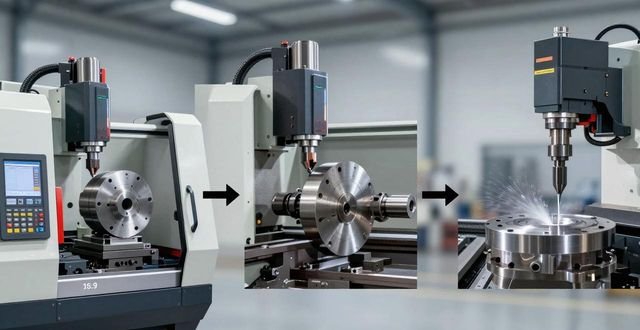
The first step in the CNC process is process division. Engineers need to determine which features are suitable to be achieved on a lathe based on the part structure, and which ones need to be transferred to a milling machine or grinder. Take the hydraulic valve body of a precision parts factory in Suzhou in March 2026. They left the outer circle, end face, and inner hole on the CNC lathe, and arranged the keyway and oil hole in the machining center.

When processing, the order must be followed in accordance with the principles of roughing first and then finishing, processing the main part first and then processing the minor part, processing the plane first and then processing the hole. Just like processing a flange, after rough turning its outer circle and inner hole, the end face must be finely turned first, and then the bolt holes must be drilled. If the order is reversed, the burrs produced by drilling will cause damage to the finished end face, causing the part to become a scrap.
Accurate setting of tool setting and tool changing points
The reference point where the tool starts cutting is called the tool setting point. The CNC system must know the coordinate offset of each tool relative to the workpiece zero point. In actual operations, the operator uses an edge finder or tool setter to measure the characteristics and content of the tool tip position. The accuracy must be controlled within 0.01 mm. In 2025, an auto parts factory in Chongqing scrapped 23 connecting rods in a row just because of an incorrect input of the tool setting point.
The setting of the tool change point is also critical. The tool change point must ensure that the tool does not hit the workpiece or fixture when exchanging. At the same time, the moving distance must be shortened as much as possible. On a horizontal CNC lathe, the tool change point is generally set 50 to 100 mm away from the end face of the workpiece in the positive direction of the Z axis. This way, it can avoid interference and save time on idle runs.
Proper planning of the knife route
What determines the processing efficiency and surface quality is the tool path. For cylindrical turning, it is necessary to use one clamping to process multiple surfaces as much as possible. For example, when machining a step shaft, continuous tool movement from right to left can reduce the number of tool retracts and feeds. In January 2026, a company in Zhejiang processed stainless steel valve stems and customized the parts processing sample confirmation process . After optimizing the tool path, the single-piece processing time was shortened from 4 minutes and 20 seconds to 3 minutes and 10 seconds.
In milling, the tool path needs to be more careful. The choice between down milling and up milling will have an impact on tool life and surface roughness. When processing aluminum alloy parts, down milling can achieve better surface finish, while when processing hardened steel, up milling is required to reduce tool impact. In addition, it is necessary to prevent the tool from leaving traces of advance and retreat on the surface of the workpiece. Generally, tangential cutting or spiral cutting is used.
Tool selection and cutting amount determination
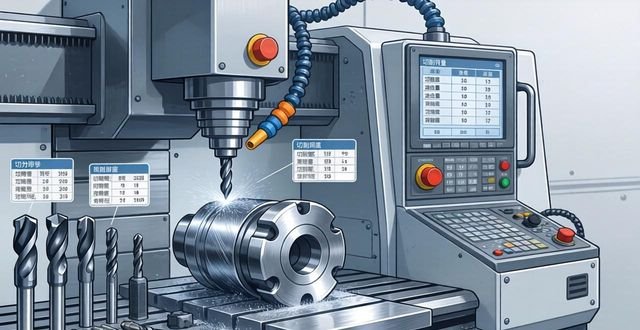
CNC machining has significantly higher requirements for cutting tools than ordinary machine tools. The cutting tools must have geometric parameters and coating processes that always maintain a stable state. In 2025, a certain cutting tool brand will launch a CVD-coated carbide insert that has a lifespan that is three times that of ordinary inserts during the processing of 40Cr quenched and tempered steel. When selecting tools, it is important to take the workpiece material, machine tool rigidity, and machining accuracy into consideration.
The cutting amount used covers cutting speed, feed amount and back cutting amount. These three parameters mutually restrict each other. Increasing the cutting speed will cause the temperature to increase, while reducing the feed rate will in turn affect the efficiency. Take the processing of steel No. 45 as an example. During rough turning, the cutting speed is recommended to be in the range of 120 to 150 meters per minute, the feed rate is 0.3 to 0.5 mm per revolution, and the back cutting amount is 2 to 4 mm, when it comes to finishing turning, the cutting speed increases to 180 to 220 meters per minute, and the feed rate drops to 0.1 to 0.2 mm per revolution.
Key inspection items in sample confirmation process
After the program is compiled, it must be verified through sample processing. When the first sample is processed, the program needs to be executed in a single step, and the dimensions and surface condition must be checked at each step. In February 2026, a company in Shenzhen processed a precision bushing. When the first sample was processed to the 8th step, it was found that the taper of the inner hole was beyond the tolerance range, and the cutting parameters were adjusted in a timely manner, thus avoiding batch scrapping.
The sample confirmation process covers dimensional measurement. The dimensional measurement needs to cover all key features and record at least 10 measuring points. A portable roughness meter is used for roughness testing, and its Ra value must meet the requirements of the drawing. Form and position tolerances such as cylindricity, coaxiality, and verticality must be verified with a three-dimensional coordinate measuring machine. Mass production can only be entered after all are qualified. Roughness testing is a test of the irregularity of the microscopic geometric shape of the surface.
When compiling CNC machining programs, what is the most troublesome process problem you have encountered? You are welcome to share your experience in the comment area to customize the parts processing sample confirmation process . The three people with the highest number of likes will receive the electronic version of the CNC programming pitfall avoidance manual compiled by us.







暂无评论内容