
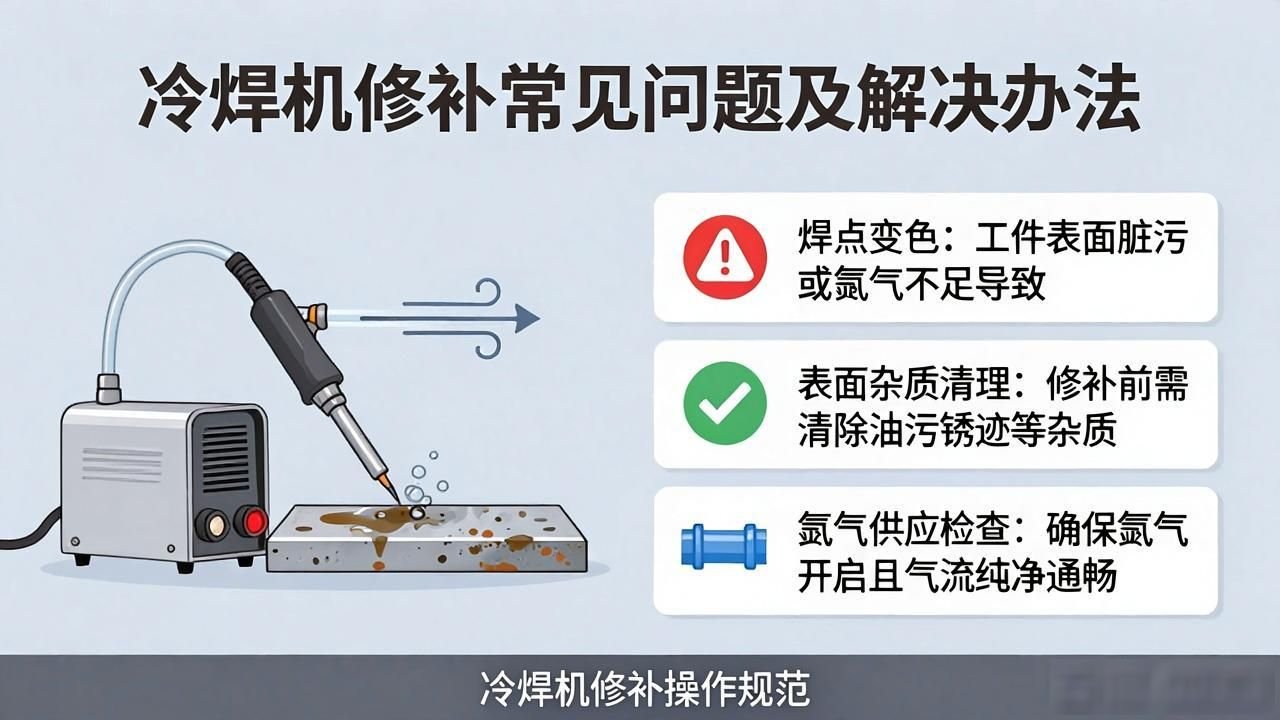
Several common repair problems and solutions for cold welding machines
The solder joints turn black and yellow after the casting defects are repaired, and the welding wire beads but does not fuse. These problems cause trouble to many skilled workers. Mastering the correct repair skills and surface treatment methods can greatly improve the quality of riveted weldment repairs.
Common causes of welding wire beading and failure to fuse
Welding wire beading in cold welding machines is one of the most common situations. The main reason is often that the tungsten electrode temperature is too high. When the distance between the tungsten needle and the workpiece is too far, the heat energy cannot be effectively transferred to the welding material, causing the welding wire to simply melt but not be successfully combined with the workpiece. The correct operating state is to place the tungsten needle on the extension line of the welding wire, with the distance controlled between 0.5 and 0.7 mm, while maintaining a height of 0.3 to 0.5 mm between the tungsten needle and the workpiece.
Another reason that is easily overlooked is that the welding gun head wears and becomes dull. The welding gun head will wear out after being used for a long time, resulting in the repair power being dispersed and the welding wire unable to receive concentrated heat. The solution is to sharpen the welding head regularly and maintain an angle of 60 to 70 degrees. At the same time, it should be noted that the angle between the welding gun and the workpiece should be maintained between 70 and 90 degrees, and the angle between the welding wire and the welding gun should be less than 90 degrees. This is the best repair angle.
How to deal with black and yellow solder joints
After repair, one of the common quality problems is the blackening and yellowing of the solder joints. This phenomenon will have an impact on the appearance of the workpiece and subsequent processing. If the exposed part of the tungsten needle is too long, the argon gas protection will not be enough, and the oxygen in the air will oxidize the weld. The solution is to adjust the tungsten needle again to maintain the exposed part at about 8 mm, so as to ensure that the argon gas can fully protect the welding area.

Among the key causes of discoloration of solder joints, excessive dirt on the surface of the workpiece occupies one of them. Before repairing, impurities such as oil and rust on the surface of the workpiece must be cleaned and made clean, otherwise the impurities will react with the weld under high temperature conditions. In addition, if the argon gas is not turned on or the amount of argon gas is insufficient , the protective effect will become worse. In this case , the argon gas supply needs to be checked.
Troubleshooting when there is an arc but cannot weld
When a cold welder arcs but cannot weld, it is often attributed to grounding problems. The most common reason is that the arc welding ground wire is not connected to the workpiece. In this case, although the arc has the conditions to generate, the current loop is not complete, so effective welding cannot be achieved. The solution is to clamp the ground wire clip directly on the workpiece to ensure that the grounding is in good condition.
Another possible reason is that the operator's hand is not in contact with the ceramic head on the welding gun. The arc starting of the cold welding machine requires the human body to form a circuit. If the contact between the hand and the ceramic head is not good, it will cause difficulty in starting the arc. During operation, firm contact between the hand and the ceramic head of the welding gun should be maintained to ensure smooth arc ignition. This is an operational detail that many novices tend to overlook.
Solution to tungsten needle sticking to workpieces
In the operation of cold welding machines, it is particularly troublesome that the tungsten needle always sticks to the workpiece. Why does this happen? The main reason is usually that the distance between the tungsten needle and the workpiece is very close, so that the tungsten needle has already contacted the surface of the workpiece before the welding material is completely melted. The solution is quite simple, just move the distance between the tungsten needle and the workpiece a little farther.
During operation, in addition to adjusting the distance, technique is also very critical. When depressing the foot switch, your hand must remain stable and the tungsten needle must not be deflected. If the tungsten needle has adhered to the workpiece, you must not forcefully remove it. You should slowly lift the tungsten needle and then cut off the power supply to prevent the tip of the tungsten needle from being damaged. Regular inspections and replacement of worn tungsten needles can also reduce needle stickiness.
Main points of surface treatment after repair
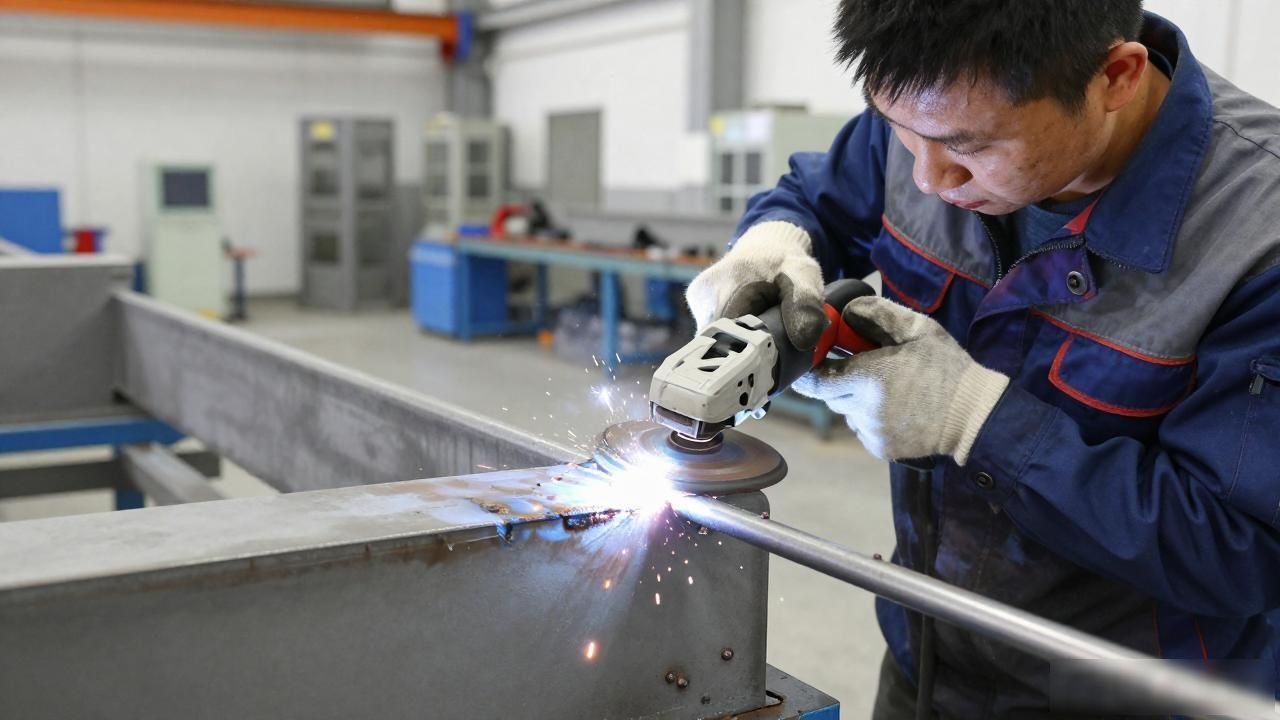
After partial repair of the riveted weldment, surface treatment is the key to ensuring the overall quality. After the repair is completed, obvious signs will often be left on the weld. Grinding, polishing and other processes are required to achieve a smooth transition with the surface of the base metal. When using a grinder or angle grinder, attention should be paid to controlling the intensity to prevent damage to the base metal caused by excessive grinding.
For workpieces that require higher requirements, the repaired area must be pickled or sandblasted to remove the oxide layer and impurities on the surface, thereby restoring the original luster of the metal. After the surface treatment is completed, it is recommended to conduct coloring inspection or penetrant inspection to check whether there are micro-cracks and other defects in the repaired area, so as to ensure that the quality of the repair can meet the requirements of use.
Routine maintenance and prevention suggestions
Routine maintenance of cold welding machines has a direct impact on the quality of repairs and the life of the equipment. After each use, the metal spatter at the head of the welding gun needs to be cleaned, the wear condition of the tungsten needle must be checked, and it must be replaced or polished in time. The argon gas nozzle must be kept unobstructed and needs to be cleaned regularly with a special cleaning agent to prevent impurities from clogging and affecting the protective effect.
Workers should develop good working habits, check whether the surface of the workpiece is clean before repairing, and confirm whether the argon gas supply is normal and whether the ground wire connection is firm. During the repair process, a stable operating method must be maintained to prevent the distance between the tungsten needle and the workpiece from changing too much. Regularly check the working condition of each component of the equipment, and deal with it immediately once problems are detected. This can effectively reduce the probability of repair defects.
After the cold welding machine is repaired, what do you think is the most critical step in surface treatment? Feel free to share your experience and opinions in the comment area. If you think this article is helpful to you, please like and share it with more friends in need.
Vastaa
Sinun täytyy kirjautua sisään kommentoidaksesi.