

ferritic stainless steel
The unique advantages and market positioning of duplex stainless steel
Duplex stainless steel has a two-phase structure of austenite and ferrite, achieving a good balance between corrosion resistance and mechanical strength. It is widely used in the chemical industry, marine engineering, and oil and gas industries. According to statistics, the global duplex stainless steel market size has reached approximately US$4.5 billion in 2025. Its processing is relatively difficult. The hot processing temperature and cooling rate need to be strictly controlled to ensure that the two-phase ratio is stable between 40% and 60% to avoid brittle phase precipitation.
This kind of duplex stainless steel is martensitic-ferritic stainless steel. Its corrosion resistance is very close to that of martensitic stainless steel. However, its hardness is lower and its plastic toughness is higher. Its welding performance is significantly improved. This type of material is usually used to manufacture pump valves and pipe fittings. In a large domestic chemical project in 2024, the qualification rate of welded joints was increased to a score of above 0.98. During processing, attention should be paid to controlling the carbon content below 0.08%, and preheating treatment mode should be used to prevent the occurrence of welding cold cracks.
Types and performance characteristics of austenitic-ferritic stainless steel
Austenitic-ferritic stainless steel can be divided into three categories based on chromium content: Cr18 type, Cr21 type and Cr25 type. Cr18 type is represented by SAF 2304. It contains about 18% chromium and only about 4% nickel content. Compared with traditional austenitic stainless steel, the cost is reduced by about 20%. This type of material is widely used in papermaking and food equipment. Its tensile strength can reach more than 550 MPa, which is nearly 50% higher than ordinary 304 stainless steel.
Cr21 duplex stainless steel such as SAF 2205 is the most widely used grade at present, accounting for about 60% of the duplex stainless steel market. Its yield strength exceeds 450 MPa, and its thermal conductivity is approximately 19 watts per meter Kelvin, twice that of austenitic stainless steel. In a seawater desalination project in Guangdong, the pipeline system made of 2205 material has been in continuous operation for 8 years without any corrosion or leakage accidents, which fully proves its resistance to pitting and crevice corrosion.
Strengthening mechanism and application of precipitation hardened stainless steel
By adding alloying elements such as copper, aluminum, and titanium to the martensite or austenite matrix, precipitation hardening stainless steel can form fine dispersed precipitation phases through solid solution and aging treatment, thereby achieving ultra-high strength. The tensile strength of these materials can reach more than 1,300 MPa, far exceeding the 600 MPa level of ordinary stainless steel. As the most typical representative, 17-4PH martensitic precipitation hardening stainless steel is widely used in the fields of aerospace engines and medical equipment.
The heat treatment process of precipitation hardening stainless steel needs to be accurately controlled. The solid solution temperature generally exists in the range of 1020 to 1060 degrees Celsius, and the aging temperature will be selected based on the target strength in the range of 480 to 620 degrees Celsius. In 2025, there is a precision manufacturing company in Jiangsu. By optimizing heat treatment parameters, the product hardness uniformity deviation can be controlled within HRC±2, and the processing scrap rate has dropped from 12% to less than 3%, which has greatly improved production efficiency.
Key points of quality control in stainless steel processing
In the stainless steel processing process, the control of chemical composition is the basis for ensuring the performance of the material. The content of impurity elements such as phosphorus and sulfur must be strictly controlled. For example, duplex stainless steel has a phosphorus content requirement of less than 0.03% and a sulfur content of less than 0.02%. The purpose is to prevent cracks during hot processing. At the same time, a spectrum analyzer must be used to test each batch, and the test records must be retained for no less than 5 years to comply with the requirements of the quality management system.
Welding process parameters significantly affect the performance of duplex stainless steel, and the line energy should be controlled within the range of 0.5 to 2.5 kilojoules per millimeter. Data from a pressure vessel manufacturer in Shanghai shows that when the welding line energy exceeds 3.0 kilojoules per millimeter, the ferrite content will drop below 25%, resulting in a decrease in corrosion resistance. Therefore, metallographic analysis must be performed regularly to ensure that the ratio of the two phases is stable between 30% and 70%, and low-hydrogen welding materials must be used.
Quality Standards for Heat Treatment and Surface Treatment

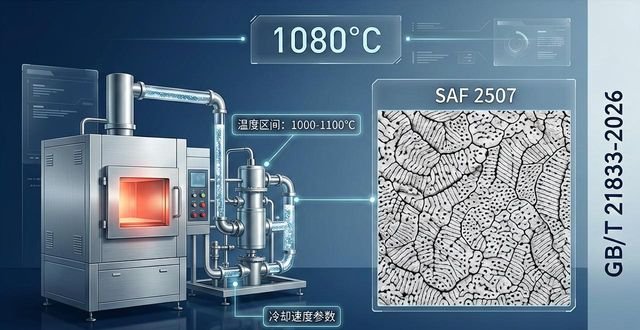
Usually when heat treating duplex stainless steel, solution treatment is used. The temperature should be controlled between 1000 and 1100 degrees Celsius, followed by rapid water cooling. Taking SAF 2507 super duplex stainless steel as an example, the solid solution temperature must be above 1080 degrees Celsius, and the cooling rate cannot be less than 10 degrees Celsius per minute, otherwise the σ phase will precipitate and the toughness will be reduced. The newly promulgated national standard GB/T 21833-2026 in 2026 has clear provisions on this.
For stainless steel, the quality of its surface treatment will directly affect the corrosion resistance life, and pickling and passivation is the most commonly used process. This process requires that the Ra value of the surface roughness cannot be greater than 0.010 millimeter to eight microns, and the thickness of the passivation film is in the range of one nanometer to three nanometers. The blue dot detection method must be used to verify the absence of rust. There is a company engaged in stainless steel processing and production in Zhejiang. After it introduced an automatic spray pickling system, The surface uniformity of the products produced by this company has been improved by 30%, and the rework rate has been reduced from 8% to less than 2%.
Detection methods and industry application trends
Non-destructive testing is an important way to ensure the quality of stainless steel processing, including ultrasonic testing, radiographic testing and penetrant testing. For duplex stainless steel welds with a thickness greater than 10 mm, 100% ultrasonic testing must be carried out, and the judgment standards are in accordance with NB/T 47013.3. During the equipment inspection of a domestic nuclear power plant in 2025, phased array ultrasonic technology was used to successfully identify tiny defects with a diameter of 0.5 mm.
With the rapid development of new energy and environmental protection industries, the application of duplex stainless steel in electric vehicle battery pack shells and hydrogen energy storage tanks has grown rapidly. According to the reports given by the industry, the average annual demand growth rate will reach 8.5% during the period from 2026 to 2030. Processing companies must continue to optimize process parameters, establish a complete quality traceability system, and equip themselves with digital testing equipment, so that they can meet increasingly stringent customer requirements.
During the processing of duplex stainless steel, what is the biggest quality problem you encountered? You are welcome to share your experience in the comment area. Like and bookmark this article to get more technical content!



暂无评论内容