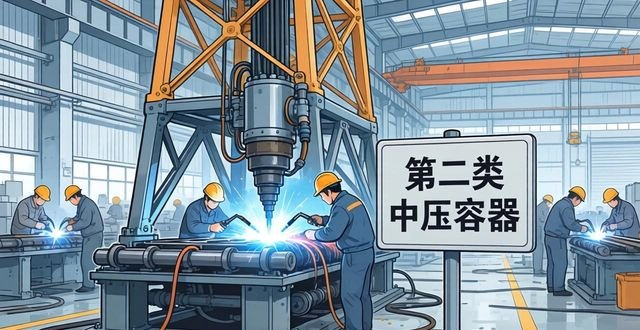


A certain tower type equipment with on-site welding belongs to the second category of medium-pressure vessels of pressure vessels. The unit that can undertake the on-site welding should have the license (). AD2 level manufacturing license (the second category of low and medium pressure vessels) BD1 level manufacturing license (the first category of pressure vessels)
You are currently holding a medium-pressure tower belonging to the second category and are about to carry out welding work on site. If you find the wrong unit to engage in the construction, not only will the tower equipment that cannot pass the on-site welding be accepted, it is a second-category medium-pressure vessel. The unit that can undertake the on-site welding should have a license (). AD2 level manufacturing license (Category 2 low and medium pressure vessels) BD1 level manufacturing license (Category 1 pressure), and may also bury safety risks. For the manufacture and installation of this type of equipment, the country has clear licensing threshold conditions, and choosing the right unit is the key.
Many people are confused about the difference between "manufacturing license" and "installation, modification and maintenance license", and it is easy to confuse the different levels of qualifications. A common mistake is to think that as long as you are qualified to install pressure vessels, you can carry out on-site assembly welding, which will cause the qualifications to not meet the requirements.
The entry threshold for the second type of medium pressure vessels is D2 level manufacturing license
According to the "Technical Safety Specifications for Special Equipment" TSG 21-2016, pressure vessels are divided into Category 1, Category 2 and Category 3 based on the design pressure and hazards of the medium. The working pressure of medium-pressure vessels in the second category is between 1.6 MPa and 10 MPa. When such equipment is assembled and welded on site, it must be undertaken by a unit holding a D2 level manufacturing license. The full name of the D2 level license is the "Second Class Low and Medium Pressure Vessel Manufacturing License". This license covers vessels with a design pressure below 10 MPa and a medium that is not extremely hazardous. This license can be used for manufacturing within the factory, and may perform assembly and welding operations on site, provided the unit has the corresponding site and equipment conditions.

Why D1 level manufacturing license cannot be used for on-site assembly welding
The first type of pressure vessels is the object of the D1 level manufacturing license. The pressure and danger level of such vessels are lower than those of the second type. Units holding D1 level license qualifications can only manufacture simple small storage tanks or heat exchangers in the factory workshop, and are not allowed to go to the user's construction site to perform on-site operations. On-site assembly welding involves more complex construction management, including welding process qualification, non-destructive testing, heat treatment and other links, all of which require a higher-level quality management system. If you invite a D1-level unit to the site to assemble and weld a second-category medium-pressure tower, the regulatory authorities will determine that the construction is beyond the scope of the permit. Not only will you have to stop the work for rectification , but you may also face fines.
Special equipment installation, modification and maintenance license cannot replace the manufacturing license
The misunderstanding exists that many people regard the "Special Equipment Installation, Modification and Maintenance License" as a pass to weld containers on site. However, this is just a misunderstanding. This license is divided into levels 1, 2 and 3. Among them, those who obtain Level 1 qualification can only engage in the overall installation, pipe connection and debugging of the pressure vessel, but they are not allowed to weld the vessel body or change its original structure. The on-site assembly of welding tower equipment is actually to complete the splicing and welding of pressure components such as cylinders and heads. This is essentially a manufacturing behavior and not a simple installation behavior. If there is a unit that only has an installation license but does not have a manufacturing license, then the unit can only assume the responsibility of lifting the welded tower to the foundation and has absolutely no right to use the welding gun.
A3 level manufacturing license is only for spherical storage tanks and cannot be used for towers
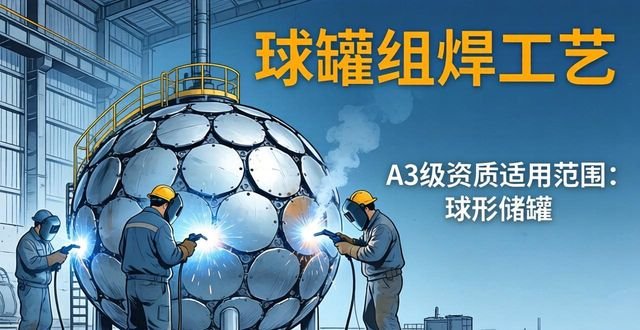
There is an A3 level manufacturing license specially established for on-site assembly welding of spherical storage tanks . How to choose a riveting welding unit with pressure vessel design qualifications ? Its scope of application is extremely narrow. The shell of the spherical tank is formed by welding multiple pieces of spherical lobes, and its process requirements are completely different from those of the cylindrical tower. The quality management system, welding process assessment, and non-destructive testing procedures of units with A3 level licenses are all compiled according to the characteristics of spherical tanks, and may not necessarily meet the requirements for longitudinal circumferential welds of tower equipment. In actual projects, the height-to-diameter ratio of the tower is large, and straightness and offset control need to be considered during assembly and welding. These are not routine items for on-site assembly and welding of spherical tanks. Therefore, even if the other party has A3 level qualification, it cannot be used to undertake on-site assembly and welding tasks of towers.
How to quickly verify whether the construction unit has a D2 level license
You can enter the name of the unit in the "National Special Equipment Publicity Information Inquiry Platform" of the State Administration for Market Regulation to view the details of its manufacturing license. The formal D2 level license will accurately indicate the words "Category II low and medium pressure vessels" and "On-site assembly welding allowed". Without these two key statements, even if the other party claims that they can do it, don't sign the contract easily. In addition, some units may hold A2 or A1 level manufacturing licenses . How to choose a riveting and welding unit with pressure vessel design qualifications? Of course, these higher level licenses also cover the D2 level range, but please pay attention to check whether the "on-site assembly welding" option is checked in the certificate attachment. Some high-level units have only approved fixed manufacturing sites, and are also not allowed to work on site.
Common consequences and real cases of illegal use of low-level qualifications
In 2021, there was a chemical plant in Shandong Province that built a new desulfurization tower. The diameter of this desulfurization tower is 2.4 meters and the height is 18 meters. It belongs to the second category of medium-pressure vessels. The construction unit found a small factory that only had a D1 manufacturing license and asked it to go to the site for welding. However, halfway through the construction, the local special inspection agency stopped it. After investigation, it was discovered that this small factory did not have a welding process qualification for medium-pressure vessels, and there were many excessive pores on the weld radiographic inspection films. In the end, the small factory had its license revoked and was fined 200,000 yuan. The chemical factory had to cut off the semi-finished products and then re-purchase qualified units. In the end, direct economic losses exceeded 800,000 yuan. This case can show that qualification review is not just a superficial formality, but is actually related to the safety status and cost aspects of the entire project.
After reading this article, have you ever encountered a situation in actual projects where you were ordered to stop work and make rectifications because your qualifications did not meet the requirements? You are welcome to share your experience in the comment area, and you can also like and save this article so that more colleagues can avoid these qualification traps.




暂无评论内容