


Chapter 10 Common CNC calculation formulas
The wonderful use of trigonometric functions in processing
During CNC machining, trigonometric functions are basic components that are encountered almost every day. Many machine operators are familiar with formulas such as tan, sin, and cos. However, when they are actually used to calculate coordinates, it is very easy to get stuck. Mastering these formulas will directly assist programming and tool setting.
When milling an inclined surface, or when arranging holes, it is often necessary to use the arctangent function to calculate the angle. If the X distance and Y distance of two points are given, and the angle of the tool's diagonal line is calculated, the result can be obtained simply by using the atan2 function. This is faster than using hand-drawn CAD.
How to find the cutting speed
The core basis for selecting the rotation speed is the cutting speed Vc. The formula is, Vc is equal to the tool diameter multiplied by the rotation speed, and then divided by one thousand. This formula seems simple, but many novices forget the unit conversion and mistakenly use millimeters as meters, so the calculated speeds are very different.
In the actual machining process, the cutting diameter of the end mill is fixed, and the nominal diameter of the tool can be directly substituted into the formula. However, when encountering a ball cutter or a round nose cutter, the situation changes. This is because the cutting diameter of such tools changes following the cutting depth.
Problems with the ball-nose knife

The effective cutting diameter of a ball cutter must be calculated based on the cutting depth and the R angle of the tool tip. The formula is eight times the cutting amount multiplied by the R angle under the square root, and then subtract four times the square of the cutting amount. This formula is derived from the geometric relationship of the sphere cross-section, and it is easier to remember after understanding the principle.
The processing of the round-nose cutter is a little more complicated. Its effective cutting diameter is equal to the result of the above formula, plus the tool diameter, and then subtracting twice the R angle. The reason for this is because there is a straight section with a constant diameter at the bottom of the round-nose cutter, which must be added separately.
Three variables for feed calculation
The number of edges multiplied by the feed per edge and then multiplied by the rotational speed equals the feed F. Improper treatment of any of these three variables will affect the processing quality. If the rotational speed is very high but the feed cannot keep up, the tool is prone to wear. If the feed is too large, tool collapse may occur.
When selecting the feed per edge, you must consider the workpiece material and the tool material. For steel parts, the feed per edge is generally between 0.1 and 0.3. For aluminum parts, it can be increased appropriately. The coatings of the tools are different, and the brands are different. The recommended feed per edge is also different. It is safest to refer to the tool manual.
Factors affecting the height of residual material
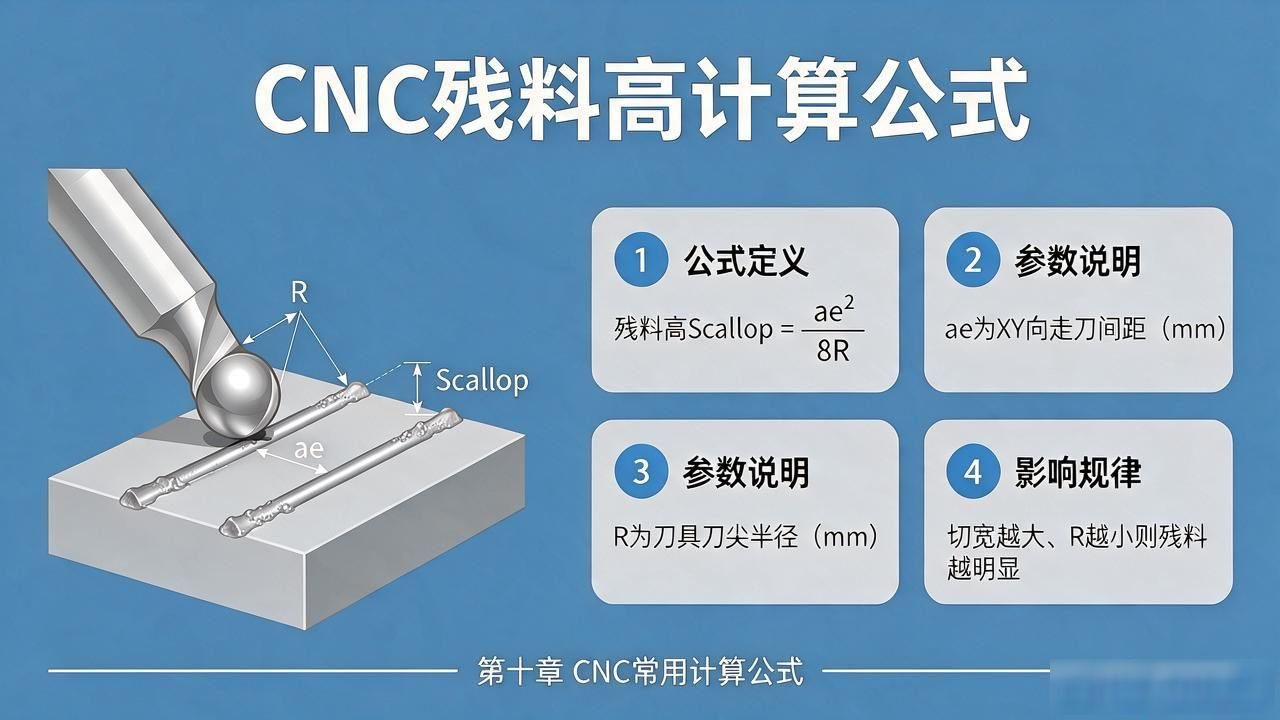
After the ball cutter or round nose cutter completes the processing, the unevenness between the adjacent tool paths is called the residual material height. The height of the remaining material can be determined based on this calculation formula: after squaring the cutting width, divide eight times the R angle of the tool tip. According to this formula, it can be shown that when the cutting width is larger and R is smaller, the residual material becomes more obvious.
In actual finishing, the control of the height of the residual material is directly related to the workload of subsequent polishing or manual trimming. Some programmers, in order to save trouble, set the cutting width to a very large size, resulting in a large amount of residual material remaining, which in turn increases the overall working hours. Reasonably dividing the step length can find a balance between efficiency and quality.
Common pitfalls in actual calculations
Many masters tend to ignore the units when formulating formulas. The unit of cutting speed is meters per minute, the tool diameter is millimeters, and the rotational speed is revolutions per minute. These three units are mixed together. The purpose of dividing the formula by one thousand is to unify the units. If you forget to divide, the error will be as much as ten times greater.
Another common mistake is to use the ball cutter as a flat cutter. The cutting speed of the ball cutter is different at different cutting depths. When the same rotation speed is used to process different depths, the actual cutting speed is not constant. If you want to accurately control the cutting conditions, you have to infer the effective cutting diameter based on the actual cutting situation, and then adjust the speed.
After reading these formulas and examples, which calculation do you think is most commonly used in actual work? Feel free to tell your experience in the comment area. If you find it helpful, don’t forget to like and forward it to more colleagues in need?









暂无评论内容