

Selection of tool path for CNC milling surface processing
The core of curved surface processing lies in the tool path
When using CNC milling for processing, the processing quality of the curved surface is largely determined by the design of the feed route. A reasonable tool feeding method can make the surface of the part smoother and at the same time reduce the wear of the tool.
When processing different surface types, the appropriate route should be selected based on the characteristics of the surface. There are differences between the processing methods of ruled surfaces and free-form surfaces. Only by choosing the right method can we achieve twice the result with half the effort.
Two options for ruled surface line cutting methods
The boundaries of ruled surfaces are generally open, and during processing, ball-nose cutting methods are mostly used. The tool position point trajectory of this method presents the distribution state of line cutting CNC milling tool path type , and the line spacing is set according to the machining accuracy requirements.
The first solution is that the tool path is perpendicular to the curved direction of the surface; each time the tool is moved along a straight line; this method has the characteristics of simple calculation of tool position points; it has few program segments; it can ensure the straightness of the busbar.

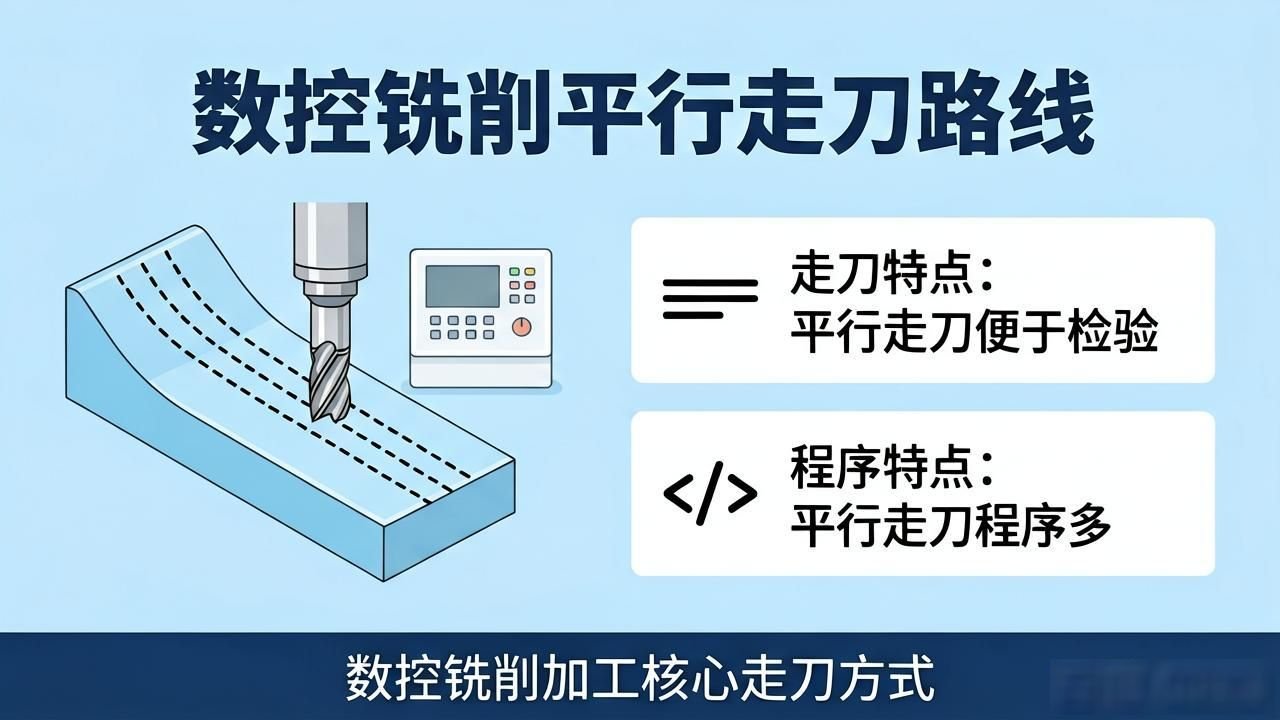
Parallel tooling facilitates inspection but requires many procedures
![图片[2]-Selection Of Tool Path For CNC Milling Surface Processing-Dalian Fuhong Machinery Co., Ltd](/wp-content/uploads/2026/08/1787429110258_1.jpg)
The second solution is used to make the tool path parallel to the curved direction of the curved surface. Its advantage is that it facilitates subsequent inspection and has high processing accuracy, but the number of program segments will significantly increase.
Because the ruled surface boundary is an open CNC milling tool path type , so the surface can extend, the ball end cutter should start cutting from outside the boundary. This will prevent the tool from cutting directly from the edge and causing damage.
Two-axis semi-linked processing of curved surface contours
When processing curved surface contours, the milling method must be selected based on the shape of the tool, the shape of the curved surface, and accuracy requirements. Among them, the most commonly used method is the line cutting method that can implement linkage of two coordinates in three coordinates.
This method will treat any two axes constituting the X, Y, and Z axes as linked interpolation axes, while the third axis will perform periodic feed alone. The X direction will be divided into multiple sections for CNC milling surface machining path selection. The ball-end milling cutter will perform milling according to the curve intercepted along the YZ plane.
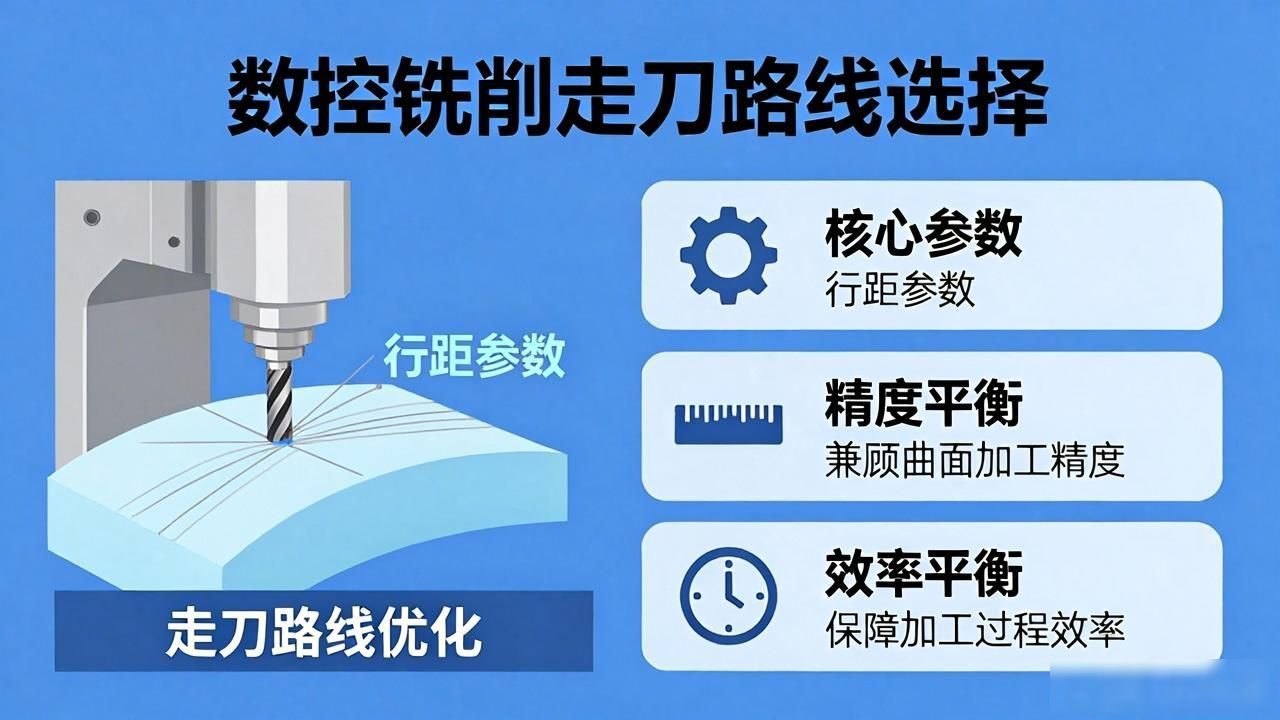
The line spacing parameter must take into account both accuracy and efficiency.
Whenever a section of processing is completed, the ΔX distance is fed, and then cutting work is carried out on the adjacent curves, and the entire curved surface is processed in this order. When selecting ΔX, surface roughness and cutter head interference issues need to be taken into consideration.
When using a ball end mill, the cutter head radius should be selected as large as possible, which is good for heat dissipation. However, the tool tip radius must be smaller than the minimum curvature radius of the curved surface, otherwise it will cause overcutting.
When programming ball-nose cutters, attention should be paid to residual lines.
When using a ball end milling cutter to process a curved surface, the tool center trajectory data is usually used for programming. In view of the changing trend of surface curvature, the position of the cutting point has been changing, showing continuity and finally forming a spatial curve.
In one case, the line connecting the cutting point to the surface will generate distorted residual grooves, and such a path is suitable for situations where the curvature changes little, and is suitable for CNC milling tool path types in rough machining conditions with low accuracy requirements. At the same time, the programming calculation of this path is relatively simple.
During actual machining, what kind of surface cutting problems have you encountered? Welcome to show your experience in the comment area!








暂无评论内容