

5 measures to reduce the cost of slow wire cutting, so practical
High costs are a headache
When slow-speed wire cutting is used to process non-standard parts, many factories are faced with the reality that the processing cost is much higher than that of ordinary wire cutting. The high price of the machine tool itself is only one aspect. More importantly, once the electrode wire is used up, it is discarded and cannot be used repeatedly. This situation directly drives up the cost of a single piece. If you want to effectively reduce costs, you must start from two aspects: improving processing efficiency and saving electrode wire, so as to maintain profit margins during the fierce market competition.
During the actual production, our team found that once the key links are accurately identified and optimized, the cost reduction will be considerable. The five specific measures shared below are all practical and effective methods that have been tested on site and are worthy of reference by the majority of machining companies.
Reducing the wire speed has a significant effect
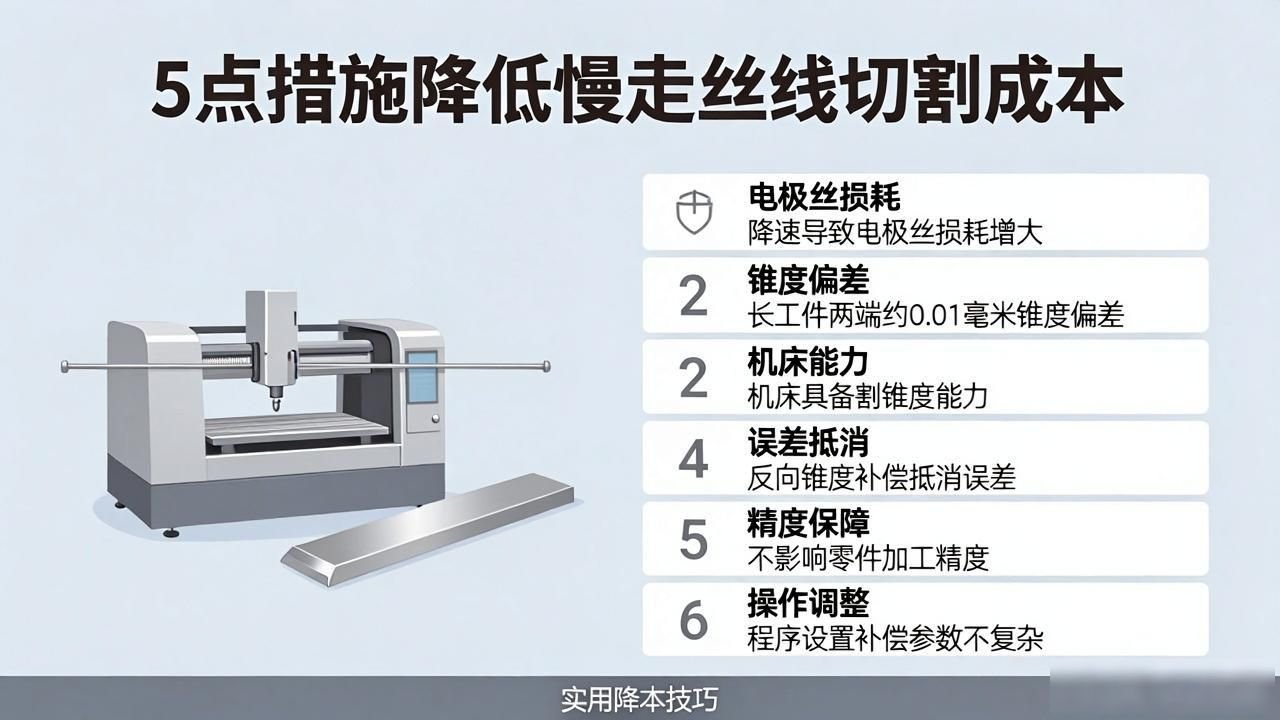
When the machine tool leaves the factory, the default wire walking speed is generally in the range of 10 to 13 meters per minute. If it is run according to these parameters, a plate of electrode wire with a length of 18,500 meters can only last for two or three days. If calculated at 10 meters per minute, 600 meters will be traveled in one hour, so the entire wire can only be used for 30 hours; if it is calculated at 12 meters per minute, the use time will be shorter, and the cost pressure will be very great. After we adjusted the wire running speed to 1.2 to 3 meters per minute, the service life of a coil of wire was extended to 15 to 20 days, and the consumption of electrode wire was greatly reduced. This is undoubtedly the most immediate way to save money.

However, slowing down will also cause new problems. The loss of the electrode wire will increase. When processing longer workpieces, there will be a taper deviation of approximately 0.01 mm in the dimensions at both ends. Fortunately, the slow wire machine tool itself has the ability to cut tapers. With the reverse taper compensation function, this dimensional error can be completely offset without affecting the accuracy of the part. The adjustment operation in this step is not complicated. You just need to set the compensation parameters reasonably in the program.
Optimize discharge parameters to improve efficiency
We are mainly engaged in processing aluminum parts. By increasing the number of discharge pulses and reducing the limiting voltage, the processing efficiency has been significantly improved. For example, there is an aluminum part with a thickness of 40 mm. It used to be entrusted to an outsourcing manufacturer for about 2 hours to process, but after we adjusted it ourselves, we could complete it in less than 40 minutes. In addition, for the processing situation of cutting semi-circular holes in a type of thin steel parts, it took 12 minutes for outsourcing, but we were able to complete it in only 4 minutes, which nearly doubled the efficiency. When the wire speed remains unchanged, the shortening of cutting time means that the consumption of electrode wire will be reduced simultaneously.
The adjustment of parameters is not without cost. When the feed speed is accelerated, the roughness of the workpiece surface will become correspondingly worse, and the risk of wire breakage will also increase. The faster the cutting speed, the worse the surface quality, which is also evident in the trimming stage. Therefore, it is necessary to find an optimal balance point between processing efficiency and surface quality. We cannot blindly pursue speed at the expense of product quality. In the end, we should set parameters based on the surface state that meets customer requirements.
Optimize tool paths to save time
For situations where there are multiple workpieces to be cut on the sheet, or where fine trimming is required, it is often not the best choice to directly use the machine tool to automatically generate a program. The main difficulty in automatically generating programs is that the route of the wiring is relatively long. Especially when the tool is introduced again after the wire is broken, the blank stroke is not handled properly, which will lead to a large number of movements that have no practical effect. Not only does this idle time consume time, but it also wastes electrode wire in a meaningless manner, thereby increasing potential costs.
After the optimization program is done manually, the length of the tool path can be significantly shortened. This requires the operator to be familiar with the shape of the part and the cutting sequence, and re-plan the tool path according to the actual situation to minimize unnecessary blank strokes. Although the optimization program will take some more time, in the long run, the saved electrode wire costs and processing time are far more than the initial investment, and the overall cost-effectiveness is quite high.
Improve the running speed of idle tool
Between the cutting lead-in section and the two parts that need to be cut, there is a process of empty cutting that cannot be avoided. During idle cutting, although there is no actual cutting operation, the electrode wire is still in operation, which will also cause wear. The default idle tool feed speed of the machine tool is 5.5 to 7 mm per minute. This speed is relatively slow, resulting in unnecessary waiting time. We increased this to 25 mm per minute during actual work, which greatly reduced the movement time during the non-cutting phase.
The overall processing efficiency is directly improved due to this adjustment, and the consumption of electrode wire per unit time is reduced. Although no material is removed during the idle cutting stage, time is a cost category, and every second saved can accumulate into considerable benefits. This change does not require the replacement of equipment or new investment, but only needs to be adjusted in the machine tool parameter settings. It is easy to operate and the effect can be seen immediately, making it suitable for rapid implementation in various production lines.
Reduce the number of threading times, save wire and reduce consumption
Every time the machine tool performs a wire threading operation, about 2 meters of electrode wire will be wasted for no reason. Many factories have never calculated this account carefully. It can be seen that reducing the number of threadings is actually a very effective way to reduce costs. For those workpieces that require hole cutting to reduce the cost of slow wire cutting, which is too practical, but also need to cut the shape, the conventional approach is to first thread the wire to cut the hole, and then thread the wire to cut the shape. As a result, every time a part is processed, the wire has to be threaded twice, which is a very obvious waste.
To solve this problem, we can change to an idea. The first job is to cut the hole first, the second job is to cut the shape first, and then the third job is to cut the hole. They are promoted alternately like this. For processing n pieces of work, it only needs to be threaded n plus 1 times. In the average case of each piece of work, it is only necessary to thread the thread once. Compared with the traditional method, this way of performing interleaved work requires one less wire to be threaded for each job. Over time, the amount of electrode wire saved is considerable. As long as the production rhythm is reasonably arranged, this method is easy to implement.
As far as the five measures mentioned above are concerned, they have been quite verified in actual production. When the tasks are in a full state, these methods can be applied comprehensively, which can successfully save the company about 50,000 yuan in processing costs incurred in this state every year. Those experiences are based on front-line work production practice, and have the characteristics of strong operability and quick results. For those of you who are also engaged in slow-moving wire processing, during the entire process of slow-moving wire processing, what other ingenious methods do you have that can reduce costs and are unique to you? Welcome to the comment area to share and communicate. If you feel that this article is helpful to you, then please like it and forward it to more friends in need.







暂无评论内容