

Detailed explanation of the differences between 16Mn, Q345 and Q355 steel grades
The historical context of brand evolution
The national standard GB 1591-88 was born in 1988. 16Mn was a very commonly used low alloy steel in engineering structures in the last century. At that time, it filled the gap in domestic high-strength steel products. Q345 thick plate (above 30mm) riveting price , was widely used in bridges, factories, pressure vessels and other fields, and has been in service for decades.
After entering the 21st century, with the progress of metallurgical technology, Q345 replaced 16Mn in the 2008 version of the national standard and became the mainstream brand. The "Q" in the name represents yield strength, and 345 indicates that the minimum yield strength is 345 MPa. The naming method is more in line with international standards.
The new standard was promulgated in 2018, with Q355 taking over as the current brand, and 16Mn and Q345 gradually withdrawing from the commercial field. This evolution reflects the development of Chinese steel standards in line with international standards, and the continuous increase in performance requirements.
The hard difference between ingredients and performance
The most critical improvement of Q355 over Q345 is the addition of micro-alloying elements such as vanadium and titanium. These elements can effectively refine the grains of steel, thereby improving the comprehensive mechanical properties of the material. The finer the grains, the better the combination of strength and toughness of the steel.
The yield strength increased from 345 MPa to 355 MPa, an increase of approximately 3%. This is a significant leap for structural design. Specifically, for large-span and heavy-load structural members, this 10 MPa increase can bring a more reliable safety margin.
In terms of low-temperature toughness, the highest impact test temperature that Q355 can reach is minus 40 degrees, which is better than Q345. The control of phosphorus and sulfur content is more stringent, the upper limit of phosphorus content is lower, and the requirement of sulfur content is more stringent Q345 thick plate (above 30mm) riveting price . As a result, the weldability and brittle fracture resistance of steel have been raised to a new level.
actual difference in market price

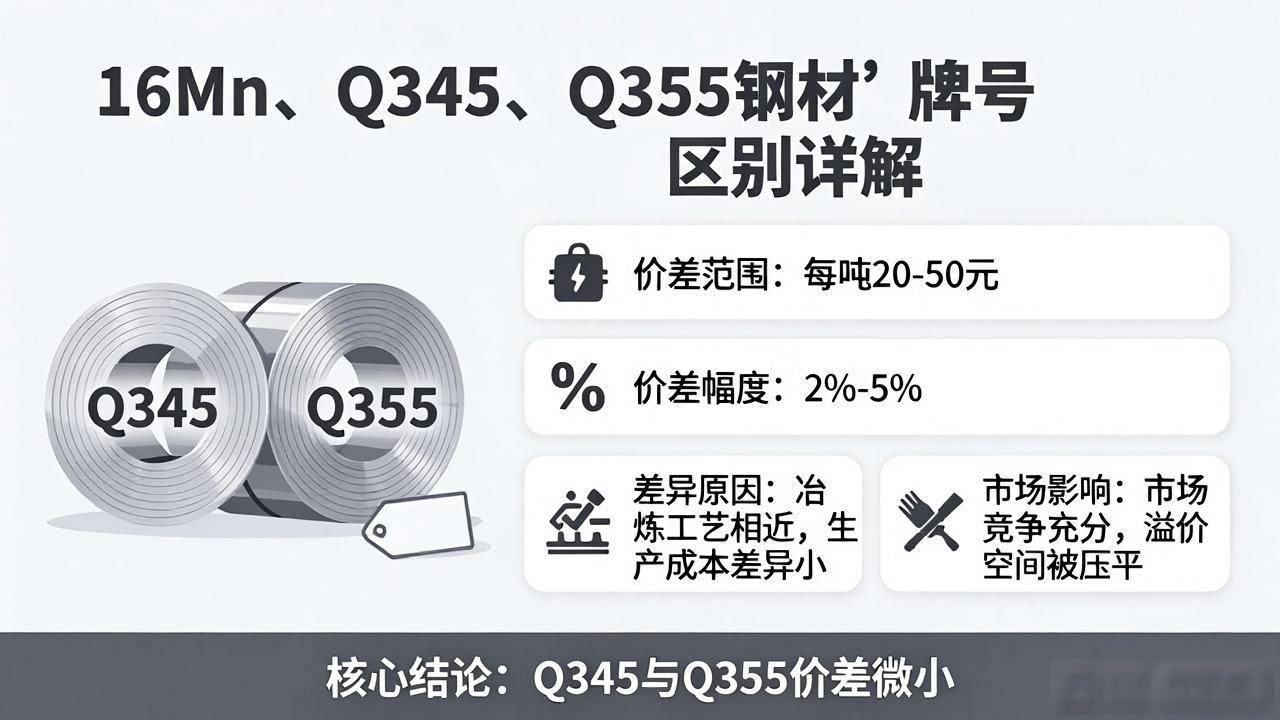
In the market, the price difference between Q345 and Q355 is generally in the range of 20 to 50 yuan per ton, with a range of about 2 to 5 percent. This price difference is quite small. The main reason is that the smelting processes of the two brands are similar to each other, and the difference in production costs is relatively limited. The market competition is sufficient, resulting in the premium space being flattened.
For thick plates over 30 mm, the differences between 16Mn, Q345, and Q355 steel grades are explained in detail. The resource supply of Q355B is quite sufficient. Major steel plants such as Baowu, Shagang, and Rizhao have stable production capacity. There are large inventories in East China and North China, and there is basically no need to wait for the production schedule when purchasing.
From the perspective of cost performance, while spending the same amount of money, purchasing the Q355 with better performance is obviously a better choice for procurement projects. Especially for projects that have high requirements for structural safety, even if you spend more money in exchange for better low-temperature toughness and welding performance, the input-output ratio is very cost-effective.
Practical advice on selecting materials for new projects
If it is a new construction project, priority should be given to the Q355 series, which is the material recommended by the current national standards. The design drawings are directly marked with Q355B or Q355C, which can avoid the trouble caused by later material replacement and facilitate material traceability during construction acceptance.
When old projects are being renovated and reinforced, if the original design uses 16Mn or Q345, Q355 can be used directly to replace it. The strength margin after replacement is sufficient to meet the safety reserve requirements of the original design, and the quality stability of the new grade is more guaranteed.
However, during the replacement process, engineers need to recalculate the carrying capacity of the node connection. Although the strength of Q355 is higher, the matching of the welded joints must be considered. It cannot simply be assumed that the higher the strength, the better. The calculation must be done based on the actual working conditions.
Key points for adjusting the welding process
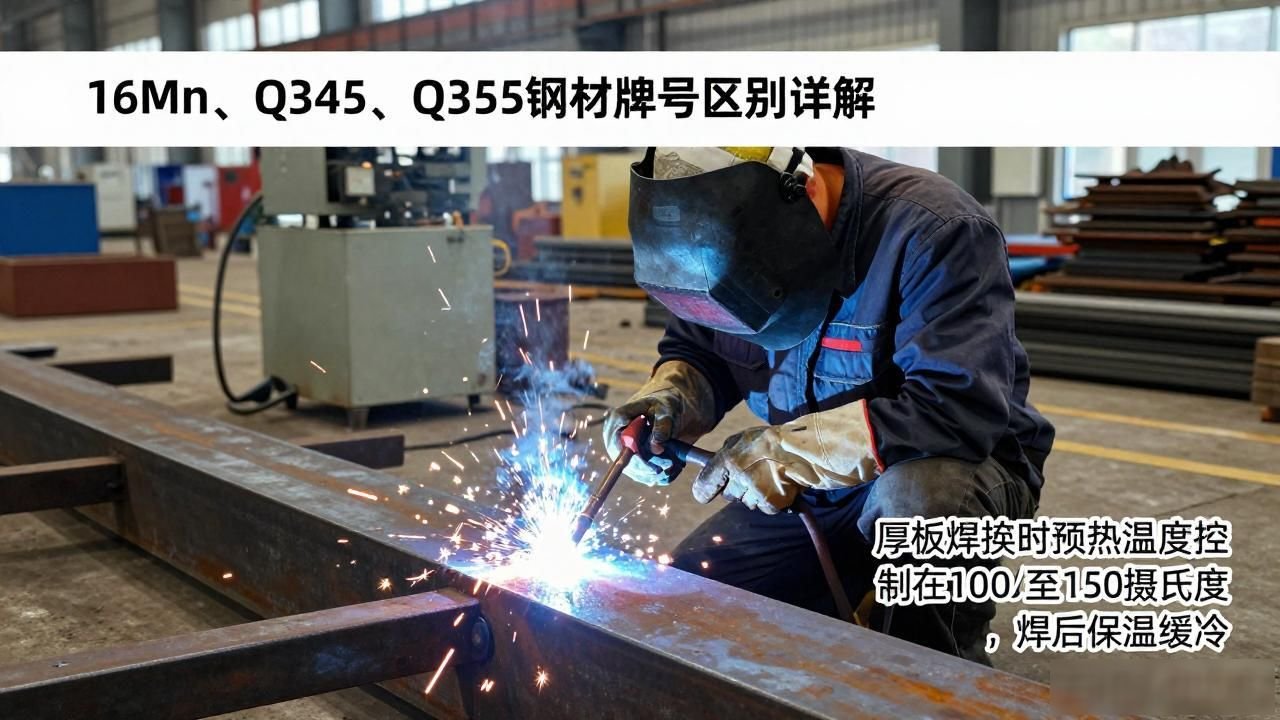
The carbon equivalent of Q355 is slightly higher than that of Q345. When welding, the preheating temperature must be increased appropriately based on the plate thickness. For thick plates above 30 mm, it is recommended to control the preheating temperature at 100 to 150 degrees Celsius . Q345 thick plate (above 30 mm) riveting price . After welding, heat preservation and slow cooling can effectively reduce the risk of hydrogen-induced cracks.
The selection of welding materials also needs to be adjusted accordingly. It is recommended to use corresponding welding materials that match the strength of Q355, such as the E50 series. The performance of the deposited metal of the welding rod or welding wire must match that of the base metal. Only in this way can we ensure that the mechanical properties of the weld will not be lower than the standards of the base metal.
The interlayer temperature also needs to be properly controlled and usually does not exceed 200 degrees Celsius. For joints with relatively large constraints, the interlayer temperature can be moderately reduced to reduce the structural coarsening in the heat-affected zone. Process assessment must be done before construction, which can greatly reduce the probability of on-site welding quality accidents.
Things to note when purchasing goods
When purchasing Q355 thick plates, you need to check whether the chemical composition and mechanical properties included in the warranty can meet the requirements set forth in GB/T 1591-2018. Focus on the three indicators of yield strength, tensile strength and impact energy. These data must meet the minimum values stipulated in the standard.
For thick plates over 30 mm, attention should be paid to the judgment of Z-direction performance. If the structure needs to prevent lamellar tearing, the Z15 or Z25 grade should be stated in the purchase contract. The steel plant will make corresponding adjustments in composition during production.
When receiving the goods, it is necessary to carry out appearance inspection and dimensional measurement to check whether there are defects such as delamination and cracks on the surface. If necessary, non-destructive testing can be carried out, or samples can be taken for re-inspection to ensure that the quality of the materials entering the site meets the standards and to prevent problems with the materials from affecting the subsequent construction progress.
The project you have is using Q345 material or Q355 material. When replacing the grade, have you encountered the troublesome situation of welding requiring rework? Welcome to leave your comments and tell us about your experience!



暂无评论内容