

What causes surface grinding cracks after heat treatment?
What causes surface grinding cracks after heat treatment?
Many factory owners have a headache because of this. The hardness has reached the standard during heat treatment, but cracks appear during the grinding process. This situation is often not caused by a single factor, but by problems in the connection of processes. Cracks appearing on the surface not only cause the scrap rate to rise sharply, but also cause precision parts to lose their expected service life, which directly affects the company's profits.
Internal stress release out of control
If the residual stress remaining after heat treatment is not fully eliminated, the heat generated during the grinding operation will instantly trigger cracks. Especially for quenched steel, its internal structure is in an unstable state . Case analysis of grinding processing enterprises . The heat generated by grinding is like secondary heating, resulting in excessive surface tensile stress and cracking.
Improper setting of grinding parameters
If the feed speed is too fast, or the grinding wheel speed is too high, a large amount of grinding heat will be generated. If the heat cannot be dissipated in time, the local temperature of the workpiece surface will rise sharply. This thermal shock will cause the surface metal to expand unevenly, resulting in tiny tears. These tiny tears will eventually form visible cracks.
Improper use of coolant
The flow rate of the coolant is insufficient, or the position of the nozzle is deviated, so that the grinding heat cannot be effectively taken away. Some companies only reduce the supply of coolant for the purpose of saving power or simplifying the operating process, eventually causing burns on the surface of the workpiece. The deterioration of the coolant will also reduce the lubrication effect, thereby increasing the friction coefficient, and will also make the occurrence of cracks more serious. The causes of surface grinding cracks after heat treatment will continue to intensify.
Unreasonable selection of grinding wheel

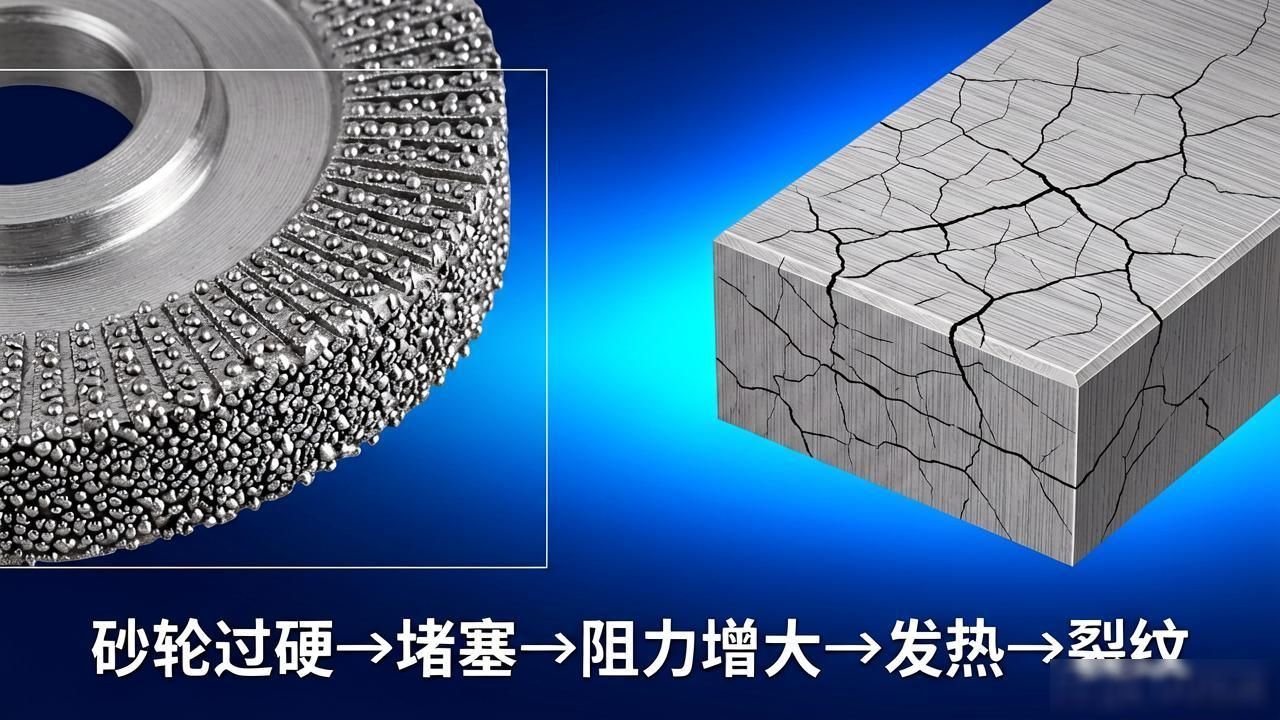
If the grinding wheel is too hard or the grain size is too fine, it will easily cause clogging, which will increase the grinding resistance. Once the resistance becomes greater, the calorific value will naturally increase. In addition, according to a case study of a grinding processing enterprise with poor self-sharpening of the grinding wheel, the passivated abrasive grains will slide on the surface of the workpiece instead of cutting, thus generating a large amount of frictional heat and inducing cracks.
Neglect of operational details
Before grinding, the workpiece was not checked for burrs or hard spots, and these defects would become stress concentration points. In addition, the design of the grinding path is not reasonable. Repeated grinding at the same position will cause overheating in this area. Ignoring these subtle links, cracks are basically inevitable.
Do you think in your workshop, is it because the coolant has not kept up with the grinding processing enterprise case analysis , or is the grinding wheel selected wrong? Welcome to leave a message in the comment area, share your experience of stepping into pitfalls, like and forward so that more colleagues can avoid pitfalls!





暂无评论内容